
 EN
What Safety Certification Does Safe lawn mower Hold
In commercial land maintenance, agricultural clearing, and municipal groundskeeping, equipment safety is the foundational benchmark of operational integrity. As engineering teams and field operators at Shandong Maide En Intelligent Technology Co., Ltd know from years of deploying heavy-duty clearing machinery across steep inclines, solar farms, and dense orchards, hazard mitigation begins at the design table. Operating high-powered rotary cutters on steep embankments or overgrown brush carries inherent risks, including thrown debris, unexpected machine rollover, and mechanical component stress. Ensuring operator protection and equipment stability requires strict compliance with international manufacturing and safety protocols. Understanding lawn mower safety certifications allows site managers and equipment purchasers to verify that machinery meets rigorous mechanical, electrical, and structural standards. When evaluating remote-controlled and heavy-duty mowers, assessing compliance with frameworks such as ANSI B71.1, UL 1083, ISO 5395, and OSHA lawn mower compliance standards provides clear proof of mechanical safety, operational reliability, and operator hazard reduction.
Mechanical Integrity and Blade Safety Standards Under ANSI B71.1
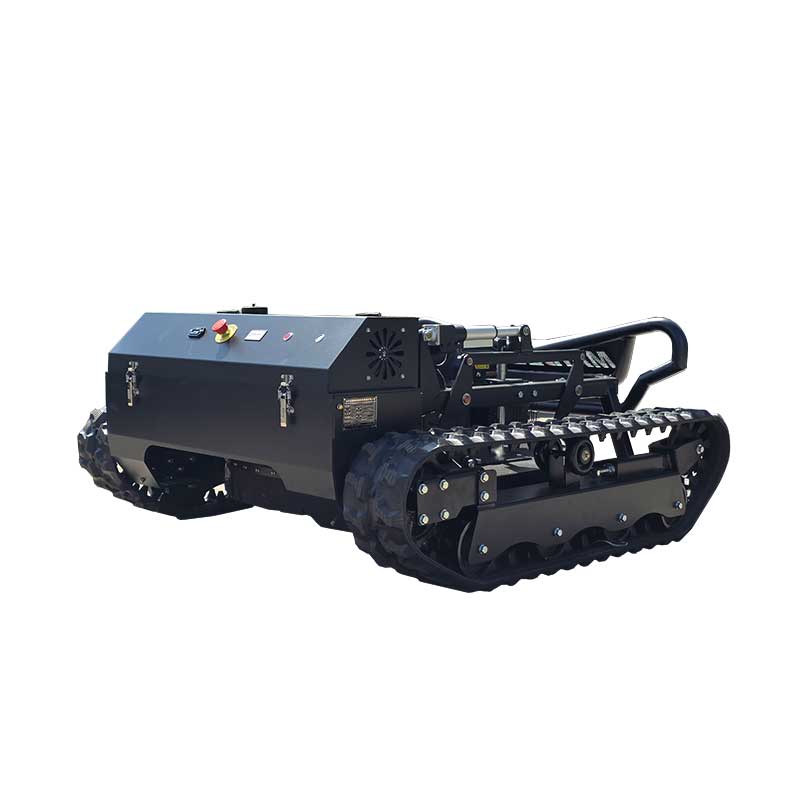
The American National Standard for Consumer Turf Care Equipment, widely recognized as ANSI B71.1, sets rigorous mechanical benchmarks designed to prevent blade contact accidents and projectile thrown-object hazards. In high-power clearing applications, high-speed rotary blades generate significant kinetic force capable of ejecting stones, wood fragments, and debris at dangerous velocities. Through extensive field testing on our remote-controlled crawler platforms at Shandong Maide En Intelligent Technology Co., Ltd, we have verified that meeting blade enclosure containment and thrown-object deflection criteria is vital for site safety. Our heavy-duty remote-controlled units feature reinforced steel cutting decks, thickened impact-resistant flexible blades, and adjustable cutter head lifting mechanisms capable of setting heights between 10mm and 200mm. Compliance with ANSI B71.1 testing mandates that cutting enclosures successfully arrest high-impact debris, ensure rapid blade stopping times upon operator release, and maintain structural integrity during continuous high-load operations. Evaluating lawn mower safety certifications under this standard provides commercial operators with confidence that cutting assemblies remain structurally contained even when striking unseen rocks or obstacles.
Electrical and Enclosure Protection Compliance via UL 1083 Guidelines
As vegetation management technology shifts toward hybrid power plants and electric drive architectures, electrical insulation and component safety become essential evaluation metrics. Standardized under UL 1083, safety requirements for electric lawn mowers focus on moisture resistance, wire insulation integrity, thermal protection, and electrical shock prevention. Modern heavy-duty clearing equipment, such as our electric tracked models powered by Loncin or Briggs & Stratton four-stroke gasoline engines ranging from 22PS to 27PS, relies on sophisticated dual-thruster electric drive systems and brushless walking motors. Applying UL 1083 electrical safety principles ensures that high-current wiring harnesses, battery storage compartments, and electronic controller housings remain fully insulated against rain, condensation, and mechanical chafing during operation on wet turf or riverbanks. Furthermore, adhering to electrical safety guidelines minimizes short-circuit risks, prevents thermal overloading during extended high-speed travel at 0-5km/h, and guarantees that electronic braking systems operate reliably to prevent runaway conditions on steep gradients.
Global Mechanical Safety Harmonization with ISO 5395 Frameworks
For commercial operators and international land clearance contractors, adherence to global safety engineering standards ensures consistent hazard prevention across varied working conditions. The international benchmark ISO 5395 outlines comprehensive safety requirements for powered lawn mowers, specifying rigorous testing protocols for operator control positioning, acoustic noise emissions, structural vibration damping, and stability on inclines. In slope clearing assignments along riverbanks, highway embankments, and mountain orchards, machine stability is a primary safety concern. At Shandong Maide En Intelligent Technology Co., Ltd, our engineering design incorporates low center-of-gravity crawler chassis structures capable of navigating maximum working slopes ranging from 50° up to 65°. Aligning equipment testing with ISO 5395 criteria verifies that track ground-pressure distribution prevents rollover hazards, while remote-control operation methods with functional control ranges of 200 meters to 500 meters keep human operators at a safe standoff distance from hazardous slopes and active cutting zones.
Regulatory Workplace Safety and OSHA Lawn Mower Compliance Protocol
In professional contracting, municipal maintenance, and commercial landscaping, workplace health and safety guidelines mandate strict equipment compliance to protect maintenance crews from jobsite hazards. Achieving OSHA lawn mower compliance requires equipment to incorporate mandatory safety mechanisms, such as operator-presence controls, clear hazard labeling, emergency stop functions, and adequate protective shielding around rotating shafts and hot exhaust manifolds. For remote-controlled mowers handling large-scale clearance efficiencies of 2,500m²/h up to 6,000m²/h, one-click start and remote shutdown capabilities allow field managers to eliminate direct physical exposure to rotating blades and exhaust heat. Adhering to federal workplace safety standards not only protects workers from severe occupational injuries but also minimizes liability for commercial groundskeeping businesses. By choosing machinery engineered around recognized lawn mower safety certifications, commercial fleet operators ensure full alignment with regulatory safety inspections, maintain low insurance overhead, and foster a safe working environment across all land clearance projects.