EN
EN
How Does Remote control mower on tracks Climb Slopes Safely
A tracked lawn mower can reduce the need for an operator to stand beside a difficult bank, but tracks and a remote are not a blanket safety guarantee. Whether a remote control mower on tracks can climb a slope safely depends on the exact machine rating, the ground beneath it, the vegetation, and the operating plan. The safest starting point is not a headline slope number. It is the operator manual for that specific tracked lawn mower and a careful inspection of the site.
From a remote-mower technical perspective, slope work is more usefully understood as a system: traction, stability, cutting resistance, visibility, machine condition, and people in the work zone all matter at once. A tracked lawn mower may give a larger contact patch than some wheeled equipment, yet wet clay, loose gravel, hidden holes, or a sudden change in grade can still defeat available grip.
Why tracks help, but do not set the safe slope limit
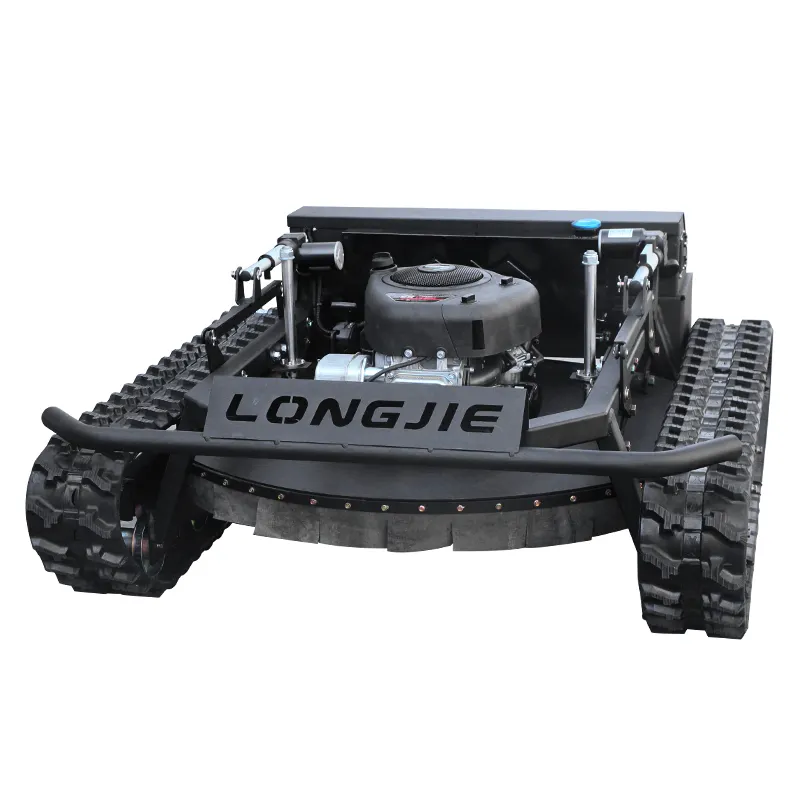
Tracks spread load across more of the ground and can help a tracked lawn mower maintain contact on rough or soft terrain. A low-mounted engine and chassis may also help keep the center of gravity lower. Those design choices can improve control, but they do not create a universal angle limit. The safe limit belongs to the machine manufacturer, its configuration, its attachment, and its manual.
In other words, do not assume that every remote control mower on tracks is suitable for the same bank. Deck position, track condition, fuel level, grass buildup, added equipment, and the direction of travel can change how the machine behaves. If the manual does not state that the tracked lawn mower is approved for the measured slope and conditions, treat the job as unsuitable until the supplier or manufacturer provides written guidance.
Start with a ground-and-grade inspection
Before starting a tracked lawn mower, walk the intended route while the machine is off. Measure the steepest portion rather than estimating it from the bottom. Then identify changes that make the effective risk higher: a crest, a ditch, a drainage channel, a culvert, exposed roots, rocks, soft shoulders, or a transition from dry grass to wet soil.
- Confirm the manufacturer-rated slope limit for this tracked lawn mower, including any limit for turning or traversing.
- Check the route for mud, loose debris, standing water, and ground that has been undermined by erosion.
- Mark obstacles and establish a route with room to stop and turn only where the manual permits.
- Postpone work after rain or when dew, frost, or cut grass can make the surface unpredictable.
A useful correction to a common assumption is that dry-looking grass may not mean firm ground. A tracked lawn mower can encounter a soft patch below the turf or lose traction when clippings accumulate under the tracks. Site inspection should therefore be repeated as conditions change, not treated as a one-time formality.
Use a route that protects stability
Follow the travel direction and turning restrictions in the operator manual. General mower safety guidance often stresses avoiding side-to-side travel on sloped ground; for a remote control mower on tracks, the exact route must still follow the manufacturer’s instructions. Turning across a slope can shift weight downhill, while a sharp turn can disturb the track’s contact with the surface. Slow, deliberate inputs help the tracked lawn mower respond predictably.
Plan the work in short passes. Do not rush to cover a whole embankment in one continuous run, and do not use momentum to force a tracked lawn mower over a crest. If progress slows, the track begins to spin, the front end becomes light, or the machine no longer follows the command cleanly, stop work. Backing away or recovering a machine should be done only by the approved method in the manual, with people kept out of the hazard area.
Control the remote-work zone
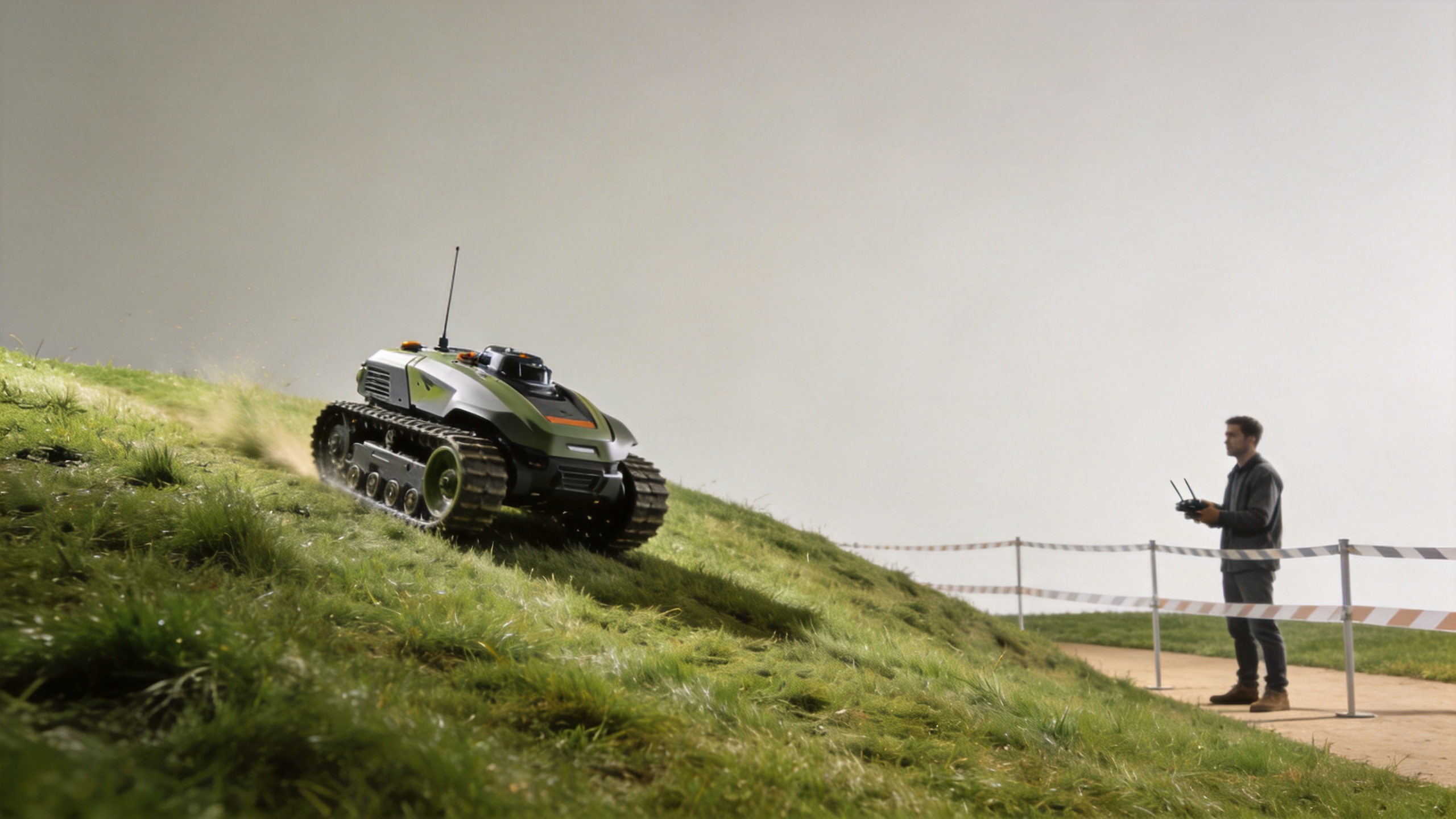
Remote control adds distance, not permission to operate without observation. Keep the tracked lawn mower within the required line of sight and position the operator on firm ground with a clear escape path. The operator should be able to see the machine, the leading edge of the cut, the downhill area, and anyone who could enter the work zone.
Create an exclusion zone before the blades engage. Keep bystanders, pets, vehicles, and coworkers away from the tracked lawn mower; debris can be thrown and an unexpected slide can enlarge the danger area quickly. Test the emergency stop, verify remote-control response, and inspect guards, blade condition, track tension, and fluid leaks before each shift. If controls are intermittent or a safety device is not working, park the machine and correct the issue before operation.
Match cutting load to the terrain
Thick weeds, long grass, and hidden woody growth add resistance that can change the behavior of a tracked lawn mower on a slope. Instead of treating every pass alike, reduce the workload where conditions demand it. A higher initial cut, a narrower pass, and a slower travel speed may be more controllable than asking the machine to take a full-width heavy cut on unstable ground.
This is where task planning matters more than a single specification. Break the job into preparation, mowing, and post-work checks. Ask whether the tracked lawn mower has enough stable access to the start point, whether the slope has a safe stopping area, and how the machine will be cleaned and inspected afterward. That approach helps a team recognize when a bank should be deferred, hand-managed, or reviewed with the equipment supplier.
A practical pre-start checklist
- Read the current manual and confirm the slope rating for the exact tracked lawn mower and configuration.
- Measure the route, inspect surface conditions, and remove visible obstacles.
- Check track condition, guards, blades, controls, emergency stop, and fuel or battery status.
- Set a line-of-sight operating position and an exclusion zone.
- Begin at a controlled speed; stop immediately for slip, unexpected movement, poor visibility, or loss of control.
The safer decision is sometimes not to mow
A remote control mower on tracks is valuable because it can keep an operator away from some difficult terrain. Still, a tracked lawn mower should only be used when the machine rating, surface condition, maintenance state, and work plan all support the task. For a new site or an unfamiliar grade, confirm the conditions with the manufacturer or supplier before operating. Safety comes from matching the tracked lawn mower to the job and stopping when the site falls outside that match.