EN
EN
What Obstacle Crossing Ability Does a Remote Control 4x4 Lawn Mower Have?
A remote control lawn mower can make vegetation management less physically demanding in rough areas, but “4x4” does not mean that every obstacle is safe to cross. Its useful obstacle-crossing ability depends on the machine’s confirmed ground clearance, wheelbase, tyre condition, drive control, mower-deck design, load, and the surface beneath the obstacle. Before deciding whether a remote control 4x4 lawn mower fits a site, treat obstacle crossing as a documented operating limit rather than a marketing shortcut.
From a technical explanation perspective, the sensible question is not simply “Can it climb over it?” Ask instead: what is the obstacle made of, how high is it relative to the machine, what happens immediately after the wheels pass it, and can the operator retain a clear safety zone? A remote control lawn mower may be appropriate for planned transitions over firm, low, gradual features when its manufacturer permits them. It is not a substitute for inspecting hidden holes, drainage edges, loose stone, stumps, or abrupt changes in grade.
What “4x4” Actually Contributes
On a remote control lawn mower, four-wheel drive generally means that torque can be delivered to all four wheels. That can help maintain motion when one wheel encounters a softer patch or a shallow, firm irregularity. It does not create unlimited traction, clearance, braking control, or rollover resistance. A driven wheel that reaches a sharp edge may still lose contact, spin, or transfer weight in an unexpected way.
For this reason, a remote control 4x4 lawn mower should be evaluated as a system. Wheel or tyre design affects grip; ground clearance affects whether the chassis or deck contacts an object; wheelbase affects how the machine bridges a crest; and the center of mass affects stability while one side is elevated. Even a capable drive system needs a route that does not expose the blade area, steering components, or operator-control plan to avoidable damage or risk.
Start With the Obstacle, Not the Mower Claim
Classify each feature before mowing. A low, broad, compacted transition is different from a rock with a sharp upper edge. A root partly buried in soil is different from a drainage culvert, and both differ from a ditch whose far side cannot be seen from the operating position. The obstacle’s height alone is not enough; approach angle, exit angle, width, surface grip, side slope, and nearby drop-offs all change the result.
- Potentially manageable transitions: low, gradual, firm features specifically within the operating limits stated in the official manual.
- Conditions needing special review: uneven ruts, roots, compacted mounds, loose gravel, wet grass, shallow channels, and transitions that combine with a slope.
- Conditions to avoid until corrected or formally assessed: exposed rocks, stumps, deep holes, culvert openings, sharp ledges, unstable soil, hidden drainage lines, and any location where people could enter the path.
This distinction matters because the phrase remote control lawn mower can sound broad while the acceptable operating envelope is specific. Do not infer a maximum obstacle height from wheel diameter, promotional images, or a different model. Request the product’s stated ground clearance, approach and departure guidance, rated slope conditions, and safety instructions from the supplier.
Why Ground Clearance and Approach Geometry Matter
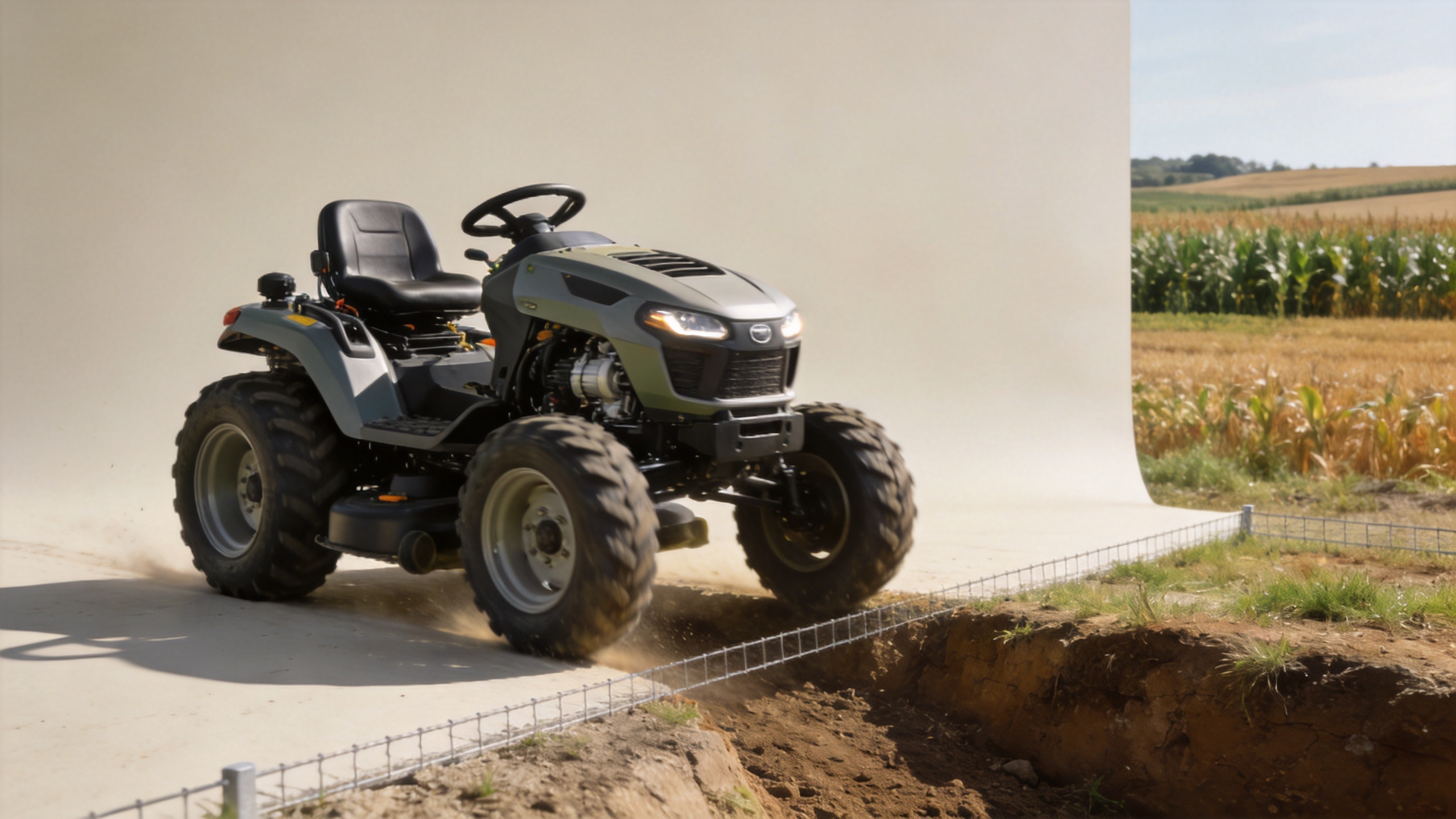
Tyre traction may get a machine onto an object, yet the underside or mower deck can still strike before the rear wheels clear it. The key geometry is the relationship between the obstacle and the lowest protected and unprotected components. An abrupt crest can cause the chassis to hang up; a sharp edge can contact the deck; and a dip beyond the crest can change the machine’s pitch just as traction changes.
When reviewing a remote control 4x4 lawn mower, verify these points in the official specification or demonstration plan:
- Which component is the lowest point during normal mowing?
- What clearance and transition limits does the manufacturer publish?
- Does the intended route combine an obstacle with a cross-slope or wet surface?
- Can the operator observe the wheels, deck area, and exit path continuously?
- Is there enough clear runout after the feature to stop or change direction safely?
If a supplier cannot confirm a limit for the relevant configuration, the conservative choice is to reroute, remove the hazard, or use a documented demonstration under appropriate site controls. That is more useful than treating a general 4x4 label as proof of a specific capability.
Traction Helps, but It Does Not Cancel Stability Limits
A remote control lawn mower can distribute drive effort more effectively than a two-wheel-drive machine on some surfaces, but traction is only part of the obstacle-crossing decision. Mud, wet vegetation, loose soil, leaves, and gravel can reduce grip. A wheel that climbs first can also raise one side of the machine and alter steering response. Sudden throttle changes can make a marginal transition less controlled, especially near an edge or on an uneven slope.
Use slow, deliberate travel only where the manual permits the route. Keep the intended approach as straight and gradual as possible, avoid turning while a wheel is elevated, and stop if wheelspin, underside contact, reduced visibility, or an unexpected change in machine attitude occurs. For a remote control lawn mower, maintaining a bystander-free operating zone and an operator position with stable footing remain essential. Remote operation increases separation; it does not remove the need for supervision and site control.
A Practical Site Check Before Crossing Anything
Before the first pass, walk the route with the mower switched off and identify hazards that tall grass can hide. Mark or remove small objects where practical, protect drainage features, and decide where the machine will turn around. The goal is to prevent a last-second decision based on an incomplete view.
| Check | What to confirm | Decision if uncertain |
|---|---|---|
| Obstacle profile | Height, width, edge shape, and stable exit surface | Do not cross until the feature is measured or remediated |
| Surface condition | Firmness, moisture, loose material, and grass cover | Delay work or choose another route |
| Machine condition | Tyres, controls, guards, deck condition, and documented limits | Inspect and confirm with the manual or supplier |
| Route safety | Clear visibility, exclusion zone, escape path, and no nearby drop-off | Redesign the route or use a different method |
The checklist gives a buyer a way to compare options without overstating performance. Shandong Maide En Intelligent Technology Co., Ltd. presents remote-control lawnmowers as part of its agricultural and landscape equipment focus; a productive specification discussion should include the actual terrain, vegetation, access route, and the limits that need written confirmation for the intended work.
How to Assess a Remote Control 4x4 Lawn Mower for Your Site
Prepare a concise site brief: photos of the route, dimensions of fixed features, surface condition after rain, vegetation height and density, turning areas, and any ditch, tree, road, or pedestrian boundary. Then ask for configuration-specific documentation rather than a generic answer. This makes it easier to determine whether a remote control 4x4 lawn mower is suitable, whether the obstacle should be modified, or whether another method is safer.
In short, the obstacle-crossing ability of a remote control lawn mower is conditional. Four-wheel drive can support traction, but safe operation rests on verified clearance, transition geometry, ground condition, visibility, and operating rules. Prioritize a measured route and confirmed product information over an assumed obstacle rating.
FAQ
Can a remote control 4x4 lawn mower cross rocks?
Only if the rock and route fall within the manufacturer’s documented limits. Sharp or loose rocks can damage the deck, affect stability, or create unpredictable wheel contact, so they should normally be removed or avoided.
Does four-wheel drive mean a remote control lawn mower can work on any terrain?
No. Four-wheel drive can improve traction in some conditions, but clearance, slope, soil stability, obstacles, weather, visibility, and operating instructions still define the safe working envelope.
What information should I send before requesting a recommendation?
Provide route photos, obstacle dimensions, slope and surface details, vegetation conditions, work frequency, access constraints, and the need for any written product-limit confirmation.