
 EN
Experience with Grasscycling in Large-Scale Turf Maintenance
Over years of managing commercial turf projects and field operations at Shandong Maide En Intelligent Technology Co., Ltd, our engineering and field testing teams have consistently evaluated how different cutting techniques impact turf longevity and soil structure. When property managers transition from traditional bag-and-collect bagging systems to grasscycling practices, the change in soil vitality becomes clear within a single growing season. In our extensive field testing across residential lawns, sloping orchards, and commercial green spaces, operating a robust self-propelled mulching gas lawn mower consistently delivers superior turf health compared to conventional bagging equipment. By processing clippings into micro-particles directly over the lawn canopy, operators eliminate the labor-intensive cycle of bagging while returning rich organic matter back into the rhizosphere. During field trials on coarse turf and sloped slopes, we observed that allowing fine grass particles to decompose naturally creates a moist, nutrient-dense topsoil layer that resists surface erosion and retains critical microbial activity throughout hot summer months.
Scientific Insights into Soil Nutrition Lawn Care Mechanics
Understanding the biological interactions below the soil surface reveals why soil nutrition lawn care depends heavily on routine organic input. Turfgrass actively absorbs primary macroeconomic macronutrients—specifically nitrogen, phosphorus, and potassium—from the upper soil profile to maintain blade vigor and cell wall rigidity. When grass blades are removed and discarded, the soil suffers a continuous depletion of these essential minerals, forcing property managers to rely on synthetic chemical fertilizers. When utilizing a four-stroke gas-powered mulching mower, the high-torque engine drives specialized mulching blades that chop grass clippings multiple times inside the cutting chamber before depositing them deep into the turf canopy. These microscopic grass particles disintegrate rapidly, feeding beneficial soil bacteria and mycorrhizal fungi. As micro-organisms break down the cellulose, nutrients are released back into the root zone in a bioavailable form, promoting robust root development, enhancing soil cation exchange capacity, and protecting topsoil against compaction.
Environmental Agronomy and Grasscycling Benefits
Agronomic studies and environmental protection guidelines strongly support the long-term grasscycling benefits of returning grass clippings to the soil. According to agricultural researchers, grass clippings are composed of approximately 80% to 90% water by weight and contain roughly 3% to 4% nitrogen, 0.5% phosphorus, and 2% to 3% potassium by dry weight. Recycled grass clippings act as a slow-release, natural fertilizer that reduces soil evaporation by up to 18% and buffers delicate root systems against thermal stress during peak heat conditions. Rather than sitting on top of the turf as unsightly thatch, micro-mulched clippings settle into the soil surface where earthworms and aerobic microorganisms digest them rapidly. This process converts organic biomass into stable humus, improving the soil's moisture-holding capacity and structure. Consequently, incorporating fine grass mulching into routine maintenance significantly minimizes reliance on synthetic lawn inputs, preventing chemical runoff into local watersheds and establishing a sustainable closed-loop ecosystem for modern landscape management.
Technical Principles of Nitrogen Recycling Lawn Management
Mastering nitrogen recycling lawn management requires a closer look at how nitrogen cycles through grass tissue and soil bacteria. Nitrogen is the fundamental building block of chlorophyll, driving photosynthesis and dense, vibrant green foliage growth. When a self-propelled mulching gas lawn mower chops grass blades into tiny sub-inch fragments, it maximizes the surface area accessible to nitrifying bacteria. These soil microbes quickly convert organic nitrogen compounds into ammonium and nitrate ions, which are readily re-absorbed by turfgrass roots. Studies in turf management show that consistent grasscycling provides up to 25% of a lawn's total annual nitrogen requirement, eliminating the need for one to two full chemical fertilizer applications per season. By relying on a self-propelled gas-powered drive system, operators can maintain steady ground speed and consistent blade tip speeds even across dense turf or high grass, ensuring an ultra-fine cut that accelerates biological nitrogen release without smothering the living lawn canopy.
Engineering Excellence from Shandong Maide En Intelligent Technology Co., Ltd
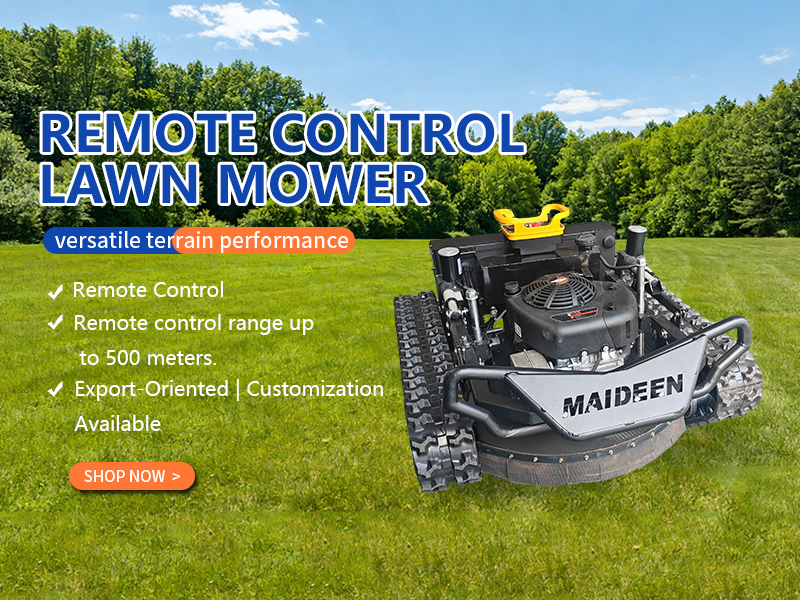
At Shandong Maide En Intelligent Technology Co., Ltd, our commitment to agronomic efficiency and equipment durability drives the design of our advanced lawn care solutions. We engineer heavy-duty grass cutting equipment built to perform under demanding field conditions, ranging from expansive commercial yards to steep inclines and orchards. Featuring powerful four-stroke gasoline engines and heavy-duty tracked or self-propelled drive systems, our equipment handles challenging terrain and dense vegetation with exceptional stability. Our high-torque engines maintain peak blade rotational speed to achieve maximum mulching efficiency, processing clippings into ultra-fine organic mulch that enriches the soil. Supported by remote control options with operational ranges up to 500 meters and adjustable cutting height ranges, our equipment combines user safety with precise cut performance. By integrating high-power gasoline engineering with sustainable agronomic principles, Shandong Maide En Intelligent Technology Co., Ltd delivers reliable machines that foster long-term soil health and superior turf quality.
Sustainable Soil Management for Long-Term Turf Vitality
Achieving lush, resilient turf requires moving away from labor-intensive bagging and chemical-heavy maintenance toward biological soil enrichment. Utilizing a high-performance self-propelled mulching gas lawn mower represents a practical, eco-friendly approach to sustainable landscape care. By leveraging natural grasscycling benefits and structured nitrogen recycling lawn management, groundskeepers and homeowners can naturally restore vital nutrients, improve moisture retention, and build resilient soil structures year after year. Integrating reliable equipment engineered by Shandong Maide En Intelligent Technology Co., Ltd ensures that every mowing pass actively contributes to healthier root zones and a greener environment. Investing in mulching technology is an investment in long-term soil fertility, reducing operational costs while preserving the natural health of your landscape.