EN
EN
Why Track driven lawn mower Reduce Damage To Turf Roots
A tracked lawn mower can be a sensible choice when mowing takes place on soft ground, uneven banks, orchard rows, or lawns with sensitive root zones. The useful benefit is not that tracks make damage impossible. Rather, a tracked lawn mower can spread the machine’s load over a broader footprint than a comparable wheeled setup, which may reduce concentrated surface pressure and the chance of visible rutting. As a technical explainer for remote mowing equipment, I would frame the decision this way: protect the turf first, then choose the machine and work pattern that fit the site.
A track driven lawn mower is particularly relevant where traction and flotation matter at the same time. But roots respond to more than a machine’s running gear. Soil moisture, total machine mass, turning behavior, repeated passes, cutting height, and the location of trees all affect the outcome. Understanding those interactions is more useful than treating a tracked lawn mower as a blanket cure.
Why turf roots are vulnerable to mowing traffic
Turf roots need pore space for oxygen, water movement, and new growth. When traffic compacts wet soil or repeatedly presses the same route, that pore space can decline. The first signs may be shallow rutting, slow recovery after rain, thin grass in wheel paths, or poor infiltration. In severe cases, root growth becomes restricted even when the leaf canopy still looks acceptable.
A tracked lawn mower does not remove the effects of soil compaction, especially on saturated ground. It changes how force is delivered at the surface. That distinction matters. A lighter machine with a poor operating pattern can still harm turf, while a carefully managed tracked lawn mower can reduce stress in a difficult mowing area.
How tracks change the load on the ground
The working principle is straightforward: ground pressure is influenced by load and contact area. A tracked lawn mower generally places its weight across the length and width of two tracks rather than concentrating it at smaller tire contact patches. More contact area can lower localized pressure, helping the machine float better on soft terrain and reducing the tendency to cut narrow ruts.
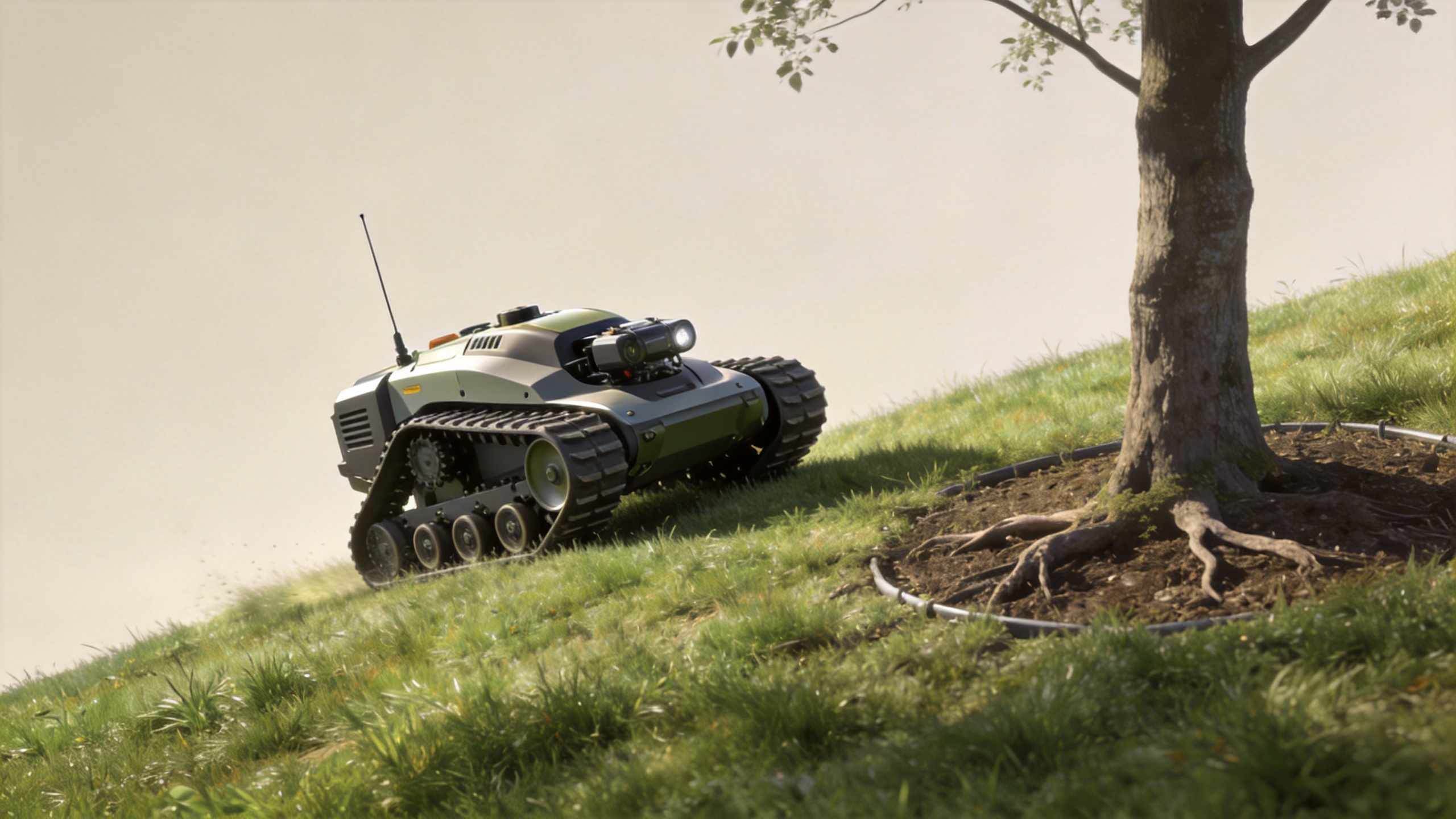
That is why a track driven lawn mower often makes sense on slopes, rough grass, and sites where a wheeled mower loses grip. A lower-risk footprint can preserve the surface long enough for roots to keep functioning. Still, it is a conditional advantage. If the soil is waterlogged, the tracked lawn mower can shear turf during a tight turn, sink under excessive load, or compact the soil through repeated traffic.
Reduced disturbance is not the same as zero root damage
It is tempting to say that a tracked lawn mower protects roots. A more accurate statement is that it may reduce some surface and root-zone risks when the equipment, ground condition, and operator technique are appropriate. Tree roots close to the surface are especially vulnerable to scraping, scalping, and repeated compaction. Tracks cannot prevent damage caused by mowing too low or pivoting in one place.
Use a tracked lawn mower to support good turf practice, not replace it. Keep a sensible cutting height, avoid exposed-root areas where possible, and plan a route that keeps traffic off the same strip on every visit. On a sloped property, working deliberately with a tracked lawn mower is often more valuable than trying to finish quickly.
Operating choices that matter as much as the tracks
1. Check moisture before starting
Walk the site before deploying a tracked lawn mower. If footprints sink deeply, water is pooling, or the soil smears under a boot, postpone mowing if the task can wait. Even a tracked lawn mower can disturb wet turf, and recovery costs can outweigh the benefit of an immediate cut.
2. Make wide, gentle turns
Sharp counter-rotating turns are often the highest-risk maneuver for turf. Use wider arcs, keep turns off fragile edges, and vary the turn location. This is where a track driven lawn mower requires operator discipline: strong traction is useful, but it can also grip enough to twist a soft surface.
3. Vary the travel pattern
A tracked lawn mower should not follow the exact same lanes every time. Alternate direction, shift headland turns, and avoid making a permanent route beside trees, drains, or irrigation components. Spreading traffic helps prevent a few narrow zones from receiving all of the site’s compaction load.
4. Match the mower to the task
Choose a tracked lawn mower for conditions that justify its traction and flotation: slopes, loose surfaces, rough vegetation, or areas where a wider footprint is valuable. On firm, open, level turf, a different mower may be more efficient. The goal is not to use tracks everywhere; it is to use the tracked lawn mower where its operating characteristics solve a real ground-condition problem.
A practical root-zone protection checklist
- Inspect soil moisture, slope changes, exposed roots, and soft patches before operating the tracked lawn mower.
- Set a cutting height that avoids scalping and reduces stress on already-thin turf.
- Use gentle turns and avoid pivoting a tracked lawn mower on saturated or fragile grass.
- Change travel lanes and turning areas between mowing visits.
- Keep unnecessary loads off the machine and stop when ruts or turf shear begin to appear.
- Review the result after the first pass; a tracked lawn mower should leave the surface stable, not merely finish the cut.
What to evaluate before choosing a tracked mower
Start with the terrain rather than a feature list. Ask where the machine will travel, how wet the soil becomes, how often the same area is cut, and whether tree-root zones or landscaped edges require special care. Then compare machine mass, track footprint, cutting system, control method, turning behavior, service access, and operator training. A tracked lawn mower is a site-management tool, so the sound choice is the one that fits both the vegetation and the ground.
For contractors and property managers, a short on-site trial is often the clearest test. Observe a tracked lawn mower at working speed, on the wettest realistic section, and through a full turn. Check the turf again after several days. That practical review can reveal whether the machine’s footprint and work pattern are genuinely compatible with the site.
Bottom line
A tracked lawn mower can help reduce localized turf disturbance because its tracks distribute load over more ground and provide controlled traction on challenging terrain. It cannot guarantee protection for every turf root. Reliable results come from combining a tracked lawn mower with dry-enough conditions, appropriate mowing height, gentle turns, varied travel lanes, and careful attention to sensitive root zones. When those practices work together, a track driven lawn mower becomes a practical way to mow difficult ground with less avoidable stress on the turf.