EN
EN
How Does Autonomous lawn mower commercial Work Without Human Remote Operation
An autonomous commercial mower is not simply a remote control lawn mower with its operator removed. A conventional remote control lawn mower follows steering and speed commands from a handheld transmitter. An autonomous system adds a perception-and-decision layer: it identifies where it is, follows a planned work area, watches for conditions that require a stop, and controls propulsion and cutting within set limits. The practical result is less continuous joystick steering, not an absence of human responsibility.
For grounds teams considering an autonomous lawn mower commercial solution, the useful question is: which tasks can the machine repeat reliably, and which decisions must remain with a trained supervisor? Looking at the workflow that way keeps safety, terrain, and verification ahead of marketing claims.
From remote control to supervised autonomy
A remote control lawn mower gives a person direct command over direction, throttle, and often blade engagement. It can be a sensible option when the route changes often or the operator needs to make frequent judgments around obstacles. By contrast, an autonomous commercial mower receives a defined operating area and route logic before work starts. Its onboard controller then makes small, repeated driving decisions while it carries out that plan.
That distinction matters. A remote control lawn mower can reduce the need to stand beside a machine in some conditions, while an autonomous mower can reduce repetitive steering during a predictable task. Neither category should be described as automatically safe or unattended. Commercial autonomy is commonly supervised: a qualified person remains responsible for setup, exclusion areas, intervention, and the stop procedure.
What lets an autonomous mower know where to go?
Most autonomous systems combine several inputs rather than trusting one signal. Depending on the configuration, those inputs can include satellite positioning, a local reference signal, wheel or track motion feedback, inertial sensors, boundary data, and obstacle-detection sensors. The controller compares its estimated position with the planned route, then adjusts steering and speed to stay within the working pattern.
In plain language, the machine repeats a loop: locate itself, compare its location with the route, choose a short movement, drive that movement, and check again. This is why a remote control lawn mower and an autonomous mower may look similar from a distance yet behave differently. The remote-operated machine waits for a person to send the next directional decision; the autonomous machine executes bounded route decisions until a rule tells it to slow, stop, or request help.
Route planning comes before blade work
A reliable route begins with a site review. Before deploying a remote control lawn mower or autonomous machine, map fixed boundaries, access points, drainage features, trees, parked equipment, slopes, and zones where people may enter. The planned path should include safe turns, margins around hazards, and a return or recovery approach. A demonstration can show movement, but it cannot replace verification on the actual property.
How the mower controls motion and cutting
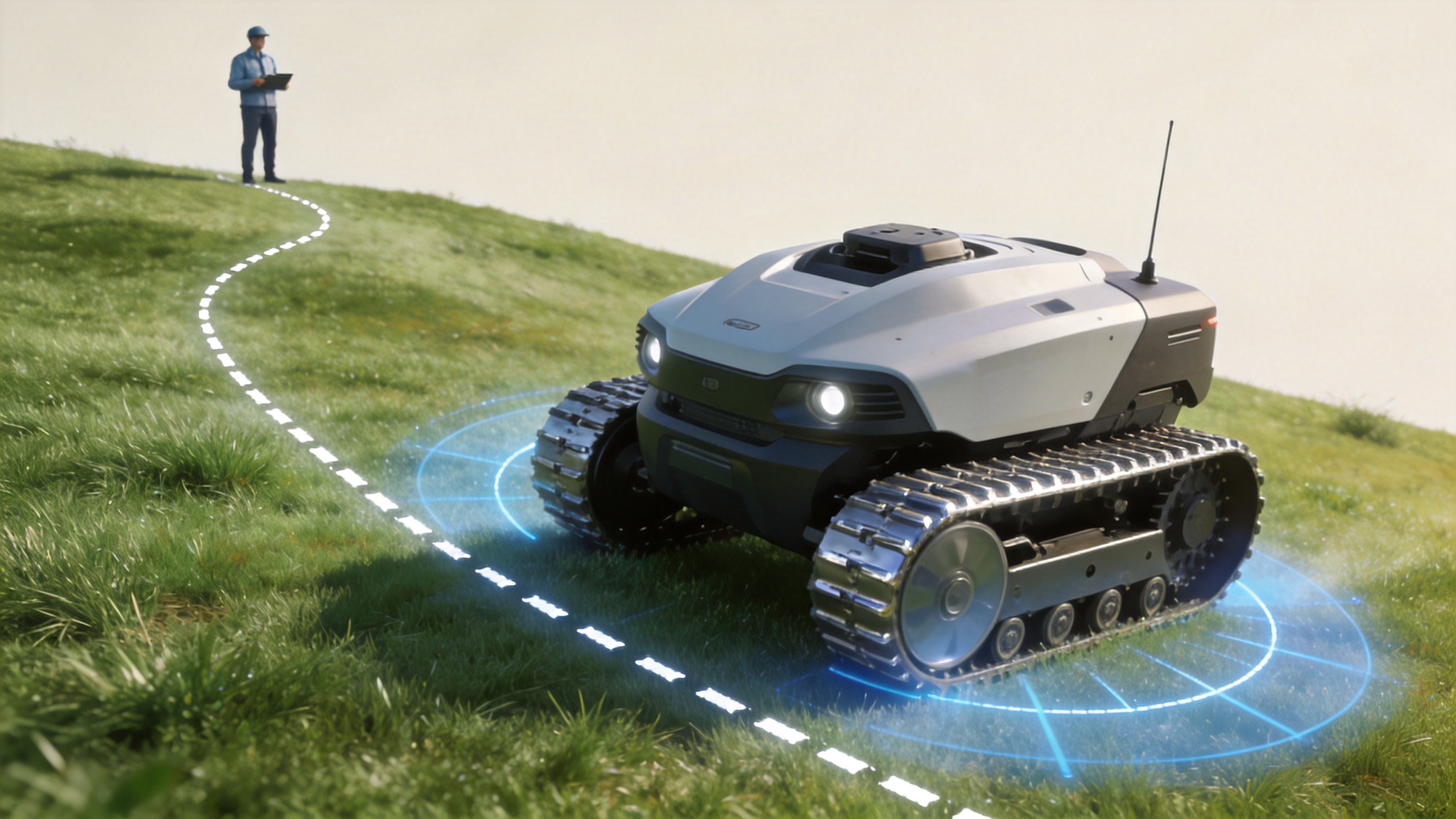
Once the route is approved, the controller sends commands to the drive system in short intervals. Feedback from motion sensors helps it correct drift; motor and system monitoring can indicate that a planned movement is not occurring as expected. The cutting system is part of the same operating logic but should not be treated as independent of travel. Ground condition, grass density, visibility, and route geometry can all change the appropriate pace and review points.
This is where a remote control lawn mower remains valuable as a comparison point. A human operator can instantly change a route based on a new visual judgment. An autonomous machine needs rules for the same event: detect it, classify it within its programmed limits, then stop or alert the supervisor when the event falls outside those limits. Buyers should ask suppliers to demonstrate those behaviors under conditions similar to the intended job, not just on a clean, open surface.
Why sensors do not remove the need for a supervisor
Sensors help an autonomous mower detect route deviations, objects, or system conditions, but they do not turn every site into a hands-off work zone. Sensor performance can be affected by terrain changes, tall vegetation, weather, light, dust, signal conditions, and the type of obstacle present. That is why a responsible remote control lawn mower or autonomous-mower workflow includes a trained person who can observe the work area, use a stop function, and address conditions the machine cannot safely interpret.
Before work begins, establish an exclusion area and confirm the permitted operating conditions. During work, the supervisor should retain a clear escalation rule: if people enter the area, visibility is inadequate, the machine reports a fault, terrain changes beyond the plan, or an obstacle cannot be assessed, stop and inspect. After work, review the route, cutting result, and any alerts before the next cycle. Efficiency matters, but this sequence should not be skipped.
Questions to ask about an autonomous lawn mower commercial system
- How is the operating boundary created, stored, and changed?
- Which positioning and obstacle-detection methods are included in the proposed configuration?
- What happens if positioning confidence drops or the machine detects an unexpected object?
- How does the supervisor stop the machine, and what training is required?
- Which terrain, vegetation, weather, and visibility conditions are within the documented operating limits?
- What pre-start checks, maintenance tasks, and recovery procedures are required?
These questions are more useful than treating “autonomous” as a single feature. They also help distinguish a remote control lawn mower intended for operator-directed work from an autonomous platform intended for repeatable, supervised routes.
Choosing the right operating model
Choose a remote control lawn mower when the task needs frequent live direction changes, the terrain is difficult to standardize, or the crew needs close control of each pass. Consider supervised autonomy when the site can be assessed, bounded, and repeated with documented rules. In either case, verify the proposed machine against the actual slope, vegetation, access, obstacles, local safety procedures, and maintenance plan.
Shandong Maide En Intelligent Technology Co., Ltd. supports buyers in organizing remote-control mowing requirements around site conditions and task needs. For an autonomous lawn mower commercial inquiry, prepare a description of the terrain, grass condition, expected work frequency, route constraints, and the safety process your team intends to use. That information makes it easier to discuss a suitable remote control lawn mower configuration without assuming capabilities that have not been confirmed in product documentation.
Conclusion
An autonomous mower works without continuous human remote steering because it combines route data, position estimation, sensor feedback, and programmed drive decisions. It does not eliminate human judgment. A sound deployment treats the machine, the supervisor, and the prepared site as one operating system. Whether you choose a remote control lawn mower or a supervised autonomous alternative, start with the site and the safety plan, then confirm the documented capabilities of the configuration under consideration.