
 EN
Field Observations on Remote Signal Behavior in Commercial Mowing
Over years of manufacturing, deploying, and servicing heavy-duty remote control mowers at Shandong Maide En Intelligent Technology Co., Ltd, our engineering support team has spent hundreds of hours analyzing signal transmission behavior across diverse operational environments. Whether managing steep highway embankments, dense orchard canopies, or sprawling commercial lawns, field personnel occasionally encounter unexpected radio communication disruptions. When dealing with lawnmower remote signal loss, recognizing the physical and environmental catalysts behind range drops is the first step toward rapid restoration. In practical field applications, signal interruptions rarely stem from internal circuit failure alone; instead, line-of-sight obstructions, physical barriers, elevated electromagnetic interference from power lines, and degraded battery voltage in handheld transmitters frequently disrupt RF link integrity. By systematically testing remote signal strength at varying distances—ranging from immediate proximity up to our equipment’s maximum effective 500-meter control boundary—our technical specialists have established a reliable, step-by-step diagnostic workflow that allows ground operators to isolate transmission faults quickly without delaying scheduled maintenance.
Diagnostic Strategies for Satellite Positioning and RTK GNSS Troubleshooting
For high-precision automated and semi-autonomous lawn mowing equipment, satellite navigation signals are just as critical as primary radio control frequencies. Executing structured RTK GNSS troubleshooting requires understanding how real-time kinematic differential correction signals interact with natural topographies and physical structures. Satellite positioning reliance means that tall building facades, dense tree foliage, metal fencing, and steep terrain walls can create multi-path reflection or temporary satellite masking, leading to positioning drift or complete link loss. When a robotic or remote mower halts due to satellite signal degradation, operators should first inspect the base station antenna height and clear line-of-sight exposure to the sky. Verifying that correction signal radios are operating on clear channels free from local industrial radio frequency noise helps stabilize centimeter-level positioning. Ensuring firm antenna cable seating, updating receiver firmware, and verifying that correction data feeds maintain steady cellular or radio connections will prevent unexpected navigation stops on expansive field projects.
Resolving Local Connectivity Interruptions and Robotic Mower Wi-Fi Issues
Beyond long-range radio controls and satellite channels, short-range wireless network stability directly governs configuration updates, telematics monitoring, and mobile application interface handling. Diagnosing robotic mower Wi-Fi issues demands a clear evaluation of signal attenuation across outdoor environments. Standard Wi-Fi signals operate on 2.4 GHz and 5 GHz frequency bands, which naturally experience rapid attenuation when passing through masonry walls, thick greenery, or wet foliage. When smart lawn mowers lose connection to local Wi-Fi networks or perimeter access points, operators should measure signal strength at the perimeter boundary using network diagnostic mobile applications. If signal dead zones exist across large lawns, installing weatherproof outdoor Wi-Fi extenders or switching to dedicated mesh network nodes ensures persistent connectivity. Furthermore, checking router channel congestion and ensuring the mower's internal wireless antenna leads remain securely connected to internal control modules prevents intermittent data drops during routine boundary syncing and remote configuration updates.
Mitigating Close-Range Protocol Failures and Bluetooth Pairing Drops
Short-range wireless connections are essential for initial pairing, sensor calibration, and localized firmware updates. Resolving Bluetooth pairing drops requires systematically isolating software protocol handshakes from physical radio frequency interference. Bluetooth technology relies on adaptive frequency hopping in the 2.4 GHz ISM band; however, nearby high-power radio transmitters, active Wi-Fi routers, metallic enclosures, and low transmitter battery levels can cause repeated connection terminations. When establishing a localized control session, operators should ensure the mobile device is positioned within 1 to 3 meters of the mower's primary receiver module during initial authentication. Clearing cached Bluetooth device profiles, cycling the mower’s main power disconnect switch, and keeping receiver antennas isolated from heavy steel chassis frames or battery cables eliminates physical signal shielding. Maintaining fully charged controller batteries and avoiding high electromagnetic interference zones ensures stable pairing during essential parameter setup.
Engineering Solutions from Shandong Maide En Intelligent Technology Co., Ltd
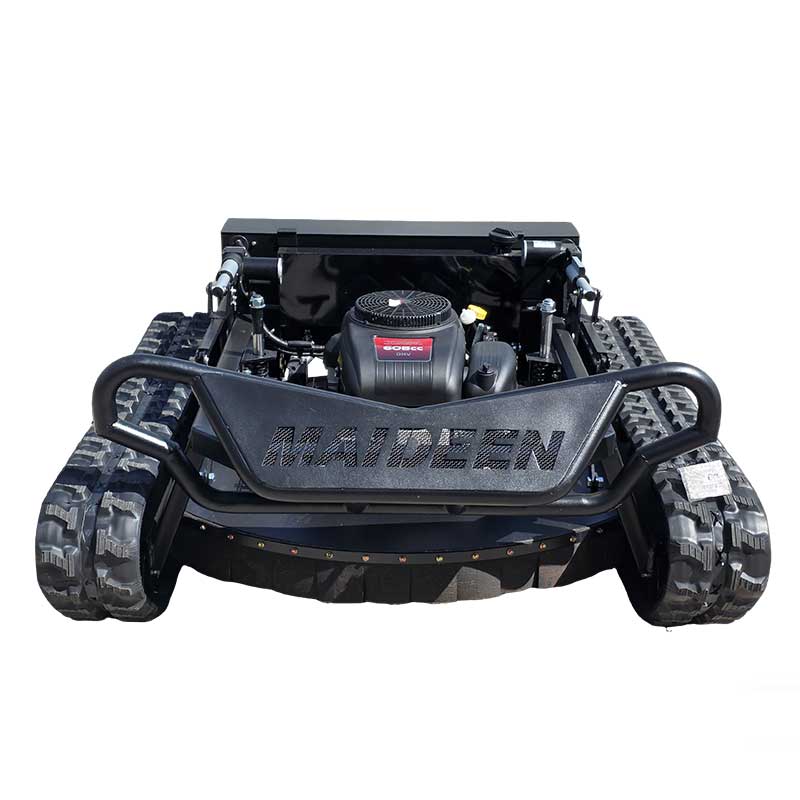
At Shandong Maide En Intelligent Technology Co., Ltd, our engineering philosophy prioritizes mechanical robustness, long-range control reliability, and operational durability under demanding site conditions. We manufacture commercial-grade remote control mowers built to handle challenging terrain, including highway slopes, solar farm grounds, forestry edges, and agricultural orchards. Powered by high-torque four-stroke gasoline engines and heavy-duty crawler track or self-propelled drive systems, our machines provide exceptional climbing stability on steep inclines. To protect operational continuity against signal degradation, our control systems utilize long-range industrial wireless technology supporting effective operational distances up to 500 meters, paired with intuitive hand-held controllers. Complemented by remote cutting height adjustments, reinforced steel decks, and optional optical monitoring systems, Shandong Maide En Intelligent Technology Co., Ltd builds intelligent land maintenance equipment designed to deliver dependable performance and maximum operator safety across every project site.
Systematic Maintenance Practices for Lasting Signal Integrity
Maintaining reliable signal transmission across long-range radio channels, satellite positioning systems, and short-range wireless protocols requires consistent preventive maintenance. Resolving lawnmower remote signal loss before heading into the field prevents costly jobsite downtime and keeps field personnel safe. By following structured procedures for RTK GNSS troubleshooting, addressing robotic mower Wi-Fi issues through proactive network mapping, and preventing Bluetooth pairing drops with proper battery management, commercial maintenance teams can ensure seamless equipment control across any landscape. Heavy-duty remote control mowers manufactured by Shandong Maide En Intelligent Technology Co., Ltd unite strong gasoline engineering with resilient wireless control protocols, delivering dependable performance across demanding terrain. Adopting a systematic approach to wireless troubleshooting ensures high operational productivity, protects valuable mechanical components, and establishes a safe, predictable working environment on every job site.