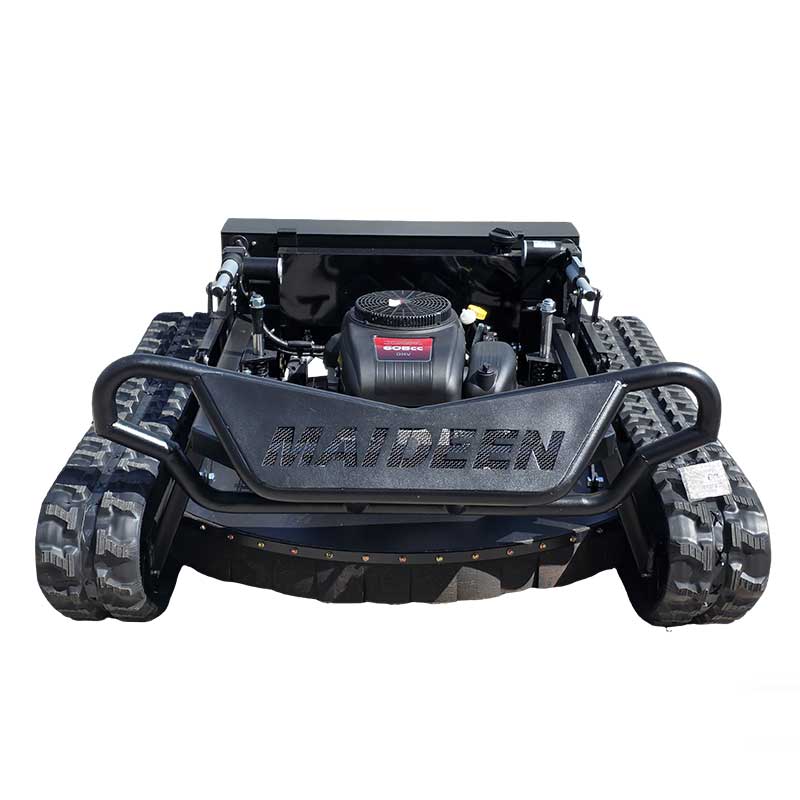
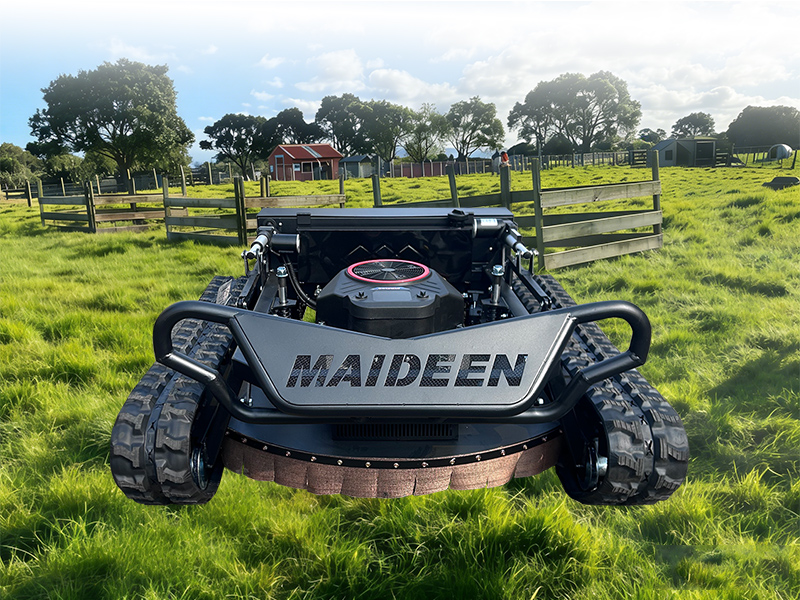
In recent years, commercial landscaping, agricultural management, and large-scale property maintenance have experienced a massive technological shift toward autonomous machinery. At Shandong Maide En Intelligent Technology Co., Ltd., we have spent years testing, deploying, and refining remote-controlled and autonomous slope-mowing equipment in rugged, real-world terrain across various global regions. One of the most frequent questions we receive from commercial property managers, solar farm operators, municipal maintenance teams, and agricultural caretakers is how modern navigation systems handle extreme environmental conditions. Specifically, field operators want to know what an advanced GPS crawler lawn mower can actually achieve on steep hillsides, dense orchards, uneven municipal grounds, and complex embankment slopes. Utilizing cutting-edge autonomous lawn mower navigation, these heavy-duty machines completely remove the guesswork from difficult turf maintenance. They ensure that operational precision and worker safety go hand in hand without exposing human operators to the severe rollover risks and physical fatigue typically associated with traditional steep-slope mowing operations.
Operating heavy mowing machinery on slopes exceeding 30 degrees presents severe safety, stability, and efficiency challenges for landscape contractors. Traditional riding mowers risk sliding or tipping over on grades, while standard push mowers expose ground-level workers to dangerous physical strain, vibration injuries, and rollover hazards. Our field deployment experience at Shandong Maide En Intelligent Technology Co., Ltd. clearly shows that integrating a robust GPS crawler lawn mower system drastically changes how job sites are executed. Because these specialized units utilize rugged rubber tracks combined with advanced satellite tracking technologies, they distribute machine weight evenly across the ground surface, minimizing soil compaction while maintaining firm traction on loose dirt or wet grass. When evaluating various robotic mower GPS functions, users often wonder how the machine stays accurately on track without requiring constant manual steering correction from an operator. The secret lies in high-precision satellite positioning hardware that communicates continuously with onboard microprocessors, allowing the heavy-duty crawler to hold straight, predictable parallel lines even when climbing or descending challenging grades.
To truly understand why satellite guidance is infinitely superior for commercial plots and hazardous industrial zones, we must look closely at how robotic mower GPS functions operate beneath the surface of the equipment. Standard consumer-grade GPS receivers often suffer from significant signal drift and multi-path interference caused by trees or nearby buildings, which can cause a commercial mower to veer off course by several meters—an entirely unacceptable margin of error when working near landscape borders, property fences, or steep drop-offs. Professional-grade machines utilize advanced differential GPS correction data and RTK (Real-Time Kinematic) technology to lock positioning down to precise centimeter-level accuracy. Based on our extensive deployment data at Shandong Maide En Intelligent Technology Co., Ltd., this high degree of positioning precision ensures that cutting path overlap is minimized and missed patches of grass are entirely eliminated. When a GPS crawler lawn mower executes a pre-programmed digital boundary, it maps out the entire perimeter using precise satellite waypoints, ensuring every square meter of turf is addressed efficiently while conserving battery power or fuel resources throughout the working cycle.
Efficiency in modern commercial landscaping and municipal upkeep is measured not just by raw cutting speed, but by labor reduction, fuel savings, and predictable routing patterns. Implementing autonomous lawn mower navigation successfully shifts the human operator's daily role from active physical steering and throttle management to system monitoring, safety oversight, and strategic path planning. In our practical trials across sprawling industrial parks, highway embankments, and expansive solar photovoltaic power stations, we observed that single crew members could oversee multiple automated machines simultaneously rather than being locked into manual operation under harsh weather conditions or blazing sun. A GPS crawler lawn mower allows facility managers to set designated working zones, obstacle exclusion zones, and efficient transit corridors through an intuitive control interface. This systematic approach reduces fuel consumption and mechanical wear by preventing erratic steering maneuvers, clearly proving that advanced robotic mower GPS functions deliver long-term economic value alongside pristine turf maintenance results.
Transitioning your commercial maintenance fleet to automated robotic systems requires careful initial setup to maximize the long-term benefits of autonomous lawn mower navigation. First, map your property carefully to identify any overhead canopy or structural obstructions dense enough to occasionally scatter satellite tracking signals, ensuring your GPS crawler lawn mower can seamlessly leverage backup inertial measurement sensors when necessary. At Shandong Maide En Intelligent Technology Co., Ltd., we always advise our commercial partners to run a manual baseline test along complex property boundaries before letting the machine operate on full autopilot mode. By carefully understanding how robotic mower GPS functions interact with local terrain features, obstacles, and weather conditions, facility managers can establish safe operational parameters that protect both the equipment and the surrounding landscape, securing a reliable, high-performance turf management routine for years to come.

 EN
EN