EN
EN
What Benefits Does Petrol 4 Stroke Lawn Mower Bring Over Two Stroke Models
When buyers compare gasoline lawn mowers, engine cycle is not a decorative specification. It changes everyday fuel handling, lubrication, sound character, maintenance planning, and the type of mowing work the machine is likely to suit. A petrol 4 stroke lawn mower is often the more familiar choice in walk-behind equipment, while a two-stroke design remains attractive when compactness and a high power-to-weight ratio matter.
From a B2B buying perspective, the useful question is not “which engine should we choose?” It is which engine fits the property, cutting schedule, operator routine, and service plan. That distinction matters because gasoline lawn mowers can look similar on a product list yet create quite different ownership tasks once they are in regular use.
The basic difference: separate oil versus mixed fuel
A four-stroke engine completes its working cycle in four piston strokes and normally keeps lubricating oil in a separate crankcase. A two-stroke engine completes a cycle in two strokes and commonly relies on oil mixed with the fuel for lubrication. This is the starting point for comparing gasoline lawn mowers, not a guarantee that one individual model will outlast another.
For the person filling a tank, the practical benefit of a petrol 4 stroke lawn mower is straightforward: petrol and engine oil are managed separately. There is no need to prepare the correct petrol-oil ratio every time fuel is purchased. That can make routine refuelling less error-prone, especially when several people use the same fleet. In contrast, a two-stroke machine needs the manufacturer’s specified fuel mix; too little oil can compromise lubrication, while too much can contribute to deposits and smoke.
Why four-stroke operation can feel more convenient
Many purchasers of gasoline lawn mowers value predictable routine more than the smallest possible engine package. Four-stroke designs commonly offer that routine through separate lubrication, a dedicated oil level to check, and scheduled oil changes. Those jobs still need attention, but they are familiar service tasks that can be written into a weekly or seasonal maintenance checklist.
With a petrol 4 stroke lawn mower, the operator can normally refuel with the specified petrol and then monitor the oil level according to the manual. That is different from claiming maintenance-free ownership. Oil condition, air filtration, spark-plug condition, blade balance, deck cleaning, and safe storage still affect performance. The benefit is that the lubrication task is separated and easier to assign, inspect, and document.
There is another small but meaningful workflow benefit. For teams that store fuel for multiple machines, avoiding a special mixed-fuel container can reduce labeling confusion. It does not remove the need for clean, approved fuel storage or model-specific fuel guidance, but it can simplify the daily process around gasoline lawn mowers.
Fuel use, smoke, and the operating environment
A two-stroke engine’s intake and exhaust processes can overlap, and its lubricating oil is burned with the fuel. These design traits are associated with a greater chance of unburned-fuel vapors and visible exhaust smoke than in a comparable four-stroke arrangement. For gasoline lawn mowers used near homes, public grounds, orchards, or crews working beside the machine, this is a relevant trade-off.
That does not mean every four-stroke mower is automatically quiet or low-emission, nor does it establish compliance for any particular product. Actual results depend on engine condition, fuel, tune, load, and local rules. Still, when a buyer wants gasoline lawn mowers that avoid routine oil-in-fuel mixing and generally support a cleaner-burning operating approach, a four-stroke configuration deserves close consideration.
Noise is equally model-specific. Deck design, blade condition, muffler design, speed, and grass load all matter. Rather than promise a noise advantage, ask the supplier for the rated sound data and compare it under the expected mowing conditions.
How engine cycle affects power and handling
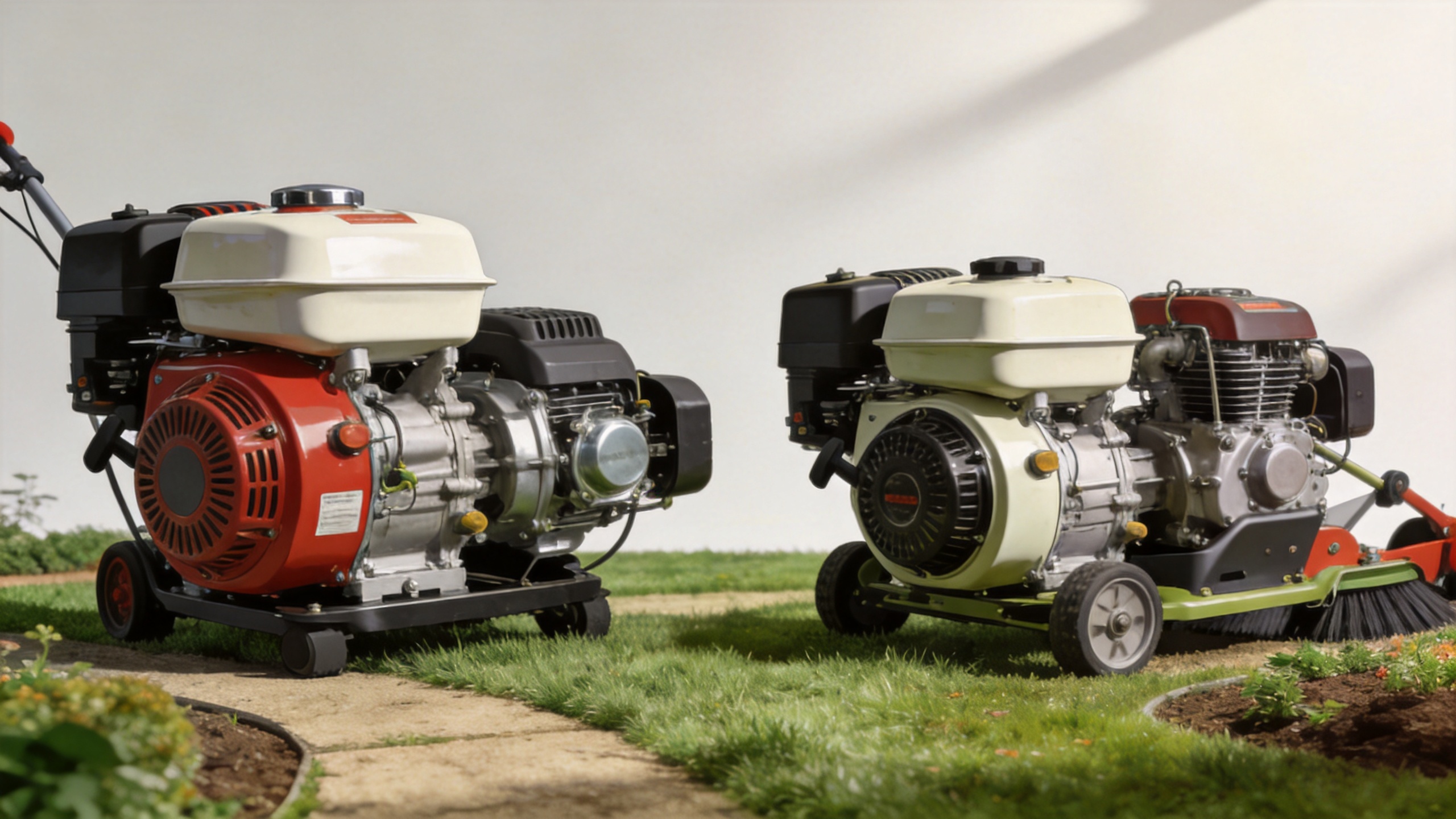
Two-stroke engines can produce useful power from a lighter, simpler engine layout. That can be advantageous for handheld equipment or tasks where the operator frequently carries and repositions the machine. But a typical walk-behind petrol 4 stroke lawn mower may accept additional engine weight in exchange for smoother-running characteristics and a more conventional maintenance approach.
For gasoline lawn mowers, do not judge handling by engine cycle alone. A heavier mower may be tiring on a small, intricate lawn yet stable on open ground. A self-propelled drive can change the real operator effort more than a modest engine-weight difference. Before specifying a unit, map the property: slope, turning frequency, grass height, obstacles, gate width, travel distance, and the likely operator. This turns a vague engine comparison into a usable selection process.
| Decision point | Four-stroke question | Two-stroke question |
|---|---|---|
| Fuel routine | Can the team check oil and follow change intervals? | Can the team reliably measure and label the correct fuel-oil mix? |
| Work pattern | Is regular lawn mowing the primary task? | Does low weight or frequent repositioning carry unusual importance? |
| Operating setting | Are smoke control and a conventional service routine priorities? | Are local rules and fuel-handling practices compatible with the design? |
| Ownership plan | Who records oil checks and scheduled service? | Who controls mix quality and mixed-fuel storage? |
Durability is a maintenance question, not an automatic promise
It is tempting to say that all four-stroke gasoline lawn mowers last longer. That is too broad. A well-serviced two-stroke engine may give dependable service, and a neglected four-stroke can fail early. The more accurate benefit is that a petrol 4 stroke lawn mower uses a dedicated lubrication system, which can make lubrication status easier to check and maintain when the owner follows the manual.
For a purchasing team, separate the engine-cycle decision from the durability review. Request the service schedule, oil specification, air-filter access, blade and deck maintenance guidance, spare-parts availability, warranty terms, and required operator training. If a model has a claimed feature or performance figure, ask for its product documentation before including it in a specification.
When a petrol 4 stroke lawn mower is usually the stronger fit
A four-stroke choice is often sensible when gasoline lawn mowers will be used for recurring grounds maintenance and the buyer wants simple refuelling, separate oil management, and a structured service routine. It can also be a practical fit for organizations that want operators to follow a short pre-use checklist rather than mix fuel on site.
It may be less decisive when minimal weight is the overriding requirement, when the work is not ordinary mowing, or when the available model range has a specific two-stroke advantage verified for the task. Engine cycle should not override the manufacturer’s slope limits, safety instructions, cutting capacity, or local emissions requirements.
A buyer checklist before choosing gasoline lawn mowers
- Confirm the grass type, height, density, mowing frequency, and total area.
- Record slopes, wet zones, drainage channels, trees, curbs, and turning points.
- Compare drive system, cutting-width needs, collection or mulching requirements, and storage space.
- For a petrol 4 stroke lawn mower, confirm the specified oil grade, oil-check method, and service intervals.
- For a two-stroke option, confirm the exact mix ratio, container labeling process, and fuel-storage controls.
- Ask for the applicable manual, parts support details, sound data, and compliance documentation before purchase.
The practical conclusion
The chief advantage of a petrol 4 stroke lawn mower over a two-stroke model is usually not a single headline performance number. It is a more straightforward ownership routine: separate fuel and oil, no routine mixing requirement, and a maintenance process that is easy to inspect. For many regular mowing applications, those are meaningful benefits.
Still, well-matched gasoline lawn mowers are chosen from the task backward. Start with the ground, grass condition, operator capability, service resources, and local requirements. Then compare confirmed model documentation rather than relying on engine-cycle labels alone. That approach helps buyers select equipment that is workable long after the first cut.