EN
EN
What Weather Condition Can Robot garden mower Work In
A robot lawnmower is most useful when its schedule matches the grass, the ground, and the safety limits in its owner’s manual. Weather is not a small detail. It changes traction, cut quality, visibility, battery behavior, and the chance that clippings will collect under the deck. The practical question is not simply whether a robot lawnmower can move in rain; it is whether the lawn, machine, and charging setup are safe for the task at that moment.
As a working rule, use a dry-weather plan unless the manual for your exact model explicitly permits something else. A robot garden mower may have a rain sensor, sealed components, or a programmed return-to-base routine, but those features do not make every wet, stormy, frozen, or overheated situation suitable. Start with the manufacturer’s limits, then inspect the site before each run.
Preferred conditions: dry grass, stable ground, and clear visibility
The most predictable conditions for a robot lawnmower are dry grass, firm soil, moderate temperatures within the stated operating range, and good daylight or camera visibility. Dry blades and leaves pass through the cutting system more cleanly. Firm ground supports consistent wheel grip, especially near turns, slopes, lawn edges, and transition strips.
A dry forecast also makes it easier to assess obstacles. Check for branches, toys, hoses, holes, exposed roots, loose stones, and animal activity before releasing a robot lawnmower. Remote or app-based control does not remove the need for site management: the operator still needs a clear route, a safe boundary, and a way to stop the machine if conditions change.
For routine mowing, shorter and more frequent cuts are generally easier on the lawn than asking a robot lawnmower to tackle tall, wet growth in one pass. If grass has become long after several wet days, let it dry and consider whether a staged cut is more appropriate for the model and site.
Can a robot lawnmower work on damp grass?
Light morning moisture is different from rain-soaked turf. Some models may travel across slightly damp grass, but damp conditions can still reduce traction and leave clippings on wheels, sensors, or the underside of the deck. Before starting a robot lawnmower, walk the lawn and look for shiny standing moisture, soft wheel tracks, clumps of grass, and slippery slope sections.
If the grass bends over, clings together, or sticks to footwear, postpone mowing when possible. A robot lawnmower can cut less evenly when wet clippings clump rather than disperse. More importantly, wet soil may let wheels spin or compact vulnerable areas. The correct decision is conditional: a small amount of surface moisture may be manageable for a particular approved model on level, well-drained turf, while the same moisture can be unsuitable on a slope or clay-heavy lawn.
Rain: check the model’s rain-sensor and manual settings
Rain is not a universal yes-or-no condition for a robot lawnmower. Retrieved manufacturer guidance shows that some robotic mowers use rain sensors to stop mowing and return to their charging stations. Other manuals specifically advise against operating while it is raining. Therefore, treat the sensor as a protective feature, not as a general authorization to mow through rainfall.
Review your manual for three separate points: whether mowing in rain is permitted, what the rain sensor actually does, and whether the charging station or power supply has additional protection requirements. If a shower begins during a programmed session, a robot lawnmower should follow its configured return behavior only if that behavior is documented for the machine. Do not override a sensor or repeatedly restart the schedule just to finish a cut.
After rainfall, wait for the lawn to drain. Pay special attention to low spots, shaded areas, compacted paths, and the approach to the charging station. A robot garden mower needs a stable path back to base; a muddy approach can create wheel slip or repeated route errors.
When wet ground means “do not mow”
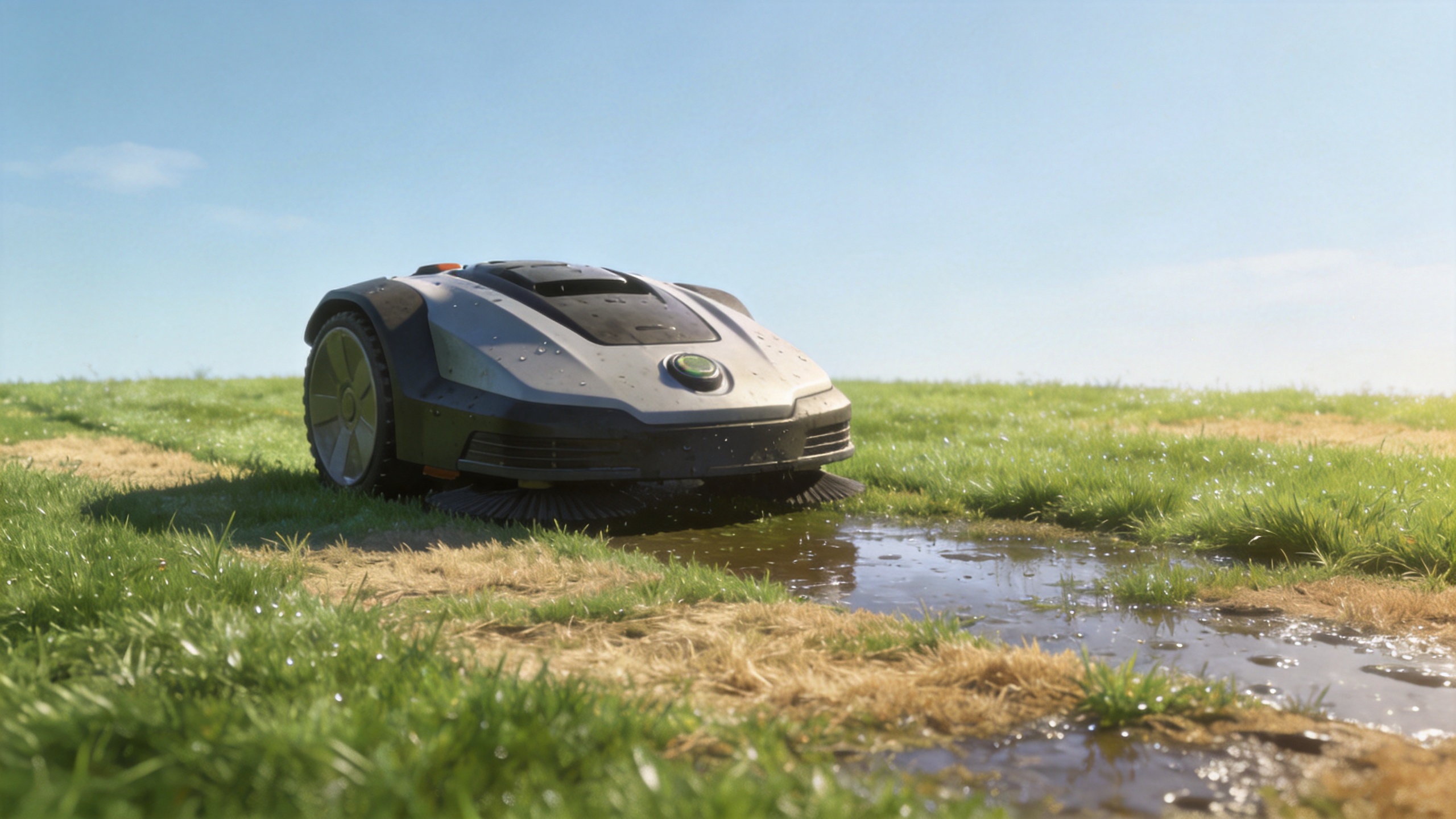
Skip a robot lawnmower session when water is pooling, the soil is soft enough to mark deeply, wheels lose grip, or clippings are already sticking to the deck. These are operating-condition signals, not merely cosmetic concerns. Continuing can damage the turf, reduce cutting consistency, and create extra cleaning or maintenance work.
- Standing water: Keep the robot lawnmower away from puddles, drainage channels, and flooded lawn edges.
- Mud or saturated soil: Delay work until the ground is firm enough to support the mower without rutting.
- Wet slopes: Avoid them unless your manual explicitly approves the slope and moisture combination; wet grass changes traction quickly.
- Heavy wet clippings: Pause the schedule, clean the machine safely according to its manual, and resume only when conditions improve.
Thunderstorms, lightning, and high wind
Do not treat a weatherproof enclosure as storm protection. A robot lawnmower should not be operating during a thunderstorm. Manufacturer support guidance for robotic mowers includes storm precautions, and some retrieved manuals explicitly say not to operate during storms. Pause the schedule, follow the instructions for the mower, charging station, boundary system, and power supply, and do not handle electrical connections while lightning is active.
High wind is also a reason to reassess. Wind can move branches, outdoor furniture, tarps, and garden debris into the planned route. It can also make a once-clear lawn unsafe before a robot lawnmower reaches that area. Inspect again after gusts or a storm front, rather than assuming the earlier map still represents the lawn.
Temperature, frost, snow, and heat
Temperature limits are model-specific, and charging limits may be narrower than mowing limits. For example, retrieved manuals list operating ranges such as 0–50°C (32–122°F) and charging ranges such as 5–45°C (41–113°F), but those figures are examples rather than a specification for every robot lawnmower. Use the limits in your own manual.
Do not run a robot lawnmower over frost, snow, or frozen soil unless the manufacturer expressly permits it. Frozen grass can be brittle, traction can be unpredictable, and hidden ice can defeat normal slope assumptions. At the other extreme, intense heat can affect batteries, electronics, and grass stress. If the lawn is dry and heat-stressed, mowing may not be the appropriate lawn-care decision even when the machine technically remains inside its operating temperature range.
A quick weather checklist before each schedule
- Check the forecast for rain, lightning, high wind, frost, and extreme temperature.
- Read the exact robot lawnmower manual for operating, charging, rain-sensor, and slope limits.
- Walk the lawn: confirm firm ground, dry-enough grass, no standing water, and no new obstacles.
- Inspect the route to the charging station and keep its approach clear and stable.
- After any wet run or interruption, inspect blades, wheels, sensors, and the underside as directed by the manufacturer.
The bottom line
A robot lawnmower is generally most predictable in dry, stable, moderate conditions with a clear route and a lawn that can support the machine without slipping or rutting. Light dampness, rain, temperature, wind, and terrain must be judged together—not as isolated features. Let the model-specific manual set the non-negotiable limits, use rain and weather features as safeguards, and postpone mowing whenever water, storms, unstable ground, or poor visibility make the next pass uncertain.