EN
EN
What Size Limit Suit Robot lawn mowers for small lawns
Choosing a robot lawnmower for a compact garden looks simple until the lawn has narrow runs, trees, beds, or separate patches. The number printed as a mower’s maximum coverage is useful, but it is not the same as the area the machine will comfortably maintain in every layout. A better choice starts with the mowable grass area, then allows for the time and route the mower needs to cover it.
From a lawn-equipment selection perspective, the practical question is not “What is the smallest machine?” It is “What capacity leaves enough working margin for this lawn’s shape and mowing routine?” That distinction helps owners compare robot lawn mowers for small lawns without paying for irrelevant capability or buying too close to the limit.
Start with mowable lawn area, not the whole property
Measure the grass the mower can actually reach. Exclude the house, driveway, patios, planting beds, ponds, and areas that are intentionally left unmown. If a garden has several grass sections, measure each section and note whether the mower can travel between them safely. The sum is the starting area for selecting a robot lawnmower.
For a small lawn, coverage bands often begin around a few hundred square metres, while other models are rated around 1,000 m² or more. These figures are model-specific planning limits, not a promise that every lawn of that size will be equally easy. A flat, open 300 m² rectangle gives a robot a very different job from 300 m² split by borders, furniture, and tight passages.
How much capacity margin should a small lawn have?
Use the manufacturer’s stated recommended area as a capacity ceiling, then select a robot lawnmower that is comfortably above your measured mowable area when the layout is complex. There is no single percentage that fits every model, because cutting width, battery size, charging behavior, navigation method, grass growth, and permitted operating hours all change the outcome.
A sensible comparison method is to classify the lawn before reading product specifications:
- Simple small lawn: one mostly open, level area with a clear charging location and few obstacles. A mower rated near the measured area may be reasonable after confirming its schedule and boundary requirements.
- Moderately complex small lawn: curves, several beds, frequent furniture, or a short narrow passage. Choose extra capacity so the machine has time to recover from turns, rerouting, and charging.
- Demanding small lawn: multiple zones, uneven ground, slopes, pet areas, or limited daytime operating hours. Capacity alone is not enough; navigation, zone support, safety rules, and access between sections must be checked first.
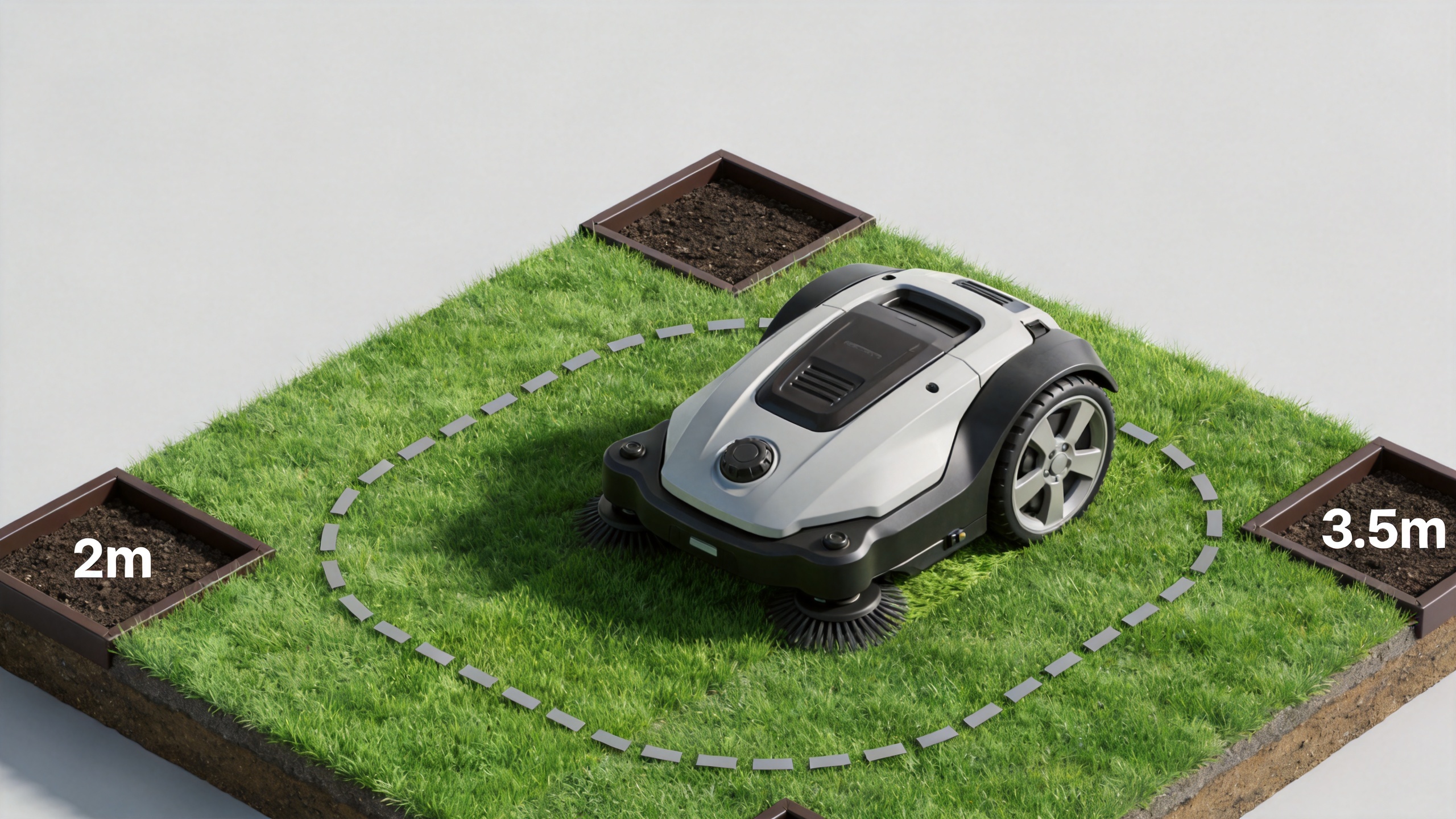
In other words, do not treat a maximum-area label as a target. Treat it as one input in a demand-versus-configuration check. This is especially important for robot lawn mowers for small lawns, where obstacles can occupy a meaningful share of the route even when the total grass area is modest.
Why the same square metres can create different workloads
Layout and turning space
Robots need usable route space along edges and around obstacles. A lawn with long clean runs is efficient; a lawn made of many small pockets requires more turns and more navigation decisions. Before selecting a robot lawnmower, sketch the lawn and mark trees, beds, play equipment, steps, drainage channels, and tight gates. This simple exercise often reveals that the usable mowing task is harder than the square-metre number suggests.
Slopes and surface changes
Check slope ratings against the steepest section the mower must cross, not the average grade of the lawn. Also consider dips, roots, loose soil, wet spots, and transitions between grass and paving. A machine may have enough area capacity but still be a poor fit if traction, clearance, or safe route access is not suitable for those conditions.
Operating hours and charging
Capacity is really an operating-time calculation. A vendor guide for one robotic mower notes that a 200 m² lawn can take roughly three to four hours to mow under normal conditions, including charging; that is an illustration rather than a universal result. Your expected schedule must still allow for the model’s own cutting cycle, charging time, weather pauses, and any local noise or safety restrictions.
Place the charging station where the mower has reliable access and where its return route is not constantly blocked. If the lawn can only be mowed during a narrow time window, select a robot lawnmower with enough practical capacity to finish its recurring work within that window instead of relying on ideal conditions.
A four-step size check before you choose
- Measure the reachable grass. Record each connected mowing section separately and total the areas.
- Map route friction. Mark slopes, narrow passages, dense obstacles, edges, and places where a mower could lose access or need supervision.
- Check the weekly operating window. Consider grass growth, charging time, rainy periods, and the hours when autonomous mowing is acceptable.
- Compare only verified specifications. Confirm the manufacturer’s recommended mowing area, slope limit, boundary or navigation requirements, zone capability, and charging-station rules for the exact model.
This sequence keeps the decision grounded. It is tempting to compare a long feature list first, but area, route access, and operating time determine whether a robot lawnmower can keep up. Features should then be evaluated against the conditions that actually affect your lawn.
When a robot lawnmower may not be the right small-lawn tool
A robot is not automatically the right answer for every compact yard. Reconsider the plan if the grass is divided by stairs or inaccessible barriers, the route contains unsafe edges, the slope exceeds the specific model’s approved limit, or the garden changes frequently. In those cases, a conventional mower, a smaller managed zone, or a different site layout may be more practical.
Safety comes before convenience. Keep children, pets, and bystanders in mind; follow the exact operating manual and local rules; and do not assume obstacle detection replaces site preparation. Clear loose objects and inspect the cutting area before unattended operation.
Questions to ask before ordering
- What is the measured mowable area, excluding non-grass surfaces?
- Is the recommended area for the exact robot lawnmower greater than that area under the manufacturer’s stated conditions?
- Can it handle the steepest slope, narrowest passage, and separate zones on this lawn?
- Where will the charging station sit, and is the route to it consistently clear?
- Can the machine complete its work within the available operating hours after allowing for charging and weather interruptions?
- What site preparation and safety checks does the manual require?
Make the capacity decision conservatively
The right size for robot lawn mowers for small lawns is rarely just the smallest rating that matches the grass area. Start with an accurate measurement, then allow for layout complexity and the time the mower has to work. A straightforward lawn can often use a modest-capacity machine efficiently. A compact but intricate garden usually benefits from more headroom and a closer look at navigation and zone access.
Before you buy, verify the exact model documentation and assess the actual site. That conservative process gives a robot lawnmower a better chance of maintaining a neat lawn on schedule without turning an advertised maximum into a daily operating problem.