
 EN
Practical Operations in Heavy-Duty Commercial Landscaping
Over years of developing, testing, and deploying specialized commercial maintenance machinery at Shandong Maide En Intelligent Technology Co., Ltd, our engineering and field service teams have evaluated power delivery systems across a wide range of challenging terrain environments. When clearing overgrown vegetation, dense brush, thick weeds, and tough saplings on steep highway embankments, solar farm perimeters, or agricultural orchards, equipment performance depends directly on continuous torque and reliable energy output. Electric battery-powered mowers often experience rapid energy depletion, reduced blade speed, or thermal throttling when encountering dense, wet, or thick brush. Operating a heavy-duty gasoline remote lawn mower solves these power limitations by providing sustained, high-torque output that maintains peak blade rotation speeds even under severe cutting resistance. In practical field deployments across 20- to 50-degree slopes, operators controlling equipment from safe vantage points up to 500 meters away rely on gasoline engine engineering to maintain consistent ground speed and clean cutting paths without experiencing power drops or frequent battery recharge interruptions.
Thermodynamic Mechanics and Fuel Energy Density Advantages
Understanding why internal combustion engines excel in heavy land maintenance requires examining the fundamental principles of fuel energy density and thermodynamic efficiency. In professional turf and brush clearing, a high-torque gasoline mower power output system benefits from the superior energy capacity of liquid petroleum fuel, which contains approximately 12,000 watt-hours of thermal energy per kilogram—vastly outperforming current lithium-ion battery configurations. When a gasoline engine operates inside a commercial mower, four-stroke combustion converts liquid fuel into continuous rotational mechanical energy. This energy drives high-torque cutting blades and heavy-duty self-propelled crawler track drive systems simultaneously. Unlike electric motors that draw high current spikes and overheat under sustained loads, gasoline engines dissipate thermal energy efficiently while delivering flat torque curves. This mechanical characteristic ensures that when the cutter deck engages heavy thickets or dense wild grass, the engine maintains high rotational velocity, preventing blade stall, reducing strain on transmission components, and delivering smooth, dependable cutting force across every pass.
Technical Analysis of Fuel Delivery: EFI vs Carburetor Lawn Mower Systems
Evaluating modern engine performance requires analyzing fuel delivery architecture, particularly when choosing between EFI vs carburetor lawn mower designs. Traditional carburetor systems rely on mechanical vacuum suction to draw fuel into the air intake stream, mixing fuel and air based on fixed mechanical jet sizes. While carburetors are mechanically simple and economical, they can struggle with air-fuel mixture precision during rapid load changes, altitude variations, or ambient temperature fluctuations. In contrast, Electronic Fuel Injection (EFI) systems utilize an Engine Control Unit (ECU) alongside high-pressure fuel injectors and sensors to continuously monitor engine load, throttle position, intake air temperature, and atmospheric pressure. By delivering precisely atomized fuel directly into the combustion chamber in real time, EFI technology optimizes combustion efficiency, improves cold-start reliability, provides crisp throttle response, and reduces fuel consumption by up to 20% compared to carbureted equivalents. This precise air-fuel metering maintains maximum torque output under heavy brush resistance while minimizing exhaust emissions and spark plug fouling.
Slope Stability and Dynamic Drive System Engineering
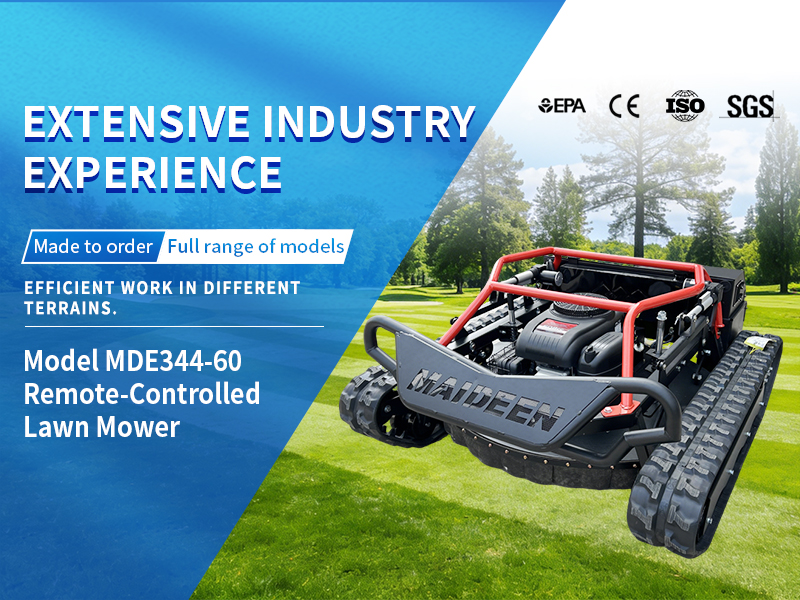
Delivering strong power output to the cutting deck is only half the battle; transferring that mechanical energy to the ground across steep inclines, muddy ditches, and uneven terrain requires robust chassis and drive engineering. When a gasoline remote lawn mower navigates challenging topographies, its high-torque four-stroke engine works in harmony with heavy-duty crawler track or self-propelled drive systems to maintain firm traction. The continuous weight distribution of rubber or steel track assemblies lowers ground pressure, allowing the machine to climb steep slopes without slipping, sinking into soft mud, or losing momentum. With remote control operational ranges reaching up to 500 meters, dual-joystick hand-held transmitters allow operators to make subtle throttle adjustments on the fly. Furthermore, remote cutting height adjustment mechanisms enable operators to raise or lower the cutter deck to adapt to varying vegetation densities and hidden terrain obstacles. This combination of high engine torque, heavy-duty track traction, and remote height adaptability ensures smooth navigation and uniform cutting quality across dangerous slopes without exposing field operators to hazardous conditions.
Manufacturing Quality from Shandong Maide En Intelligent Technology Co., Ltd
At Shandong Maide En Intelligent Technology Co., Ltd, our engineering philosophy focuses on combining raw mechanical strength with advanced, user-focused safety technology. We specialize in manufacturing commercial-grade remote control mowers designed specifically for demanding vegetation management across solar power installations, highway greenbelts, forestry borders, and fruit orchards. Our equipment features heavy-duty crawler track drive systems engineered for superior slope stability, paired with powerful four-stroke gasoline engines that supply dependable cutting energy under tough field conditions. Designed to support effective wireless control distances up to 500 meters, our mowers give groundskeeping crews the flexibility to manage large areas from safe, comfortable positions. Featuring adjustable cutting heights, reinforced steel decks, and optional optical camera monitoring systems, equipment built by Shandong Maide En Intelligent Technology Co., Ltd offers an ideal balance of mechanical power, durability, and operational safety for commercial land clearing projects.
Sustainable Power Solutions for Commercial Land Care
Achieving maximum productivity across unmaintained land, highway embankments, and commercial estates demands equipment capable of delivering sustained, uncompromising performance. Utilizing a high-performance gasoline remote lawn mower ensures that land maintenance crews possess the high gasoline mower power output required to tackle dense brush and thick vegetation efficiently. By understanding the operational advantages of EFI vs carburetor lawn mower systems and relying on heavy-duty machinery manufactured by Shandong Maide En Intelligent Technology Co., Ltd, commercial groundskeeping teams can maximize jobsite efficiency, protect mechanical components, and maintain high safety standards across challenging terrain. Investing in proven gasoline-powered remote control technology delivers long-term durability, reduces operational downtime, and provides a reliable solution for modern vegetation management.