EN
EN
How Long Is the Service Life of Tracks on a Remote Control Lawn Mower with Tracks?
A tracked lawn mower earns its place on difficult ground because the track system spreads contact over a larger area and supports remote operation away from the cutting zone. Still, buyers often ask for one service-life number. There is no responsible universal answer. The usable life of tracks on a remote control lawn mower with tracks depends on terrain, turning habits, track tension, debris, storage, and how quickly early wear is addressed.
From a remote-mower technical perspective, it helps to separate “how many hours have passed” from “what work the machine has done.” A tracked lawn mower cutting dry grass on a consistent surface works very differently from one repeatedly crossing sharp stones, roots, ruts, wet soil, and hard access roads. That distinction gives owners a more useful maintenance plan than a promised replacement interval.
Why a Single Track-Life Figure Is Misleading
Track life is a wear outcome, not a fixed calendar event. A tracked lawn mower may see more stress during frequent pivot turns, side-slope maneuvering, loading, transport, and work around abrasive material than during straightforward mowing. The rubber compound, internal reinforcement, sprocket condition, roller alignment, track tension, and operator technique all influence the result.
At first, it is tempting to assume that mowing area decides everything. In practice, slope angle, ground texture, obstacles, moisture, and turning frequency can matter just as much. This is why a supplier should be asked for model-specific maintenance instructions rather than a generic hour claim. For a remote control lawn mower with tracks, the operating environment needs to be part of every service-life discussion.
The Conditions That Shorten Track Service Life
Hard surfaces and aggressive turns
A tracked lawn mower can lose tread faster when it spins or makes abrupt turns on concrete, asphalt, compacted gravel, or other high-grip surfaces. Smooth, wider turns where the site allows them reduce scuffing. This does not mean the machine cannot cross a hard access path; it means repeated high-speed pivots should not become the default routine.
Debris trapped in the undercarriage
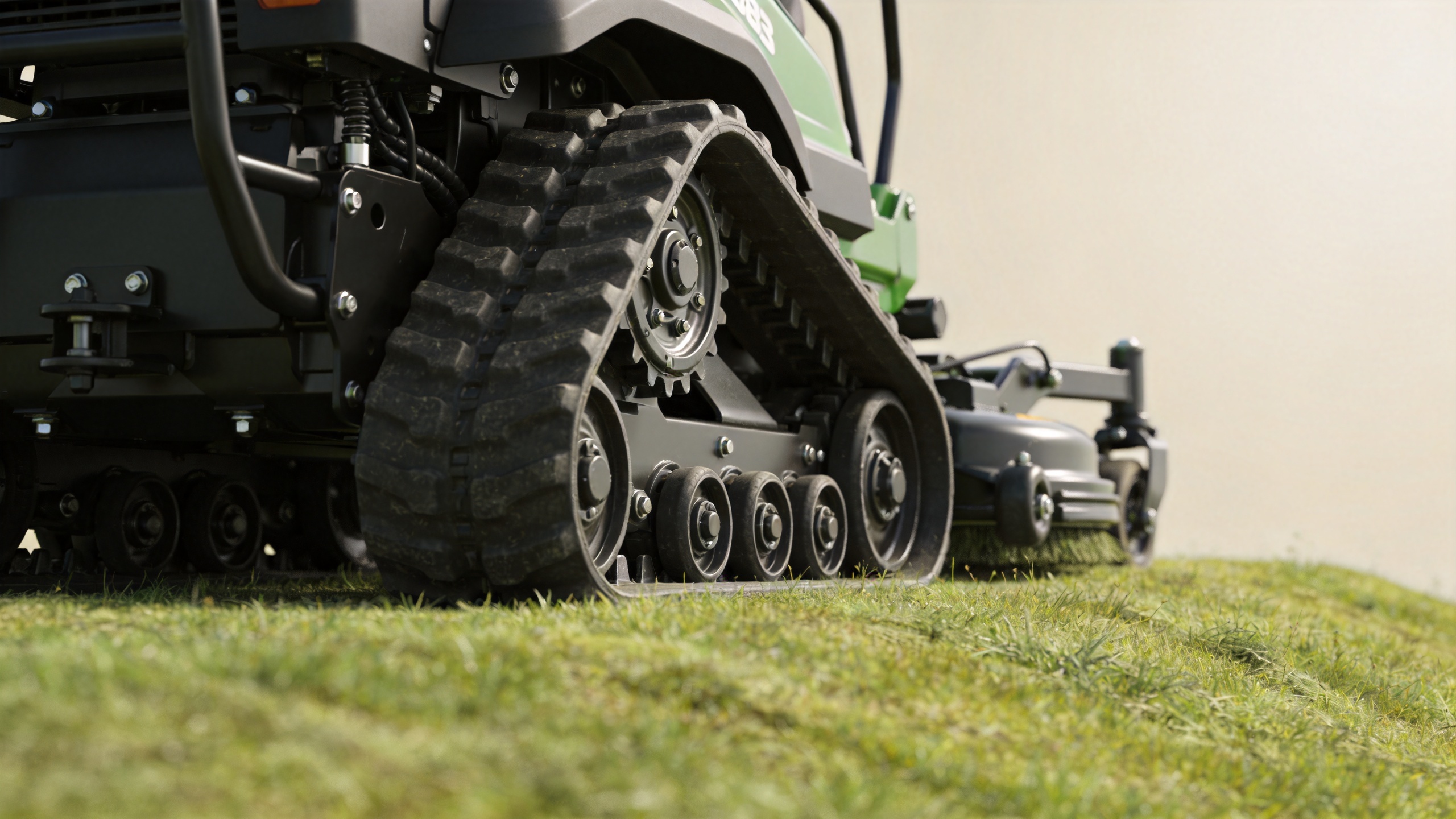
Soil, long grass, wire, branches, and stones can pack around the undercarriage. Left in place, they may interfere with normal movement or hide wear. After a job, clean the tracked lawn mower only when it is shut down, secured, and safe to inspect. A simple walk-around is often the earliest opportunity to spot cuts, missing rubber, unusual guide-lug wear, or material caught near the drive components.
Incorrect tension and misalignment
Track tension must follow the manual for the exact machine. A track that is too loose can slip or run poorly over its drive components; one that is overly tight can add unnecessary load. Do not substitute a generic measurement found online for the manufacturer’s procedure. If the remote control lawn mower with tracks begins to pull to one side, derail, make new noises, or show uneven wear, pause work and request a qualified inspection.
Rough or unsuitable ground
A tracked lawn mower is commonly considered for rough, sloped, or soft areas, but that does not make every obstacle harmless. Sharp debris, broken masonry, exposed metal, and repeated impacts can damage rubber tracks. Walk the route before operation, remove hazards where practical, and plan turns away from the harshest edges.
What to Check Before, During, and After Mowing
For a tracked lawn mower, a short inspection routine is more valuable than waiting for an obvious failure. Before mowing, check visible track condition, the undercarriage area, and whether debris is already lodged in the system. During work, watch for tracking changes, vibration, irregular movement, or a response that differs from normal operation. After work, remove accumulated grass and soil and make a note of any new damage.
- Look for: cuts, cracks, exposed internal material, missing sections, torn guide lugs, and uneven tread wear.
- Check the route: note hard crossings, sharp turns, wet areas, and debris exposure that could explain accelerated wear.
- Review tension: use only the machine-specific procedure and service interval.
- Inspect related parts: sprockets, rollers, and guides should be assessed if wear is uneven or the track does not run smoothly.
- Record observations: photos and operating notes help a service team judge a remote control lawn mower with tracks in its actual working conditions.
How to Extend the Working Life of a Tracked Lawn Mower
Longer life usually comes from consistent habits, not from one special treatment. Use gradual turns where possible, avoid spinning tracks, remove debris promptly, keep tension within the specified setting, and do not continue operating after a derailment or significant impact. When a tracked lawn mower is parked for an extended period, clean it first and keep it in a dry, shaded, protected location. Periodic checks during storage are worthwhile because small issues are easier to manage before the next season.
It is also sensible to match the machine to the task. A tracked lawn mower should be evaluated against slope, vegetation density, ground condition, work frequency, and the people responsible for inspection. In other words, do not compare only cutting width or engine information. Ask what replacement-track support, parts identification, tension guidance, and after-sales process are available for the intended operating environment.
When Should You Plan a Replacement or Service Review?
Schedule a review when visible damage, repeated derailing, unusual vibration, loss of normal movement, rapidly uneven tread, or a material change appears. Waiting until a track fails completely can create downtime and may affect related undercarriage components. For a remote control lawn mower with tracks, an early review is especially prudent before a high-workload period or after operation on unusually abrasive terrain.
The practical answer is clear: a tracked lawn mower does not have one fixed lifespan. Its service life is managed through suitable operation, regular inspection, correct tension, debris control, and timely support. If you are comparing options, provide the supplier with photos of the terrain, expected mowing frequency, vegetation type, and turning conditions. That information makes a track-life recommendation more credible and helps protect the machine over time.