EN
What Trade Offs Exist For Low cost lawn mower?
A low cost lawn mower can be a sensible purchase when the work is predictable, the site is straightforward, and the buyer knows which features are essential. It can also become an expensive shortcut when a low initial price removes the very capabilities that keep a mowing task safe, repeatable, and serviceable. For a procurement team, the useful question is not simply “What is the lowest-priced lawn mower?” It is “Which costs and operating limits move elsewhere when the purchase price comes down?”
From a B2B buyer’s perspective, a lawn mower should be compared against the mowing task: terrain, grass condition, route complexity, work frequency, operator skill, and the support available after delivery. A low cost lawn mower may fit a small, level, regularly maintained area. It may be a weak fit for high grass, uneven ground, long shifts, or sites with frequent obstacles. The distinction matters more than a feature list.
The main trade-off: lower purchase price versus a complete working system
The purchase price is visible; the rest of the operating system is less visible. A lower-priced lawn mower may have a simpler drive system, fewer convenience features, a smaller power source, or a narrower intended duty cycle. None of those facts automatically make it unsuitable. They do mean that the buyer should check whether the savings match the actual assignment.
A practical comparison separates three layers. First, identify non-negotiables: functional guards, operator controls, braking or stopping behavior where applicable, stable handling, and a cutting system suited to the vegetation. Second, identify task-fit items: propulsion, working width, battery capacity or fuel access, turning space, and transport. Third, compare convenience items such as electric start, accessory compatibility, or a more refined control layout. Budget pressure should not move a safety or site-fit requirement into the “nice to have” column.
Where a low cost lawn mower can make sense
A sensible use case for a low cost lawn mower is a defined, low-complexity job. Think of a regularly maintained, relatively flat area with clear boundaries, limited debris, and a realistic schedule for cleaning and inspection. In that setting, simpler equipment can be easier to train on and may avoid paying for capacity that will not be used.
- Predictable grass condition: short, maintained grass usually creates fewer demands than dense, wet, or overgrown vegetation.
- Short, planned sessions: a smaller battery or a simple push design may be workable when the work can be divided into manageable blocks.
- Easy access to service: a lower initial price is less concerning when parts, maintenance instructions, and qualified support can be confirmed before purchase.
- Simple site geometry: open areas with fewer turns, trees, drainage edges, and narrow passages reduce the need for specialized maneuverability.
Capability trade-offs that can appear later
Power source and uninterrupted work time
Low-priced battery and gas walk-behind options can both be useful, but they shift the operating burden differently. Battery equipment is often easier to store and has fewer routine engine-service tasks. Its useful work time, however, depends on the battery, the grass condition, the drive load, and the charging plan. A self-propelled function can also consume energy that would otherwise be available for cutting. Gas equipment can support longer continuous work, but it typically adds fuel handling, oil-related service, and more frequent maintenance considerations.
Propulsion, pace, and operator effort
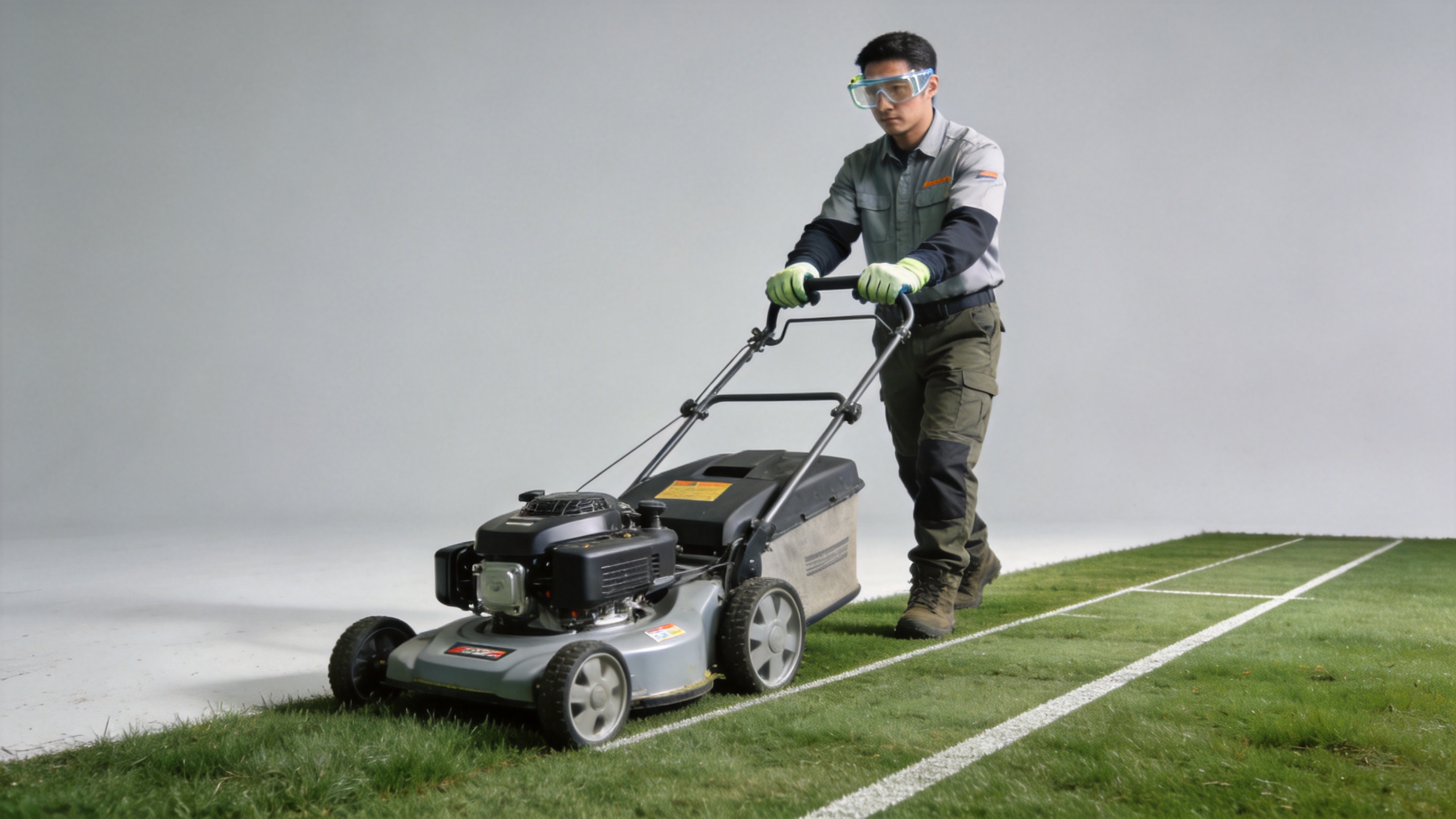
A push lawn mower may carry a lower price and fewer moving parts. The trade-off is physical effort and pace, particularly over larger areas or ground that is not smooth. Self-propelled drive can reduce pushing effort, yet it adds components that should be understood, checked, and supported. The right choice depends on the route, not on the assumption that one style is universally better.
Cutting quality versus vegetation tolerance
A low cost lawn mower may be adequate for routine trimming but less forgiving when grass becomes tall, thick, wet, or mixed with rough vegetation. That is not a criticism of every value model; it is a reminder to match the cutting system to the expected material. Buyers should request clear information about intended conditions, height adjustment, blade access, and limits around debris or uneven terrain.
The ownership-cost trade-off
A low cost lawn mower can have a low total cost of ownership, but only if the buyer can maintain it within its intended workload. Compare the initial quote with the likely need for blades, belts, filters, oil or battery care, transport, storage, and downtime. The comparison should also include access to instructions, replacement parts, and service communication. A low price that is paired with uncertain support can transfer risk to the maintenance team.
| Buyer question | Why it matters | What to confirm |
|---|---|---|
| What is essential for safe operation? | Budget savings should not remove core safety controls. | Guards, stop controls, operating instructions, and site-specific procedures. |
| What will the mower cut on the hardest day? | Normal grass and dense or wet growth create different loads. | Intended vegetation, terrain limits, and demonstration conditions. |
| What happens after a battery, blade, or drive component wears? | Ownership cost includes availability and downtime. | Parts list, maintenance intervals, service route, and turnaround expectations. |
| Which features reduce work rather than merely add appeal? | Useful configuration should match the route and operator. | Propulsion, power plan, maneuverability, and transport requirements. |
Safety and site conditions are not optional trade-offs
Efficiency matters, but it does not replace a site check. Before operating any lawn mower, remove visible debris, identify slopes and soft ground, mark boundaries, and consider trees, ditches, retaining edges, pedestrians, and traffic. For riding equipment, rollover risk and slope guidance require special attention. For walk-behind equipment, footing, line of travel, blade controls, and obstacle clearance remain important.
A low cost lawn mower may be appropriate only after the site conditions have been reviewed. If the area has steep grades, wet ground, blind turns, heavy debris, or frequent public access, the purchase discussion should shift toward a documented risk assessment and the manufacturer’s operating guidance. No article can replace that assessment, operator training, or local safety requirements.
A decision checklist for budget-focused buyers
- Describe the task. Record area, terrain, grass height and density, obstacle pattern, seasonal changes, and planned mowing frequency.
- Set non-negotiables first. List safety controls, site-fit limits, service access, and operator requirements before comparing optional features.
- Compare the operating plan. For each lawn mower, check runtime or fuel plan, propulsion, turnaround needs, storage, transport, and cleaning time.
- Request evidence, not slogans. Ask for the current specification, operating documentation, maintenance schedule, and confirmation of what is included in the quoted configuration.
- Price the support path. Identify wear parts, service contacts, response expectations, and who will perform routine checks.
- Choose the simplest mower that still meets the real job. A lower-priced option is defensible when it meets the essential requirements; it is not defensible when it merely postpones a predictable capability gap.
Bottom line
A low cost lawn mower is not automatically a compromise in the wrong direction. It can be an efficient, rational choice for a simple and well-defined mowing assignment. The trade-offs become unfavorable when the purchase price masks a shortfall in safety, task capacity, maintenance support, or site compatibility. Rather than asking which lawn mower has the lowest number on the quote, ask which configuration can complete the intended work with clear operating limits and a credible support plan.