EN
EN
How Does Robot that mows lawn Plan Mowing Route Automatically
A robot lawnmower does not simply drive until it meets grass. It builds a working picture of the lawn, follows a coverage pattern, reacts to boundaries and obstacles, and revisits areas as conditions change. The exact technology varies by model, but the route-planning logic is surprisingly practical: define the work area, estimate where the machine is, choose the next safe strip or zone, and return to charge before the battery is exhausted.
If you are assessing a robot lawnmower, route planning is worth understanding because it affects cut consistency, setup work, supervision needs, and the type of property the machine can handle. A robot that mows lawn can be highly autonomous, but autonomy still depends on a clear site boundary and a route system suited to the lawn.
Route Planning Starts With a Map or Boundary
Before a robot lawnmower can mow efficiently, it needs to know where mowing is allowed. Traditional machines use a perimeter wire. The wire acts as a physical reference: when the mower detects it, the machine turns or follows it to an assigned passage. This approach can be dependable on properties where satellite reception is inconsistent, although installation and later landscape changes require attention.
Wire-free systems use a different reference. A robot lawnmower may use satellite positioning with RTK correction, cameras, LiDAR, wheel sensors, or a combination of these inputs. During setup, the owner or installer typically teaches boundaries, no-go areas, routes between zones, and the charging station location. The mower stores that information as a map. It is important not to assume every wire-free model uses the same sensors or provides the same accuracy; tree cover, buildings, and changing light can affect some navigation methods.
How a Robot Lawnmower Knows Where It Is
Once a route begins, the robot lawnmower constantly estimates its position rather than relying on one signal alone. GPS or RTK can provide a global position for an open lawn. Wheel encoders estimate distance traveled. An inertial sensor can notice turns or slope changes. Camera- and LiDAR-equipped machines can compare nearby edges, objects, or terrain features with the map. In practice, this is a feedback loop: plan, move, measure, and correct.
That feedback matters near narrow passages, garden borders, and trees. A robot lawnmower that loses confidence in its location may slow down, choose a safer path, request help, or fall back to a boundary-based behavior, depending on its design. This is why a demonstration on a simple open lawn does not prove that a mower will behave the same way on every property.
How the Robot Lawnmower Chooses a Coverage Pattern
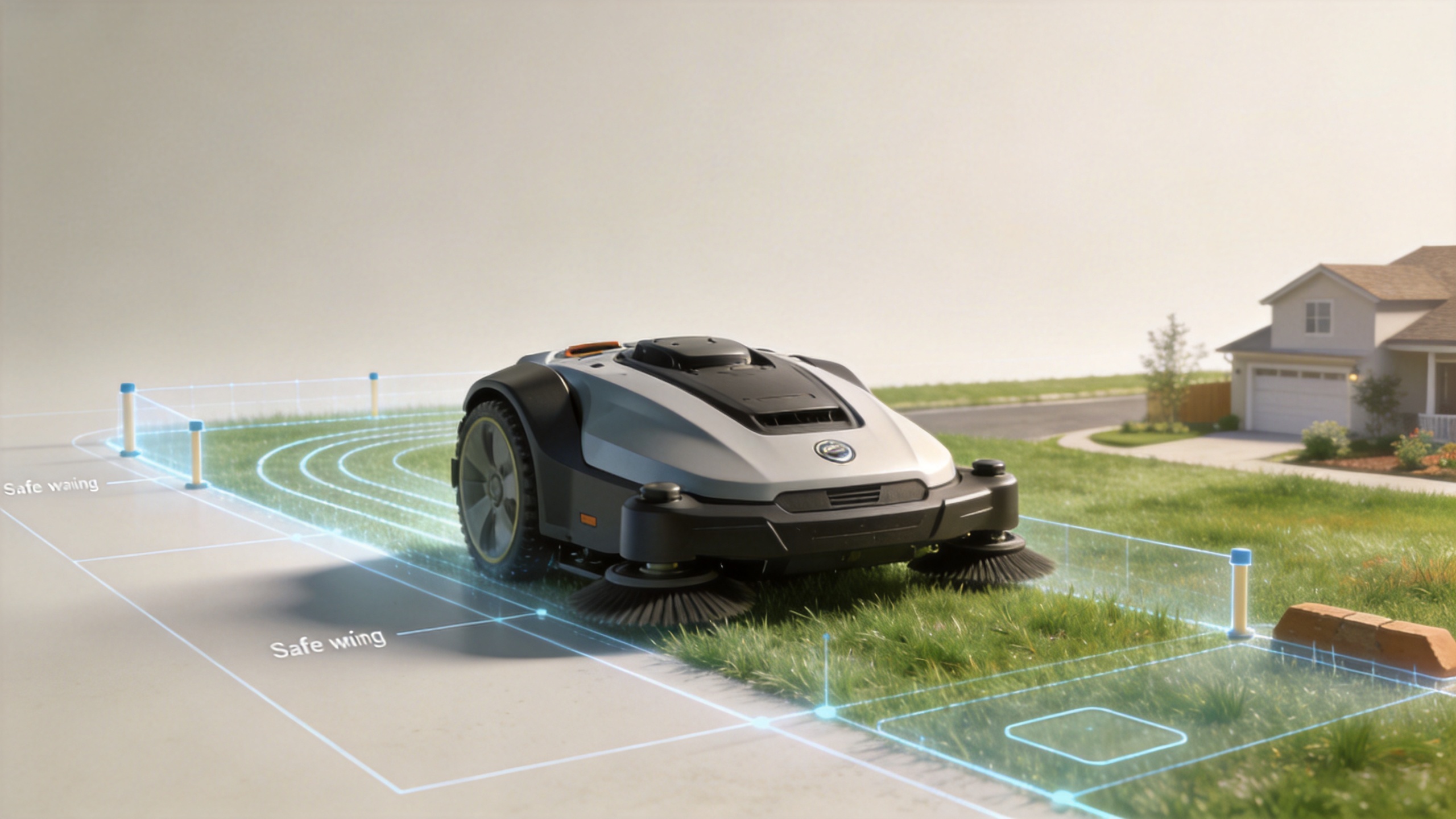
After localization, the robot lawnmower selects a pattern that balances complete coverage with practical turning space. Older or simpler machines may use a semi-random pattern: they change direction when they meet a boundary or obstacle and gradually cover the work area over repeated sessions. Newer mapped systems can use parallel lanes, alternating angles, zone-by-zone sequences, or scheduled sections. A planned pattern can make the route easier to inspect and can reduce repeated travel, but it also needs enough room for turns and reliable position information.
A capable robot lawnmower does not treat every square meter as identical. The map can separate a front lawn from a side yard, reserve a narrow corridor as a transit route, and exclude a flower bed or pond edge. If grass grows faster in one zone, the schedule can favor that zone. If the machine detects that a section has already been cut during the current cycle, it can move on instead of making unnecessary passes.
Obstacle Avoidance Changes the Route in Real Time
A route is only useful if the robot lawnmower can adapt safely. Bump sensors, lift and tilt sensors, ultrasonic sensors, cameras, and LiDAR are examples of technologies that may help a machine identify an obstruction. When the mower encounters a fixed object, it may slow down, stop, turn around it, and rejoin its planned lane. When an object is uncertain, a cautious system should favor a safer response over maintaining the fastest route.
Obstacle avoidance has limits. A robot lawnmower should not be expected to recognize every small item, pet, toy, wire, or low branch in all lighting and weather conditions. Clear the lawn before scheduled operation, mark sensitive boundaries accurately, and follow the manufacturer’s safety guidance. Route planning is more reliable when the site is prepared for it.
Battery Planning Is Part of the Mowing Route
Every robot lawnmower also plans around energy. It must leave enough charge to travel back to its docking station, sometimes through a defined guide route or a mapped corridor. Rather than treating the return trip as an afterthought, the controller estimates travel time, battery state, and the distance from the dock before taking on another section of lawn.
When charging is complete, the robot lawnmower can resume a paused zone, start a new scheduled area, or choose a different route to spread wear across the lawn. The practical result is not necessarily one fully uniform pass in a single session. Frequent, smaller mowing cycles can help maintain an even appearance while giving the machine regular opportunities to recharge and reassess its position.
What Affects Route Reliability on a Real Property
For a robot lawnmower, acreage is only one planning input. Walk the site and note slopes, drainage channels, dense tree cover, reflective glass, narrow gates, uneven ground, loose gravel, and places where people or pets often cross. Satellite-based navigation may need clearer sky visibility. Vision-based systems may respond differently in deep shade, glare, or heavy rain. Boundary-wire systems need an intact wire and carefully defined edges.
Also look at grass conditions. Tall or wet grass increases the load on a robot lawnmower and may make a route take longer than expected. For a first setup, use a conservative schedule, watch several full cycles, and adjust zones or exclusions based on observed behavior. This operator check is often more valuable than relying on a feature list alone.
A Practical Route-Planning Checklist
- Measure the actual mowing areas and identify separate zones.
- Mark permanent hazards, water edges, flower beds, and narrow passages.
- Match the navigation method to tree cover, obstacles, and boundary complexity.
- Confirm that the charging station has a clear, reliable approach route.
- Run supervised test cycles before allowing a robot lawnmower to follow an unattended schedule.
- Recheck the map after landscaping changes, storms, or new seasonal obstacles.
Bottom Line
A robot lawnmower plans its mowing route by combining a defined work area, position feedback, coverage logic, obstacle responses, and battery-aware return decisions. The right setup is not simply the one with the most advanced label; it is the one whose navigation method matches the lawn’s visibility, boundaries, terrain, and daily activity. Set the map carefully, keep the work area clear, and verify real routes before relying on automatic mowing.