EN
EN
How Does Diesel lawn mower Motor Work Under Heavy Load
When diesel lawn mowers enter tall, dense grass or climb a working slope, the engine is asked to do more than keep turning. It must keep the crankshaft, hydraulic drive, and cutting deck moving while the resistance at the blades rises. The useful question is not simply whether a diesel lawn mower motor has enough power on paper. It is how the fuel, air, governor, drivetrain, and operator work together when the cutting load changes.
From a technical operating perspective, diesel lawn mowers should be judged by the conditions around them: grass height, moisture, ground speed, deck condition, terrain, and the operator’s response to changing engine sound. A brief RPM dip can be a normal load response. Repeated bogging, sustained smoke, or an engine that will not recover deserves a pause and inspection.
What changes when a mower meets heavy grass?
A mower deck needs torque to keep its blades at operating speed. In light grass, the engine has reserve capacity. In wet, fibrous, or overgrown material, the blades must cut and discharge more plant matter, so resistance rises. If travel speed stays the same, the diesel lawn mower motor sees that resistance as a demand for more torque.
The first visible sign may be a small drop in engine speed. That is not automatically a fault. A diesel engine is designed to react to load changes, but it has limits. When the deck load becomes greater than the engine and drivetrain can support at the selected speed, blade speed falls, cut quality can decline, and heat or smoke may increase.
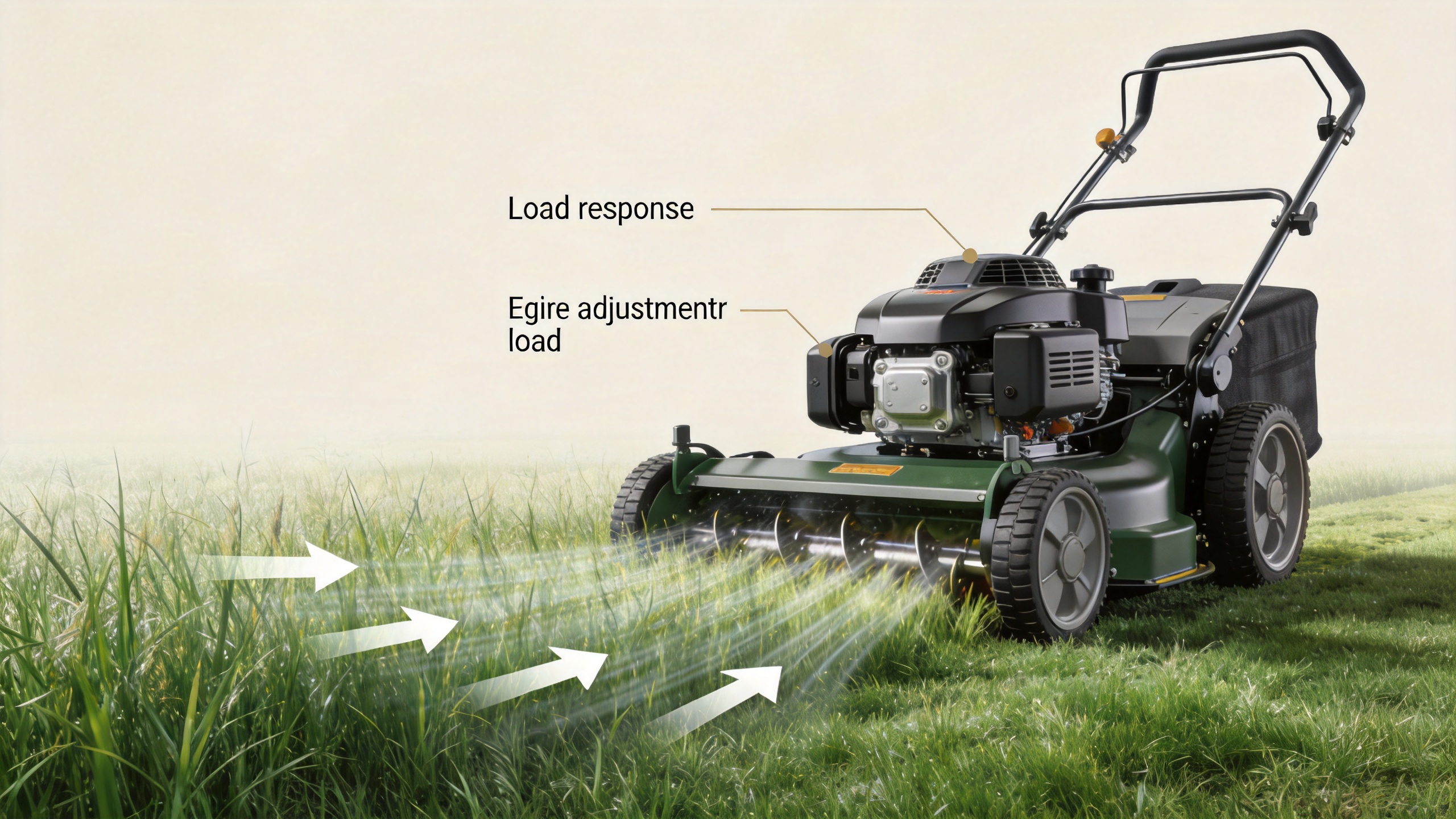
How the diesel lawn mower motor responds to load
1. The governor senses the speed change
As heavy mowing slows the engine, the governor system responds to the change in speed. Its job is to control fuel delivery so the engine can move back toward the selected operating RPM. The exact mechanism differs by engine model, so the operator manual and service data should take priority. Functionally, however, the governor is the link between a falling engine speed and a request for more fuel.
2. More fuel must be matched by usable air
In a healthy diesel lawn mower motor, the added fuel is injected into hot compressed air and combustion produces the torque needed to resist the load. This is why clean air intake parts, correct fuel supply, and sound injectors matter during heavy work. A restricted air filter, contaminated fuel, or an unresolved injection issue can reduce the engine’s ability to recover cleanly. If black smoke persists rather than appearing only briefly during a transition, stop treating it as a performance feature and inspect the machine according to its service guidance.
3. Torque travels through the mower systems
Engine torque does not cut grass by itself. It travels through belts, clutches, gearboxes, hydraulic components, or other drive arrangements before it reaches the deck and wheels. A slipping belt, dull blade, packed deck, or hydraulic system operating outside its normal condition can make the engine work harder without producing a clean cut. For diesel lawn mowers, checking the whole power path is more useful than blaming the engine alone.
Why RPM recovery matters more than a single power number
Commercial diesel lawn mowers are often discussed in terms of engine size, horsepower, or deck width. Those details can help comparison, but they do not explain the complete heavy-load experience. What matters in the field is whether the engine recovers sensibly after a short load increase and whether the mower continues to cut at an appropriate travel speed.
Start by reducing ground speed before the engine is overloaded. It may seem counterintuitive: operators sometimes try to finish a dense strip at the same pace and then wonder why the cut turns uneven. A better approach is to match forward speed to grass volume and deck discharge conditions. The engine then has more opportunity to maintain blade speed instead of repeatedly falling below its useful operating range.
Normal heavy-load behavior versus warning signs
| What you notice | What it may mean | Practical response |
|---|---|---|
| A brief change in engine note followed by steady recovery | A normal governor and torque response to a temporary cutting load | Continue only if cut quality, temperature indications, and operating guidance remain normal. |
| Repeated bogging in dense grass | Ground speed or cutting volume may exceed the current working capacity | Slow down, raise or stage the cut if appropriate, and review deck cleanliness and blade condition. |
| Persistent dark exhaust under ordinary mowing | Airflow, fuel delivery, combustion, or load conditions may need inspection | Follow the manufacturer’s service procedure; do not assume the smoke is normal. |
| Heat warnings, belt odor, vibration, or declining cut quality | A deck, drive, or engine-support issue may be adding resistance | Disengage safely, inspect as permitted by the manual, and arrange qualified service when needed. |
Set up diesel lawn mowers for demanding work
Before entering a heavy section, walk the area for hidden debris, soft ground, drainage edges, and obstacles. Then think in terms of preparation, work, and review rather than one continuous pass.
- Before work: Check fluid levels, cooling-air paths, the air-intake condition, blades, guards, belt or deck condition, and the manufacturer’s required safety checks.
- During work: Keep a manageable ground speed, listen for a sustained drop in RPM, watch the discharge pattern, and use extra caution on slopes or uneven ground.
- After work: Remove accumulated debris only after following shutdown and isolation instructions, then look for signs of heat, loose components, or abnormal wear.
For a diesel lawn mower motor, this routine is not busywork. It helps separate a demanding but reasonable grass condition from a load created by a blocked deck, dull blades, poor airflow, or a drive-system concern.
Choose a work plan, not just a machine
Diesel lawn mowers can be a practical option for demanding commercial or property-maintenance work when the equipment, mowing plan, and site conditions match. Before comparing models, document the grass type and typical height, whether mowing is seasonal or frequent, the slope and surface condition, route constraints, desired cut height, and service support requirements. That information gives a supplier or technician a far clearer basis for discussing an appropriate configuration.
Shandong Maide En Intelligent Technology Co., Ltd. works in remote-control lawn mower and agricultural machinery topics, where site conditions and safe operating boundaries should be clarified before a configuration is selected. For any specific diesel mower, confirm the engine manual, rated operating limits, maintenance intervals, and local safety requirements rather than relying on general guidance alone.
Frequently asked questions
Does a diesel lawn mower motor automatically add power under heavy grass?
It does not create unlimited power. The governor can adjust fuel delivery in response to a speed drop, helping the engine develop torque within its designed range. If the load remains too high, the operator should reduce ground speed or change the mowing approach.
Is black smoke normal with diesel lawn mowers?
No. A brief change during a load transition is different from persistent dark smoke. Persistent smoke should be evaluated using the engine manufacturer’s instructions because air restriction, fuel-system condition, or excessive load can be involved.
Why does cut quality drop before the engine stalls?
Blade speed can fall when deck resistance rises. The engine may still be running, but the blades may no longer have the speed needed to lift, cut, and discharge grass consistently. Reducing travel speed and checking the deck are sensible first steps.
Key takeaway
The heavy-load behavior of diesel lawn mowers is a system response: the governor reacts to RPM loss, fuel and air support combustion, torque moves through the drive components, and the operator controls how much material reaches the deck. Manage the mowing load early, maintain the air and cutting systems, and treat sustained smoke, heat, vibration, or poor recovery as signals to inspect rather than push harder.