EN
EN
What Safety Sensors Does Lawnmower automatic Equip?
When buyers ask what makes a lawnmower automatic safer to run, the short answer is that protection comes from a group of sensors rather than one magic feature. An automatic lawn mower has to recognize when it is being lifted, when it has met an object, when it is leaving its permitted area, and when conditions are unsuitable for cutting. Each sensor addresses a different moment of risk. Understanding that division helps a homeowner, dealer, or landscape manager compare machines more carefully.
As with any powered cutting equipment, sensors reduce risk but do not eliminate the need for sensible setup, supervision, inspection, and clear operating rules. The right question is not simply, “Does this lawn mower have sensors?” It is, “Which sensors does it have, what action does each one trigger, and how has the system been designed to behave when a signal is unclear?”
Why an automatic lawn mower needs several layers of sensing
A conventional walk-behind mower has an operator close to the controls. A lawnmower automatic works with more independence, so it needs a way to respond to changing conditions without waiting for a hand on a handle. In practice, the safety system is usually layered: one group of sensors protects people from blade exposure, another helps the machine avoid obstacles, and another keeps the mower within a planned work zone.
This layered approach matters because no single sensor sees every hazard. A bumper can detect contact but may not identify a small object before contact. A camera or ultrasonic sensor may detect an object ahead but can be affected by light, dirt, angle, or surface texture. Boundary and navigation systems can keep a lawn mower on course, but they do not replace a lift sensor. A sound purchase decision looks at how those layers work together.
Lift sensors: the first protection to check
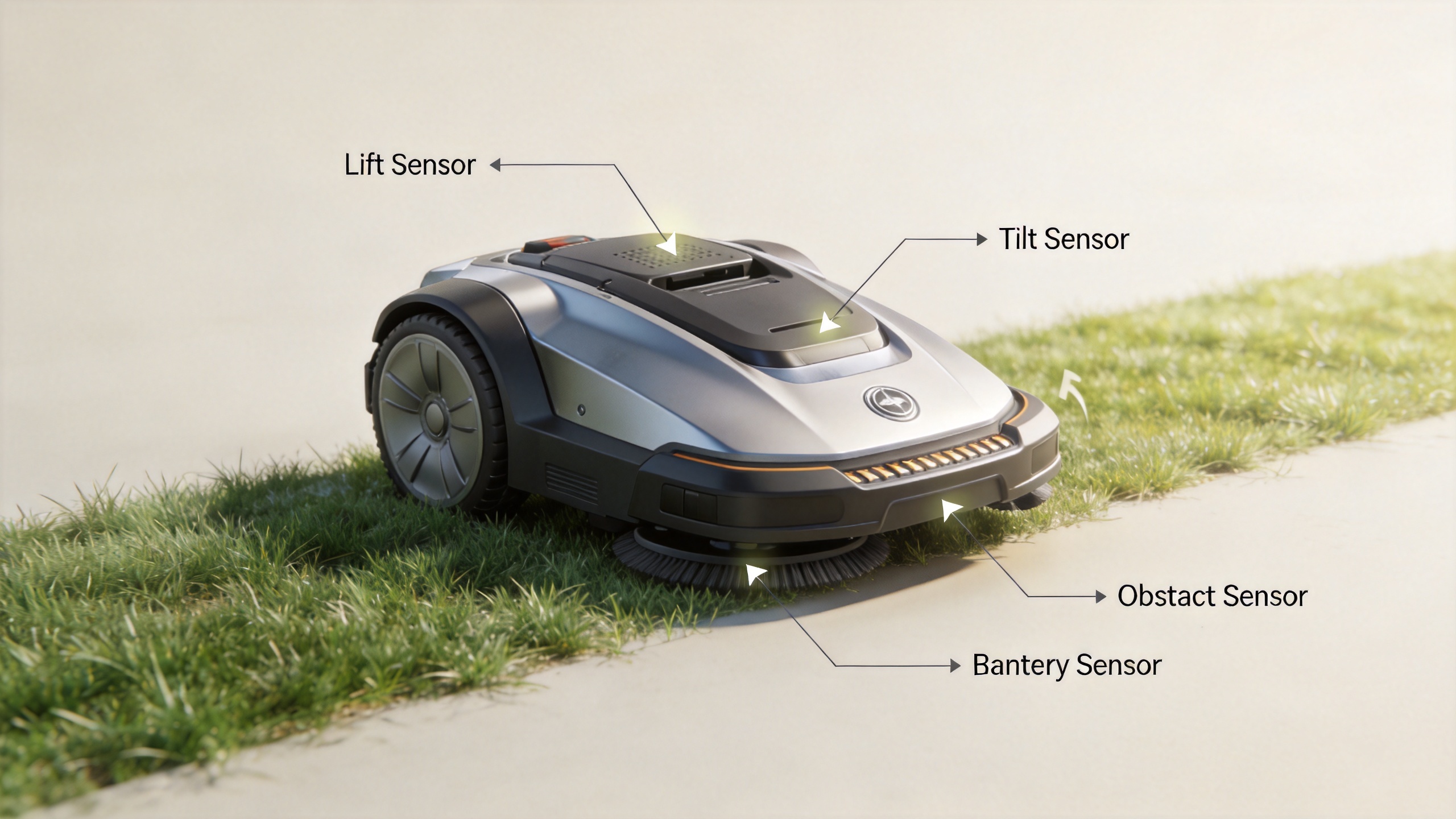
Lift sensors are among the most important protections on an automatic lawn mower. They monitor whether the machine has been raised from the ground. When the housing is lifted, the expected response is a rapid stop of the cutting blade. That response is intended to reduce exposure to a rotating blade if someone picks up the mower, a child interferes with it, or the machine rides unexpectedly onto an object.
When comparing models, ask how the mower detects lifting and whether the cutting system stops independently of the drive wheels. It is also worth checking the owner documentation for the required inspection routine. A lift sensor must not be defeated, taped over, or treated as a substitute for switching the mower off before handling it.
Tilt and rollover sensors
A lawn mower can become unstable on a steep slope, at a ditch edge, or when it crosses uneven ground. Tilt sensors monitor the machine’s angle. If the mower tilts beyond its permitted operating position, the system can stop the blade and halt or reverse movement. Some designs combine tilt detection with lift detection, but buyers should still confirm the stated slope limit and follow it.
Do not assume that a lawnmower automatic is appropriate for every incline just because it has a tilt sensor. The sensor is a protective response, not a license to operate outside the manufacturer’s slope guidance. Before installation, walk the area and identify drop-offs, retaining edges, drainage channels, loose stones, and soft ground that could make a mower tip or slide.
Collision and bumper sensors
Many automatic mower designs use a movable bumper or impact-sensitive shell. When the lawn mower touches a solid obstacle, the bumper signal tells the control system to stop, turn, or choose a new path. This is useful around tree trunks, fixed garden features, and other large, predictable objects.
Collision sensing has a practical limitation: it reacts at or after contact. It should not be treated as reliable protection for people, pets, toys, hoses, or fragile landscaping. Before a mowing cycle, clear the grass of objects that could be struck or thrown. Keep children and pets away from the work area, and schedule the lawn mower for periods when the lawn is known to be clear.
Obstacle-detection sensors
Higher-specification systems may add ultrasonic sensing, radar, LiDAR, cameras, or other vision-based detection. Their purpose is to identify an object before a lawn mower reaches it, allowing the mower to slow, stop, or steer around it. This can reduce unnecessary contact and improve route planning, especially in a lawn with furniture, beds, and regularly changing features.
These sensors should be evaluated in real site conditions. Low sunlight, glare, tall grass, wet lenses, mud, narrow obstacles, and objects close to the ground can all affect how a system performs. Ask a supplier which obstacles the system is designed to recognize and what the mower does when it cannot classify an object. Conservative behavior—slowing or stopping rather than forcing a route—is generally easier to manage safely.
Boundary and navigation sensing
An automatic lawn mower needs a reliable definition of where it may operate. In a wired installation, sensors detect the signal from a buried or surface boundary wire and cause the mower to turn before crossing the line. Wire-free designs can instead use satellite positioning, reference stations, cameras, or other navigation aids to define a virtual boundary.
Boundary sensing is safety-related because it helps keep the lawn mower away from driveways, public paths, ponds, flower beds, and other no-go zones. It requires careful setup. Test every edge at low speed, create buffers around water and drops, and revise the map after changes to the garden. A virtual boundary can be convenient, but it needs the same deliberate planning as a physical wire.
Rain, moisture, and weather responses
Some models include rain sensors that detect precipitation and interrupt a mowing cycle, often directing the lawn mower back to its charging station. This feature can help avoid poor mowing conditions and unnecessary operation on wet grass. It is useful, but it should not be interpreted as complete weather protection. Heavy rain, standing water, lightning risk, and saturated ground call for a manual decision not to run the machine.
For a lawnmower automatic, check whether rain sensitivity is adjustable, whether the mower has a delay before restarting, and whether the charging location remains dry and appropriately protected. Regularly wipe sensor surfaces and inspect seals according to the maintenance instructions.
Other useful protective functions
Depending on the model, the safety package may also include wheel-slip detection, blade-motor overload monitoring, docking sensors, PIN-code access, alarm functions, and stop controls. Wheel-slip sensing can help the mower recognize a loss of traction. Overload monitoring may stop the blade when grass, debris, or an obstruction overloads the cutting system. A visible stop button gives people nearby a direct way to interrupt operation.
Security functions are different from personal-safety sensors, but they still matter in an automatic lawn mower program. A PIN lock or alarm can discourage unauthorized use after the mower is removed from its assigned area. Confirm what happens after a restart, loss of positioning signal, or power interruption, rather than relying on a feature name alone.
A practical sensor checklist before you buy
- Confirm lift and tilt detection, and ask what stops first: the blade, drive system, or both.
- Ask whether obstacle avoidance is contact-based, pre-contact, or a combination of both.
- Map boundaries with extra clearance around water, slopes, paths, and public-access areas.
- Check the specified slope limit and the conditions that reduce traction.
- Review the rain response, restart delay, charging-station placement, and cleaning requirements.
- Use the stop control and power-off procedure before cleaning, moving, or inspecting the lawn mower.
- Ask about applicable testing or compliance documentation, such as the safety requirements associated with IEC 60335-2-107 for robotic battery-powered electrical lawnmowers.
The bottom line
The safest lawnmower automatic is not defined by the largest number of sensor labels. It is defined by a clear, well-maintained system of lift protection, tilt response, collision handling, obstacle detection, boundary control, and sensible operator practices. Compare the response behind each feature, set up the work zone carefully, and keep people, pets, and loose objects out of the mowing area. That combination gives a lawn mower a stronger chance to work productively while staying within a controlled safety plan.