
 EN
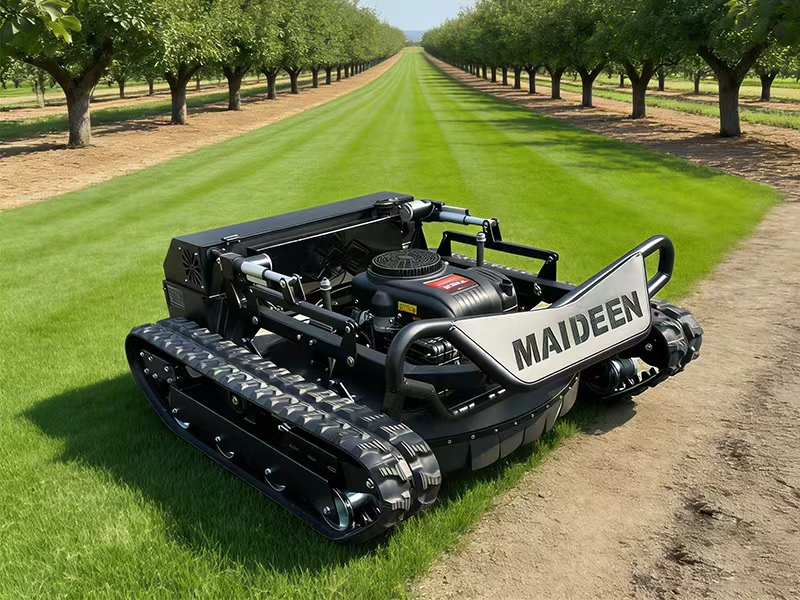
Precision, Safety, and Efficiency: How Remote Control Lawn Mowers Excel in Confined or Complex Yards
Reduced Physical Risk and Enhanced Obstacle Navigation on Slopes, Near Structures, or Around Play Areas
Remote control lawn mowers remove the operator from the immediate cutting zone—significantly lowering exposure to flying debris, blade contact, and slips on steep terrain. Operators maintain full control from a safe distance, making them especially valuable on slopes up to 45 degrees and in yards bordered by retaining walls, fences, or play equipment. Without the physical demand of walking behind the unit, fatigue drops and reaction time improves. Track or zero-turn designs enable tight pivots around trees, garden beds, and fixed features without repeated passes—while remote visibility lets operators adjust direction before the mower reaches a hazard. Modern safety systems stop the blades in under 0.2 seconds if the unit tilts or lifts, and dual-channel emergency stop buttons add redundant fail-safes. This combination reduces the risk of unintended movement into structures or over small objects like children’s toys. For confined or complex yards, remote operation delivers precision without requiring the operator to step onto unstable ground or navigate blind spots near raised landscape features.
Real-World Impact: Case Study — 37% Faster Mowing and Zero Incidents on a 0.25-Acre Irregular Residential Lot
A monitored trial on a 0.25-acre residential lot—with curved beds, a steep side slope, and a swing set—compared a standard walk-behind mower with a remote control model. The remote unit completed mowing in 31 minutes, down from 49 minutes—a 37% time saving. Its zero-turn capability eliminated repeated backing and repositioning around the play area, while its track system maintained traction on the damp slope after light rain, removing the need for manual assistance. The operator remained on level ground throughout, improving sightlines to boundaries and reducing physical strain. Over the trial period, there were zero slips, zero blade contact events, and zero damage to landscape fixtures. Adjustable deck height also handled transitions between sun-exposed and shaded turf without scalping. For small landscaping projects, this demonstrates how remote control mowers can accelerate work and reduce the physical hazards commonly associated with irregular terrain.
Multifunctional Versatility: Why 3-in-1 Remote Control Lawn Mowers Streamline Seasonal Landscaping Tasks
A 3-in-1 remote control lawn mower helps small landscaping operators adapt to seasonal changes without adding machines—or crew.
From Grass Cutting to Leaf Collection — Seamless Role Switching Without Equipment Changes
Traditional setups often require separate mowers, baggers, and leaf vacuums—adding cost, storage demands, and operational friction. A 3-in-1 remote control mower eliminates that complexity by switching between cutting, mulching, and collection modes via simple mechanical or electronic adjustments. In spring and summer, it cuts and mulches grass to feed the soil; in autumn, the same unit collects leaves and light debris—no second engine required. For small crews, this seamless transition reduces trips back to the truck, keeps the worksite uncluttered, and maintains safe standoff distances while navigating tight corners, slopes, or beds adjacent to structures. The result is fewer equipment changes, lower physical strain, and faster completion of routine maintenance—all from a single platform that adapts to seasonal needs.
Space and Time Savings: Eliminating Storage Clutter and Setup Downtime for Small-Scale Operators
Storing three separate lawn machines consumes valuable floor space many small-scale operators simply don’t have. A single 3-in-1 unit consolidates mowing, mulching, and collection into one compact footprint—freeing up van or shed capacity for hand tools, PPE, and consumables. Setup downtime also declines significantly: there’s no need to unload, fuel, and stage multiple engines at the start of each job. One remote platform can be positioned quickly, and mode changes take seconds—not minutes—and certainly not trailer swaps. When leaf season begins, the same mower shifts to collection mode without adding new equipment. This efficiency helps lean operations accept more jobs while controlling overhead. The time saved on daily setup often equals several billable hours per month—making the 3-in-1 remote control mower a practical investment for small commercial crews.
Cordless Power Meets Remote Operation: Battery Performance, Runtime Realities, and Operational Boundaries
Matching 12–22-Minute Battery Cycles to Typical Small-Yard Sessions — Optimizing Charge Cycles and Uptime
Most compact remote mower units deliver 12–22 minutes of active cutting per charge under moderate load. On a typical 0.25-acre lot, a full pass takes 18–25 minutes—so one battery may fall short in thick or damp grass. Smart scheduling mitigates downtime: run the mower in 10–12-minute zones, swap to a second pack, and recharge the first during the next cut. Lithium-ion batteries perform best between 50°F and 86°F; cold mornings can reduce usable runtime by up to 20% [Battery University, 2022]. These cells also thrive on partial discharge—recharge when remaining capacity hits 20–30%, rather than draining to zero. Higher amp-hour (Ah) packs extend runtime but add weight and cost; many small-yard models pair a 4–6 Ah battery with a rapid charger that reaches 80% in 40–60 minutes. For small commercial crews, two batteries per machine typically sustain continuous operation—one running while the other charges—keeping jobs within predictable time windows and avoiding workflow interruptions.
Balancing Autonomy and Accountability: When Remote Oversight Is Essential (e.g., Pets, Unfenced Zones, or Shared Spaces)
Remote operation does not eliminate operator responsibility. While the mower can cut from a perimeter position, active visual supervision remains essential near pets, children, unfenced property lines, and shared drives. Keep the unit within clear line of sight at all times and stay ready to trigger the emergency stop. If a pet enters the yard, pause the deck immediately—don’t attempt to steer around it remotely. Unfenced areas invite roaming animals and pedestrian shortcuts, so slow to walking speed as the mower approaches gaps or blind corners. In shared or unfenced zones, set conservative boundaries: avoid slopes beyond the manufacturer’s rated limit, point the discharge chute away from walkways, and reduce speed near obscured edges. Always verify local noise ordinances and safety regulations before operating in communal spaces. Many experienced operators also conduct a brief, low-speed obstacle-check pass before the main cut—taking just two to three minutes but preventing blade strikes and unintended contact. Remote mowers are most effective as supervised tools—not set-and-forget devices.
Frequently Asked Questions (FAQs)
1. Can remote control lawn mowers work on slopes?
Yes, many remote control lawn mowers are designed to operate effectively on slopes with inclines up to 45 degrees, thanks to their track or zero-turn designs and advanced traction systems.
2. How safe are remote control lawn mowers around children and pets?
Remote control lawn mowers come equipped with modern safety features such as dual-channel emergency stop buttons and blade-stop systems that activate in under 0.2 seconds. However, active visual supervision is essential when operating near children or pets to prevent incidents.
3. How long does a battery last in a remote control lawn mower?
Battery life typically ranges from 12 to 22 minutes under moderate load. Using two batteries and a rapid charger can help ensure continuous operation for longer tasks.
4. Can a remote control lawn mower handle different landscaping tasks?
Yes, a 3-in-1 remote control mower can switch between mowing, mulching, and leaf collection modes, eliminating the need for multiple pieces of equipment and increasing efficiency.
5. Are remote control lawn mowers suitable for small-scale commercial operations?
Yes, especially the 3-in-1 models that save on storage space and setup time. They are ideal for small landscaping crews handling multiple small to medium-sized projects.
6. Are there any weather or temperature-related considerations for these mowers?
Yes, lithium-ion batteries in remote control mowers perform best in temperatures between 50°F and 86°F. Cold temperatures can reduce runtime, while partial discharges are recommended for longer battery life.
Table of Contents
- Precision, Safety, and Efficiency: How Remote Control Lawn Mowers Excel in Confined or Complex Yards
- Multifunctional Versatility: Why 3-in-1 Remote Control Lawn Mowers Streamline Seasonal Landscaping Tasks
- Cordless Power Meets Remote Operation: Battery Performance, Runtime Realities, and Operational Boundaries
-
Frequently Asked Questions (FAQs)
- 1. Can remote control lawn mowers work on slopes?
- 2. How safe are remote control lawn mowers around children and pets?
- 3. How long does a battery last in a remote control lawn mower?
- 4. Can a remote control lawn mower handle different landscaping tasks?
- 5. Are remote control lawn mowers suitable for small-scale commercial operations?
- 6. Are there any weather or temperature-related considerations for these mowers?