EN
EN
Why Self Mowing Lawnmowers Reduce Operator Fatigue
On a long mowing shift, fatigue rarely comes from one dramatic task. It builds through walking, steering, holding a handle against vibration, watching uneven ground, turning at boundaries, and repeating the same motions. A lawn mower that takes over propulsion or cutting travel can reduce part of that load. A remote or self mowing lawnmower can change it more substantially by moving the operator from directly behind the machine to a supervised control position.
That does not make mowing automatic in the sense of “set it and forget it.” A responsible operator still plans the route, checks the work area, watches machine behavior, and stops work when conditions change. In day-to-day work, the value is straightforward: a well-matched machine can reduce unnecessary strain while leaving the important judgments with the operator.
Where conventional mowing creates fatigue
A walk-behind lawn mower asks the operator to provide more than guidance. Depending on the site and machine, the person may push or stabilize the unit, hold controls for long periods, compensate for bumps, and repeatedly turn at the end of each pass. Wet grass, dense growth, heat, dust, and slopes increase the effort. Even a self-propelled lawn mower still leaves the operator close to the noise, vibration, and changing surface.
Handle position matters too. Ergonomic research on mower controls has identified hand and upper-body posture as a concern during sustained operation. The point is not that every conventional mower is unsuitable; it is that task duration and terrain determine whether the repeated motions become a meaningful burden.
How a self mowing lawnmower changes the work
A practical way to assess fatigue reduction is to split the job into physical work and supervisory work. A self mowing lawnmower does not remove both. It can reduce the former and shift the operator toward the latter.
1. Less pushing, steering force, and walking
When the machine drives itself or follows remote commands, the operator no longer needs to continuously propel it across the site. That can reduce leg effort on long routes and reduce the shoulder and forearm effort associated with correcting direction. On broad, repeatable mowing areas, this difference can be noticeable over a full shift.
The benefit depends on the site. A small, flat lawn may not justify a more complex setup. A larger area with repeated passes, uneven ground, or dense vegetation is more likely to reveal the value of reducing physical guidance.
2. More distance from vibration, heat, dust, and pollen
Remote-control mowing is commonly positioned as a way for operators to remain outside the immediate mowing zone. That distance may reduce direct exposure to engine heat, airborne debris, dust, pollen, and continuous vibration. It can also make the work less physically draining in hot or high-growth conditions.
Distance is not a substitute for personal protective equipment or a site-specific safety plan. The operator still needs clear visibility, a safe standing location, and an agreed exclusion area. It is reduced exposure, not a removal of responsibility.
3. A safer posture on slopes and difficult ground
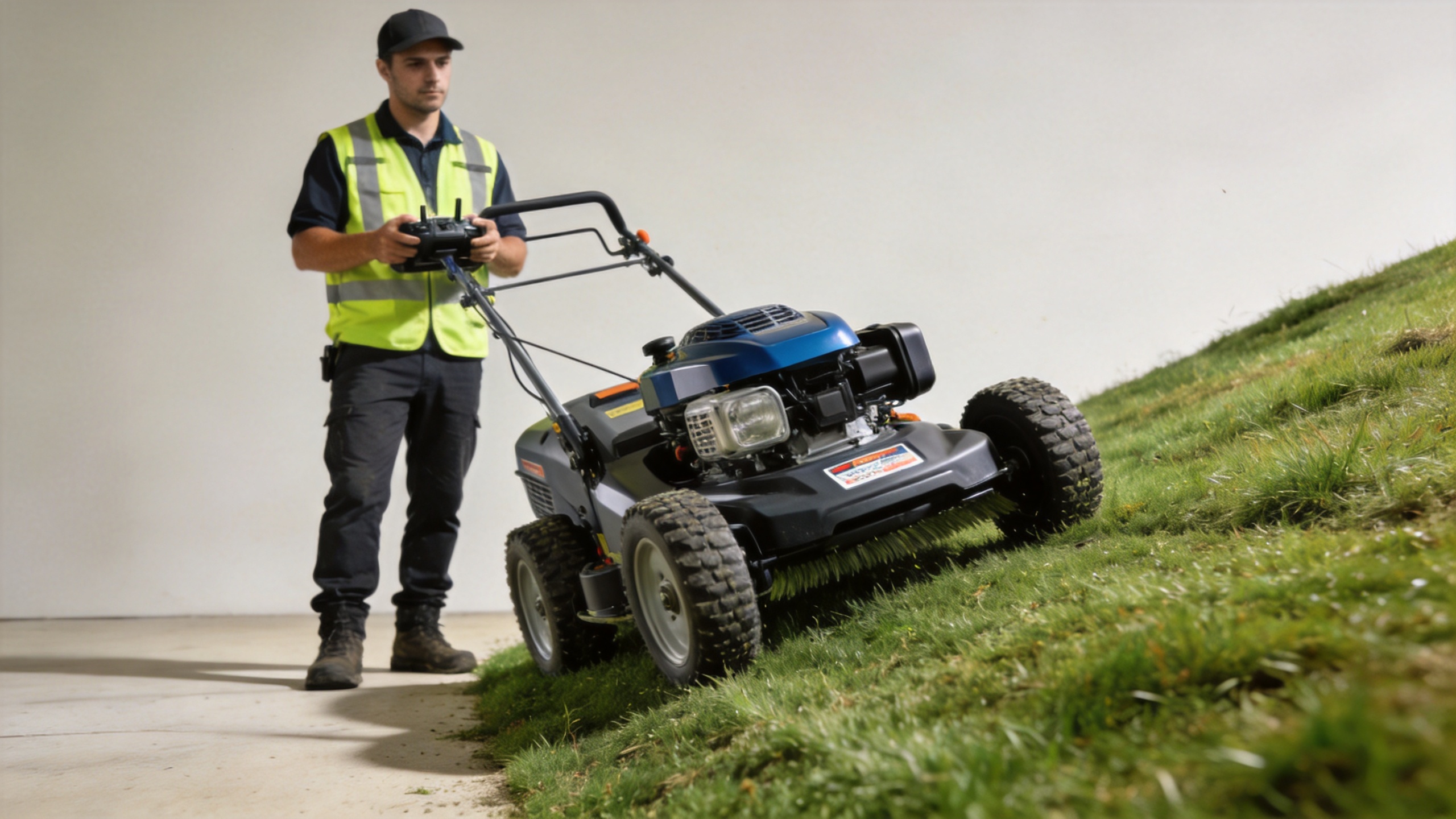
Slopes are where fatigue and safety overlap. Walking behind a lawn mower on an incline can force awkward footing and repeated body corrections. With a remotely controlled configuration, the operator may be able to choose firmer, safer ground while monitoring the machine from a distance. That can reduce the need to follow every pass physically.
Still, a remote lawn mower must be selected for the actual slope, ground cover, traction conditions, and operating instructions. “Remote” does not mean it will suit every bank, ditch edge, or wet surface. Inspect boundaries first, identify obstacles, and stop if traction or sight lines become uncertain.
Fatigue reduction is a workflow benefit, not just a machine feature
Buyers sometimes focus on a single specification, such as travel speed. In practice, fatigue reduction comes from the whole workflow: how the mower enters the work area, how it turns, whether the operator can maintain a useful viewing position, and how often debris or terrain changes interrupt the route.
- Before mowing: walk the site, remove visible obstacles, identify soft ground and restricted edges, and decide where the operator can stand safely.
- During mowing: use manageable passes, keep the machine within a clear line of sight, and pause for changes in grass density or ground condition.
- After mowing: inspect the cutting area, clear buildup according to the manufacturer’s guidance, and note where the route caused extra corrections.
This routine matters because a self mowing lawnmower is most useful when it reduces repeated effort without creating new uncertainty. A short post-job review often reveals whether the operating position, route, or cutting plan should change next time.
What to check before choosing a fatigue-reducing lawn mower
Instead of asking only whether a lawn mower is self-propelled or remote-controlled, ask how it fits the job. Use the following checklist during evaluation:
- Terrain: What are the actual slope angles, surface changes, ditches, and boundary edges?
- Vegetation: Is the work mainly maintained turf, tall grass, brushy growth, or a mix?
- Shift length: How long will an operator mow continuously before a break or a machine check?
- Visibility: Can the operator maintain a reliable view of the mowing path from a safe position?
- Control method: Does the control layout allow precise correction without constant strain or overreaction?
- Maintenance plan: Who will perform cleaning, blade checks, and routine inspection, and when?
For professional teams, a demonstration on representative terrain is more informative than a smooth, short test run. Bring the conditions that create fatigue in real work: the usual grass height, the awkward boundary, and the section where footing changes. A smooth demonstration helps, but it does not prove that every site will be equally manageable.
Use technology to preserve attention, not replace it
The strongest case for a self mowing lawnmower is not that it allows an operator to disengage. It is that it can preserve energy for decisions that machines cannot reliably make alone: recognizing a hidden obstacle, responding to changing weather, checking a slope edge, or deciding that the route should stop.
Shandong Maide En Intelligent Technology Co., Ltd. works in remote-control lawnmowers and agricultural machinery for global markets. For buyers evaluating a remote mowing workflow, the useful conversation starts with the site: terrain, vegetation, working hours, operator position, and maintenance capability. That is how a lawn mower becomes a practical fatigue-management tool rather than simply another feature list.
Conclusion
A self mowing lawnmower can reduce operator fatigue by lowering the amount of pushing, walking, sustained handle control, and direct exposure required during a mowing shift. The result depends on matching the lawn mower to real terrain and using a disciplined operating routine. When the machine handles more of the repetitive travel and the operator keeps control of planning and oversight, mowing can become less physically demanding while remaining deliberate and safe.