EN
EN
Why Grass cutting machine for home garden Easy For Ordinary Users
A grass cutter can make routine lawn care feel less demanding, but “easy” should mean more than a simple start button. For an ordinary home-garden user, the right grass cutter matches the size of the lawn, the kind of growth present, and the amount of walking, lifting, turning, and maintenance the user can comfortably manage. A small, regular lawn usually calls for a different grass cutter than a rough area with tall weeds, hidden roots, or uneven ground.
From an operator-focused point of view, the useful question is not “Which grass cutter has the most features?” It is “Which grass cutter makes this specific cutting job clear, controlled, and repeatable?” That shift helps a buyer avoid paying for a machine that is too large, too heavy, or simply wrong for the work.
Why a grass cutter can be easier than manual cutting
Hand tools can be practical for a tiny edge or a single patch, but they ask the user to supply nearly all of the force and repetition. A suitable grass cutter transfers much of that repeated cutting work to the machine. On a manageable home lawn, this can reduce the effort of trimming a broad area and produce a more consistent result than working one small section at a time.
That does not mean every grass cutter is automatically easy. A heavy machine can be tiring to steer. A cutting system designed for thick brush can be unnecessary for short turf. In other words, a grass cutter becomes simpler to use when its working range fits the garden rather than when its specification sheet looks impressive.
Start with the lawn, not the machine
Before choosing a grass cutter, walk the garden and divide the task into ordinary lawn, edges, narrow passages, and any overgrown patches. A compact, relatively flat lawn with open turning space is usually the easiest setting for a lawn-oriented grass cutter. Tight corners may need a separate trimming approach. Dense stems, stones, tree roots, drainage channels, or steep slopes deserve extra caution rather than a stronger machine by default.
It is easy to assume that lawn area decides everything. More accurately, slope, obstacles, grass height, and how often the lawn is cut can change the right grass cutter just as much. If the garden has not been maintained for a long time, reduce the first pass into smaller sections instead of expecting one pass to solve every condition.
What makes a grass cutting machine for home garden manageable?
A grass cutting machine for home garden feels manageable when the user can understand its controls, move it without strain, and stop it promptly when conditions change. Look for a grass cutter with a control layout that is easy to reach, an operating method explained clearly in its manual, and a size that suits the available storage and access route.
- Comfortable movement: Check whether the grass cutter can turn around trees, beds, and paths without awkward lifting.
- Clear controls: The operator should know how to start, stop, and disengage the cutting action before entering the lawn.
- Realistic cutting task: Choose a grass cutter for lawn grass if lawn grass is the job; do not treat a brush-clearing tool as a universal answer.
- Simple upkeep: Ask how the grass cutter should be cleaned, inspected, stored, and serviced after normal use.
With a grass cutting machine for home garden, a suitable choice is often the one that keeps routine tasks uncomplicated. It is better to have a grass cutter that the household can prepare and maintain correctly than a more aggressive option that is rarely used because it feels difficult.
Easy use still depends on a safe routine
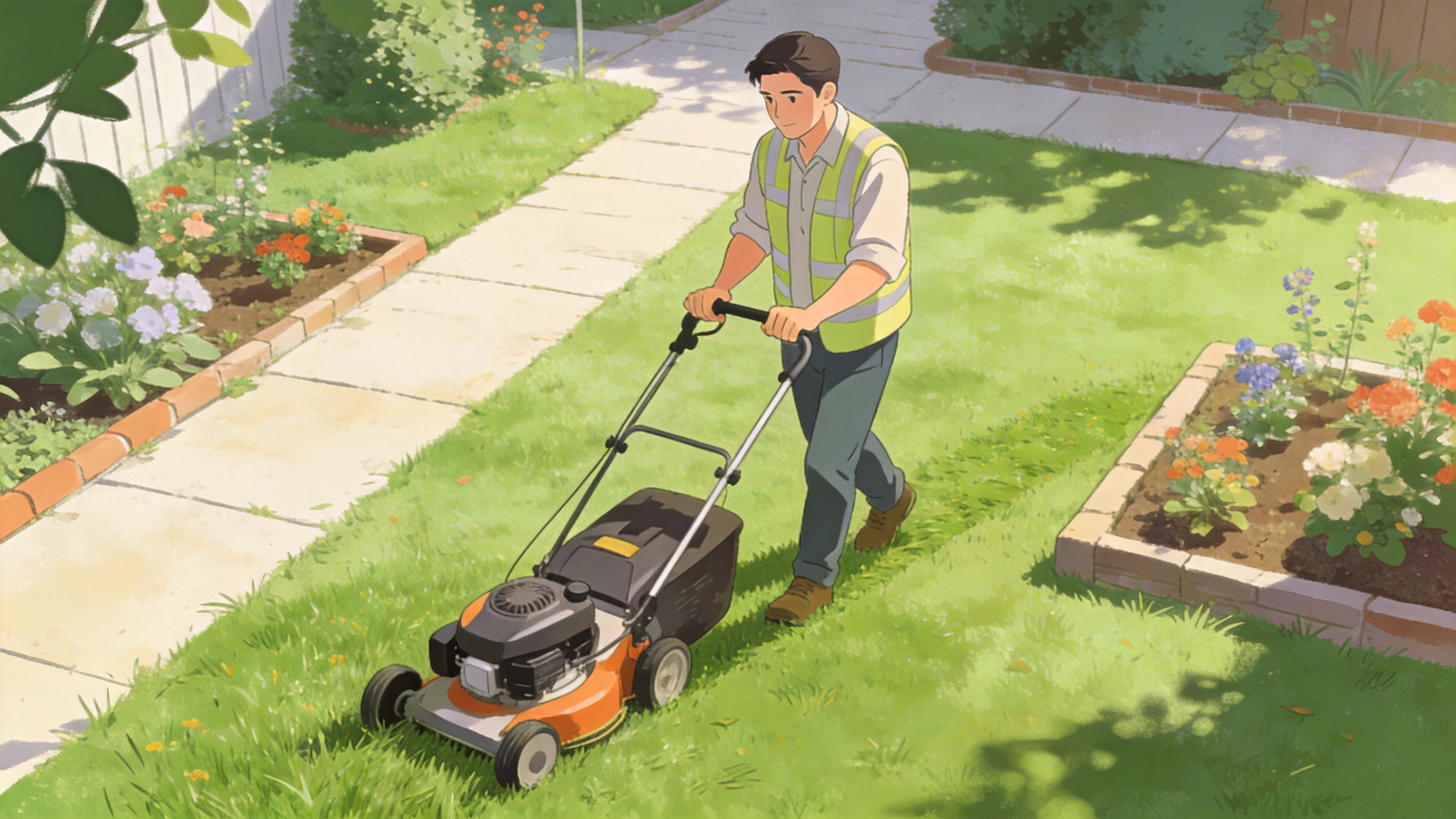
Convenience is not the same as no risk. Before using a grass cutter, inspect the work area for stones, branches, toys, wire, holes, and drop-offs. Consumer and landscape safety guidance consistently emphasizes clearing debris and bystanders before mowing because loose objects can be thrown by cutting equipment. Keep children, pets, and other people away from the active area, and follow the machine’s applicable operating instructions.
Wear the protective equipment specified for the grass cutter and avoid rushing through wet, unstable, or poorly lit conditions. If the lawn has a slope, uncertain footing, or an obstacle that makes the route hard to see, pause and reassess. The grass cutter may be suitable for the garden, but the immediate site condition may not be suitable for that session.
A practical first-use checklist
- Read the grass cutter manual and identify the start, stop, and safety controls.
- Clear the lawn and mark hazards that the grass cutter should not approach.
- Check the visible condition of the grass cutter, including guards, fasteners, and the cutting area, as directed by its manual.
- Begin with a small, open section so the user can learn the grass cutter’s movement and turning behavior.
- Stop the grass cutter before inspecting a blockage or adjusting anything near the cutting area.
- After use, remove grass and debris only by the approved method, then store the grass cutter according to the manufacturer’s guidance.
Maintenance is part of keeping a grass cutter easy
A grass cutter tends to stay easier to use when routine care is planned rather than postponed. After each session, note anything unusual: vibration, loose parts, damaged guards, an awkward handle position, or buildup around the cutting area. Do not assume a problem will disappear on the next use. Use the product documentation for cleaning, blade or line service, fuel or battery handling, and storage requirements.
For ordinary users, this is an important decision point. A grass cutter with a maintenance process the household can follow is usually a better long-term fit than one that requires unexplained procedures. When comparing options, ask the supplier for the current operating manual, maintenance schedule, compatible consumables, and the support route for parts or service.
Choose ease through fit, not hype
The right grass cutter can make a home-garden routine more approachable by replacing repetitive manual cutting with a structured process: inspect the lawn, prepare the machine, cut within its intended conditions, and clean it afterward. A grass cutting machine for home garden is easiest for ordinary users when it fits the lawn’s terrain, the expected cutting frequency, and the operator’s confidence—not when it promises the most.
Before buying, make a short list of lawn size, grass condition, slopes, obstacles, storage space, and the people who will use the grass cutter. That simple list gives a supplier the information needed to discuss suitable configurations without guessing. Most importantly, keep safety and the approved instructions ahead of speed. That is how a grass cutter remains a helpful garden tool instead of becoming a difficult chore.