EN
EN
What Standards Help Users Select Best lawnmower robot
Choosing a robot lawnmower is less about finding the longest feature list and more about proving that a machine suits the site, the people around it, and the buyer’s operating plan. As a practical selection exercise, begin with the ground rather than the brochure. A robot lawnmower suitable for a neat, open residential lawn may be the wrong choice for a sloped orchard edge, a landscaped commercial property, or a site with frequent public access.
This guide turns the decision into a standards-led checklist. It does not rank brands or make model-specific certification claims. Instead, it helps users compare a robot lawnmower against documented safety expectations, real terrain conditions, navigation limits, and support needs before purchase.
Start with the operating boundary, not the advertised coverage
A coverage figure is only useful when its conditions resemble your property. Walk the proposed mowing area and record usable turf, narrow passages, tree roots, drainage channels, exposed edging, gates, and places where the surface changes. Include the route from the charging point to each work zone. A robot lawnmower that can theoretically cover the total area may still lose productive time if it must repeatedly negotiate bottlenecks or return across difficult ground.
Measure the steepest sustained slope rather than judging the whole lawn by eye. Also note wet areas and loose soil. Slope capability should be treated as a site-and-traction question, not a marketing badge: the relevant comparison is the manufacturer’s documented operating limit versus the steepest route the mower must repeatedly travel. Keep a margin for changing grass, moisture, and surface condition.
Use safety standards as a documentation check
For buyers in markets where they apply, robotic-mower safety standards provide a useful framework for questions to ask a supplier. Search evidence for EN 50636-2-107 describes requirements addressing significant hazards associated with battery-powered robotic lawnmowers and their peripherals. UL Solutions also identifies IEC 60335-2-107 as a basis for robotic lawn mower safety testing and certification services. These references do not automatically prove that every robot lawnmower is compliant in every destination market; applicable regulations, product configuration, and supporting documents still need to be checked.
Ask for the exact model designation, the target-market declaration or test documentation where appropriate, the manual, and the instructions that describe boundary setup, emergency stopping, blade handling, charging, and maintenance. A reliable supplier should be able to clarify which documents apply to the offered configuration instead of making broad, unverified claims.
A buyer’s safety-document checklist
- Confirm the exact robot lawnmower model and any accessories included in the quotation.
- Ask which applicable safety standard or test basis is referenced for the target market.
- Review instructions for stop controls, lift or tilt response, blade servicing, charging, and storage.
- Check how the boundary system, virtual map, or designated work zones prevent entry into unsuitable areas.
- Plan exclusion zones for water, drops, loose material, children’s play areas, and any route with unpredictable traffic.
Match navigation to the property’s complexity
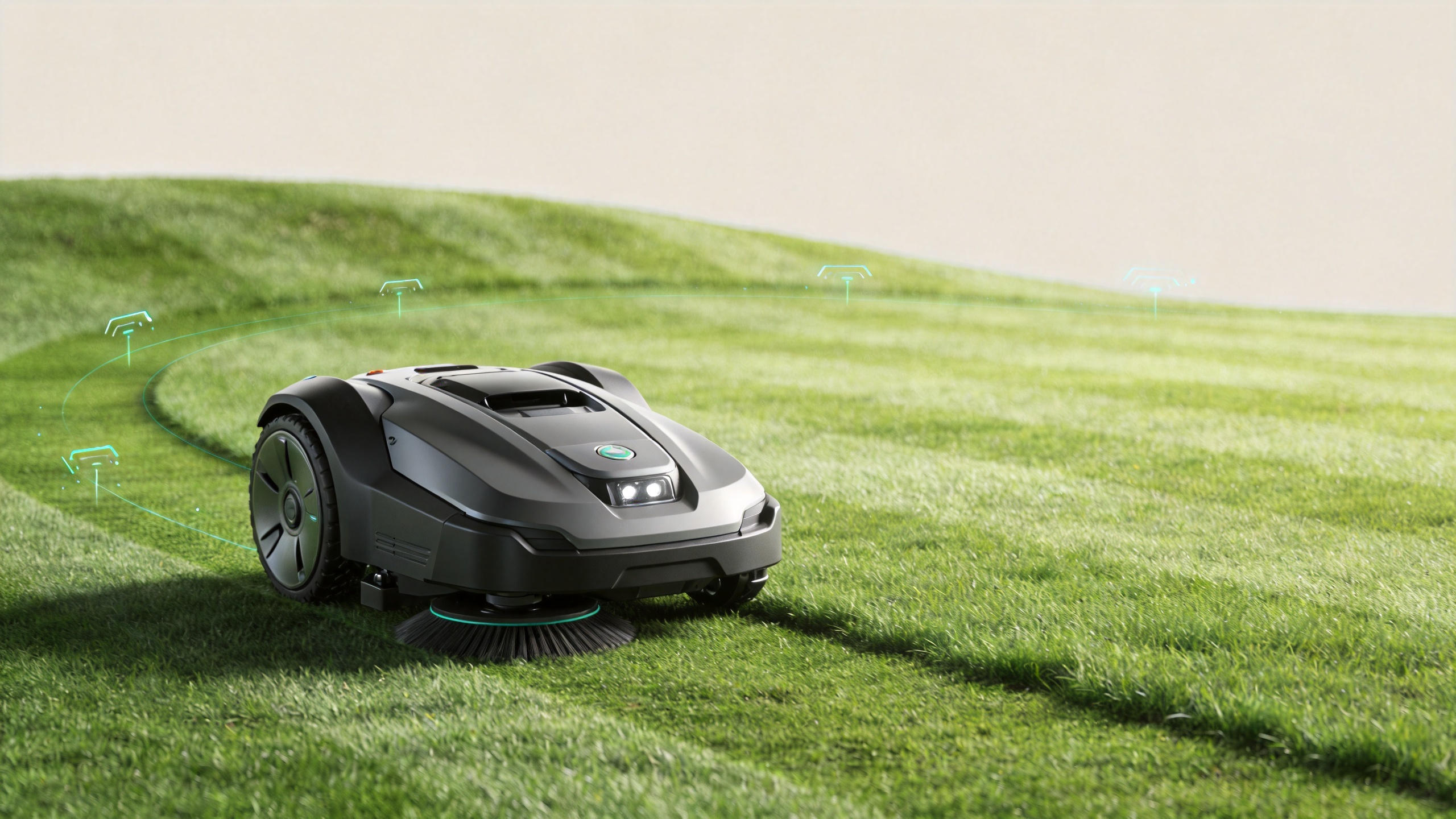
Navigation should be evaluated as a workflow, not as a single technology label. Whether a robot lawnmower uses a physical boundary, satellite assistance, camera-based perception, or another system, the buyer needs to know how the robot lawnmower behaves under trees, along walls, near reflective surfaces, and when the map needs adjustment. The relevant question is simple: can the system repeatedly keep the mower inside safe, mowable turf under normal site conditions?
Create a short acceptance route before ordering. It should include a normal open section, the tightest passage, a representative slope, and an obstacle-rich area. Ask the supplier to explain how the selected robot lawnmower is set up for that route and what the operator must do if it loses position, meets an obstruction, or cannot complete the return trip. This is more useful than assuming that an app connection alone resolves navigation risk.
Compare cutting work with grass-management needs
A robot lawnmower is generally intended for regular maintenance cutting, not for rescuing heavily overgrown grass in one pass. When comparing a robot lawnmower with conventional mowing, clarify which tasks remain outside its routine work. That difference matters when defining a work schedule. Consider grass type, expected growth rate, desired appearance, debris exposure, and the time windows in which mowing is acceptable. If the site has seasonal growth peaks, decide whether the robot lawnmower will handle the routine work while another process covers occasional recovery cutting.
Review the stated cutting-height adjustment, cutting-width information, blade replacement process, and cleaning instructions in the official documentation. Avoid assuming cut quality from photos alone. A suitable robot lawnmower has a maintenance routine and operating schedule that match the property’s grass conditions and the staff time available to supervise it.
Assess charging, weather, and daily supervision
Place the charging station where the approach route is stable, accessible for inspection, and protected from avoidable interference. Confirm the electrical arrangement with a qualified local professional when needed, and follow the manufacturer’s instructions for weather exposure and seasonal storage. The robot lawnmower should have a clear daily operating routine: visual walk-around, inspection of blades and wheels, boundary or map review, and a response plan for alerts. Every robot lawnmower operator should also know the manual stop and recovery procedure.
It is tempting to view autonomy as zero supervision. A more realistic standard is managed autonomy. The operator still decides when the lawn is safe to mow, when conditions require a pause, and when a damaged blade, blocked wheel, or altered boundary needs attention.
Evaluate serviceability before comparing optional features
For a business buyer, downtime and parts access can outweigh a marginal feature difference. Before selecting a robot lawnmower, ask about the spare-parts path, expected consumables, service contact, software-update method, warranty scope, and lead times for replacement components. Request a written list of what routine maintenance the owner may perform and what requires trained service.
Shandong Maide En Intelligent Technology presents remote-control lawnmowers and related agricultural machinery for international markets. For any sourcing discussion, use the same evidence-first approach: define site conditions, confirm the exact configuration, and request documentation that can be checked against the target market’s requirements. Do not treat a general company description as proof of a specific model’s capabilities or certifications.
A simple decision scorecard for a robot lawnmower
| Selection area | What to verify | Decision signal |
|---|---|---|
| Site fit | Area, slope, passages, surface, obstacles | The documented operating limits leave a practical margin. |
| Safety evidence | Model-specific documents, operating instructions, applicable testing basis | The supplier identifies documents and target-market scope clearly. |
| Navigation | Boundary or mapping behavior on the real site | A planned acceptance route can be explained and tested. |
| Cutting workflow | Grass condition, schedule, blade maintenance | Routine mowing aligns with the property’s maintenance plan. |
| Ownership support | Parts, service, updates, warranty | The buyer understands who handles routine and corrective work. |
Final selection standard: evidence, fit, and a testable plan
A well-chosen robot lawnmower is not defined by one headline specification. Select a robot lawnmower when its documented safety information is appropriate for the target market, its operating limits fit the actual property with margin, and its navigation and support plan can be tested before full deployment. Put those requirements in the purchase discussion early. That approach reduces surprises after installation and gives users a defensible basis for choosing the right machine.