EN
What Is the Limitation of Wheel Lawn Mower on Sloped Land?
A wheel lawn mower can work well on a smooth, modest incline, but sloped land changes the job quickly. A lawn mower that feels stable on level turf may lose traction, drift sideways, or become difficult to turn when its wheels meet wet grass, loose soil, ruts, stones, or a sharp change in grade. The key limitation is not simply engine power. It is whether the lawn mower, the ground, and the operator’s planned route remain within the equipment maker’s approved conditions.
From an operator’s perspective, slope mowing deserves a different decision process. Before choosing or using a lawn mower, assess the grade, grass condition, surface firmness, obstacles, turning space, and safe escape route. This approach is more useful than assuming that a larger or more powerful lawn mower will automatically be better on a hill.
Why Wheels Become the Weak Point on a Slope
On level ground, a wheel lawn mower distributes its weight relatively evenly and the tires mainly need enough grip to move forward. On a slope, gravity shifts load toward the downhill side. That shift can reduce contact and grip at one or more wheels, especially during a turn, a stop, or a transition between dry and damp turf. A wheel lawn mower may then slide before the operator has time to correct the route.
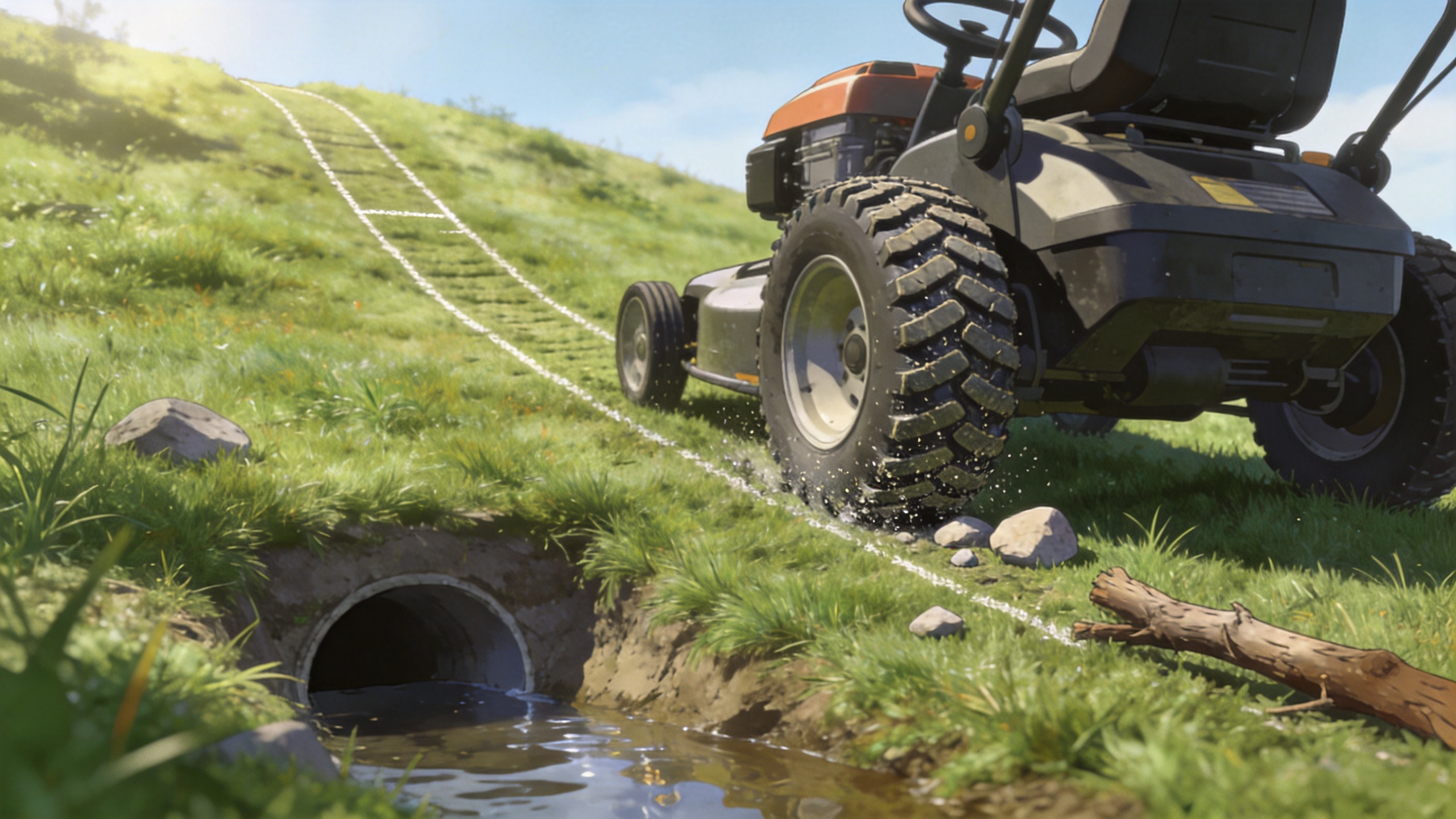
Traction is also conditional. Short, dry grass on firm soil behaves differently from long grass over damp clay or a surface scattered with leaves. The same lawn mower can feel predictable in one part of a site and unstable a few metres away. Ruts, buried stones, drainage channels, and wheel spin can all upset the path. For this reason, the manufacturer’s slope rating and operating instructions should control the decision; no generic angle is a substitute for the manual.
Common Limitations of a Wheel Lawn Mower on Sloped Land
1. Reduced traction on wet or loose ground
Wet grass and unstable soil reduce the grip available to a lawn mower. When a drive wheel spins, the machine may stop climbing, slide downhill, or pull to one side. Adding speed rarely fixes the problem and can make a loss of control harder to manage. If the ground is wet, soft, frozen, or covered with loose debris, postponing the task is often the safer decision.
2. Side-slope instability
Travelling across a slope is often more demanding than it appears because the lawn mower’s weight stays biased downhill. A sideways slide can move the machine toward a fence, ditch, tree, road, or other hazard. Wide wheels do not remove this limitation: the center of gravity, tire condition, ground cover, and the mower’s approved operating angle all still matter.
3. Turning and stopping become less predictable
A turn changes how weight transfers through a lawn mower. Tight turns, sudden braking, and reversing can reduce stability or cause a wheel to lose grip. Do not rely on a quick correction after a wheel begins to slide. Plan the route so turns occur on the flattest available ground, and keep clear of boundaries where there is no recovery space.
4. Uneven terrain magnifies wheel limitations
A hill is rarely one smooth plane. Humps, holes, exposed roots, curbs, and changes in grass density can make one wheel rise or drop unexpectedly. That can alter cutting height and machine balance at the same time. A lawn mower that suits an open, even lawn may be a poor fit for an irregular embankment or a site with drainage features.
5. Operator visibility and route control are restricted
On sloped land, the operator must monitor the mower’s path, wheel placement, obstacles, and people nearby. Blind spots increase near trees, terraces, retaining edges, and tall grass. A lawn mower should not be treated as a hands-off solution simply because it has powered drive or remote-control features. Site supervision, exclusion zones, and a clear route remain necessary.
Do Not Treat a Number as a Universal Slope Limit
Some safety guidance discusses thresholds around 15 degrees for typical riding mowers, while other workplace practices separate moderate grades from much steeper terrain. Those examples are useful reminders, not a universal specification for every lawn mower. Machine design, tire type, mower configuration, operating direction, ground condition, and local rules can change the acceptable limit. Check the exact product documentation and follow site safety requirements before work begins.
In practical terms, the question is not “Can this lawn mower reach the top?” It is “Can this lawn mower complete the route, turn, stop, and leave the area without exceeding its documented operating limits?” If any part of that answer is uncertain, reassess the work method.
A Pre-Work Check for Wheel Lawn Mower Use
- Confirm the grade: Measure or verify the slope instead of estimating it by eye, then compare it with the manufacturer’s guidance.
- Inspect the surface: Look for moisture, loose soil, holes, roots, stones, fallen branches, and abrupt changes in grade.
- Review tire condition: Check inflation, wear, damage, and buildup that could reduce grip. Do not assume a tread pattern solves every condition.
- Plan the route: Identify where the lawn mower will start, turn, stop, and exit. Keep turns away from drop-offs, ditches, trees, and public areas.
- Set the work boundary: Keep people, pets, and vehicles outside the cutting area, and stop if visibility or surface conditions change.
- Know when to change equipment: A specialized slope-capable solution or a different work method may be more appropriate when the site is beyond the wheel lawn mower’s documented range.
How to Choose a Better Approach for Hilly Ground
Start with the job rather than a feature list. For a lightly sloped, well-drained lawn, a wheel lawn mower may be suitable when the manual permits it and the operator can maintain a controlled route. For a steep, uneven, wet, or obstacle-heavy site, selection should prioritize verified slope capability, stability, safe operating procedures, and a realistic plan for the whole task.
It is helpful to divide the property into zones. The lawn mower may be appropriate for flat or moderate sections, while edges, drainage swales, and steep banks require another method. This is not a sign that the lawn mower is inadequate; it is a recognition that terrain changes the risk and the equipment requirement.
Questions to Ask Before Ordering or Deploying a Lawn Mower
- What is the maximum slope permitted by the exact lawn mower manual?
- What ground, moisture, and grass conditions does that guidance assume?
- How will the machine turn, stop, and exit at the top and bottom of the slope?
- Are there ditches, fences, trees, terraces, or public paths within the likely slide path?
- What training, inspection, and maintenance checks are required for the intended work?
For organizations evaluating mowing equipment, Shandong Maide En Intelligent Technology can discuss site conditions and configuration requirements for lawn and agricultural machinery. Any capability, configuration, and slope suitability should be confirmed against the final product documentation and the actual site assessment.
Conclusion
The main limitation of a wheel lawn mower on sloped land is that traction and stability can change faster than the operator expects. Wet grass, loose soil, uneven ground, turns, and limited recovery space all narrow the margin for safe work. Use the lawn mower only within its documented conditions, inspect the terrain before each job, and choose a different method when the slope or surface creates uncertainty. A careful site check is the practical first step toward safer, more reliable mowing.