EN
EN
Why Tracked Robot Mowers Keep Stable on Sloped Orchard Ground
For orchard managers, a robot lawnmower is not judged by how neatly it cuts a flat demonstration lawn. It is judged by whether it can follow a safe, repeatable path between trees when the ground changes from dry grass to loose soil, wet leaves, shallow ruts, and side slopes. A tracked robot mower can be a useful option in that setting because its running gear changes how force is spread across the ground. Still, tracks are not a blanket approval for every hill. Stability depends on the machine, the surface, the route, and the operating limits verified for that specific model.
This distinction matters in orchards. Tree rows can create narrow turn zones, roots can lift turf, irrigation can soften one side of a lane, and a drainage ditch may sit only a few metres from the mowing path. The practical question is not simply whether a robot lawnmower has tracks. It is whether the complete machine-and-site combination stays within a documented, manageable safety boundary.
Why tracks change the stability conversation
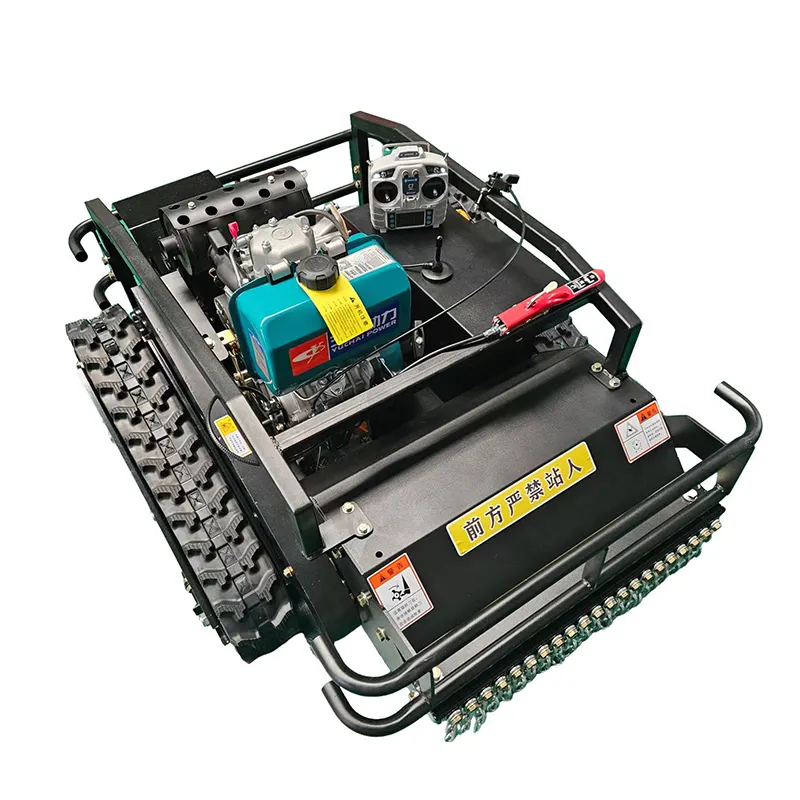
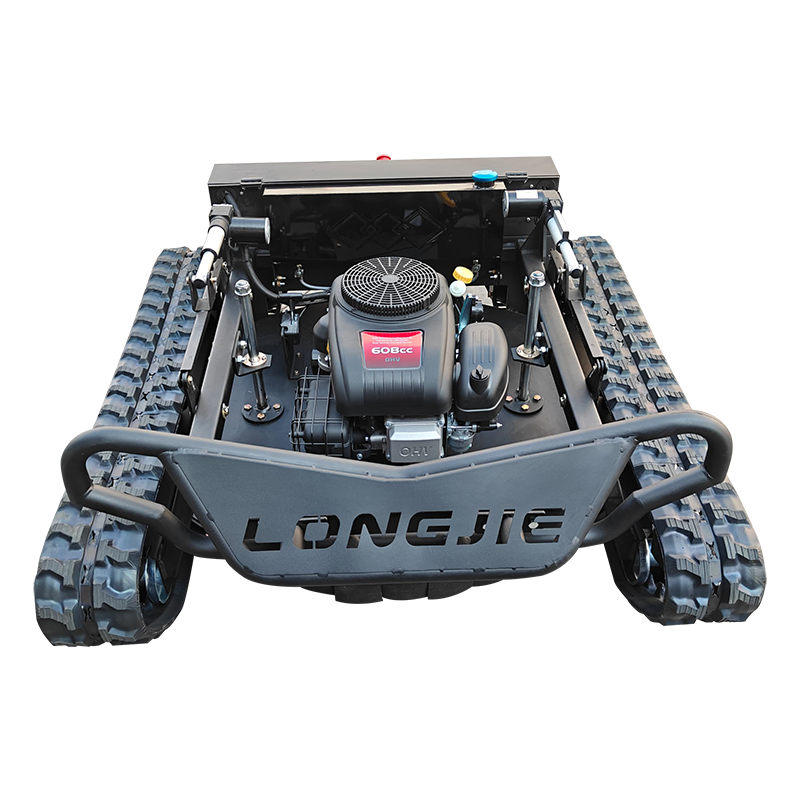
A tracked robot mower typically puts a longer, wider contact patch on the soil than a wheel arrangement of comparable size. More contact area can distribute ground pressure over a larger footprint and give the machine more opportunities to find grip on uneven turf. On an orchard lane, that can help when one section of ground is firmer than the other or when the mower crosses small surface irregularities.
Traction is only one part of the picture. Stability also concerns how the robot lawnmower resists sliding, yawing, pitching, or lifting a track while it is moving. A low, well-managed centre of mass, an appropriate track width, balanced payload, and smooth power delivery all influence that behaviour. If a mower abruptly accelerates, turns sharply across a slope, or carries debris that shifts its balance, the available grip can be used up quickly. In other words, tracks can improve the margin for control; they do not cancel gravity.
Four forces a tracked robot mower must manage
1. Downhill pull
Gravity pulls the machine toward the bottom of the slope. As the grade increases, that pull becomes more important relative to the traction available at the tracks. The right operating grade is therefore a model-specific question. Confirm the manufacturer’s rated slope limit for the actual configuration, rather than relying on a generic claim about tracked machines.
2. Side-slope loading
Travelling across a slope can be more demanding than travelling straight up or down because the machine’s weight shifts toward the downhill track. The outer edge of a track may cross softer soil or a root mound while the uphill track has better support. Route planning should keep turns gradual, avoid abrupt cross-slope manoeuvres, and leave room away from drop-offs, ditches, and tree bases.
3. Surface shear
Dry, dense turf, loose dust, wet grass, leaf litter, mud, and compacted wheel ruts do not provide the same resistance to sliding. A tracked robot mower may maintain contact where a wheeled unit spins, but it can still lose lateral hold if the soil layer shears. Inspect the route after irrigation, rainfall, or harvesting activity; an acceptable lane in the morning may be a poor choice later in the day.
4. Dynamic movement
Starting, stopping, climbing over roots, and steering each transfer load through the chassis. Smooth commands usually preserve a more predictable contact patch than repeated sharp corrections. This is one reason a robot lawnmower route should be tested slowly first. Observe how it enters turns, how it responds at row ends, and whether the tracks remain evenly supported rather than assuming a successful straight pass proves the whole route.
Why orchard ground creates special stability challenges
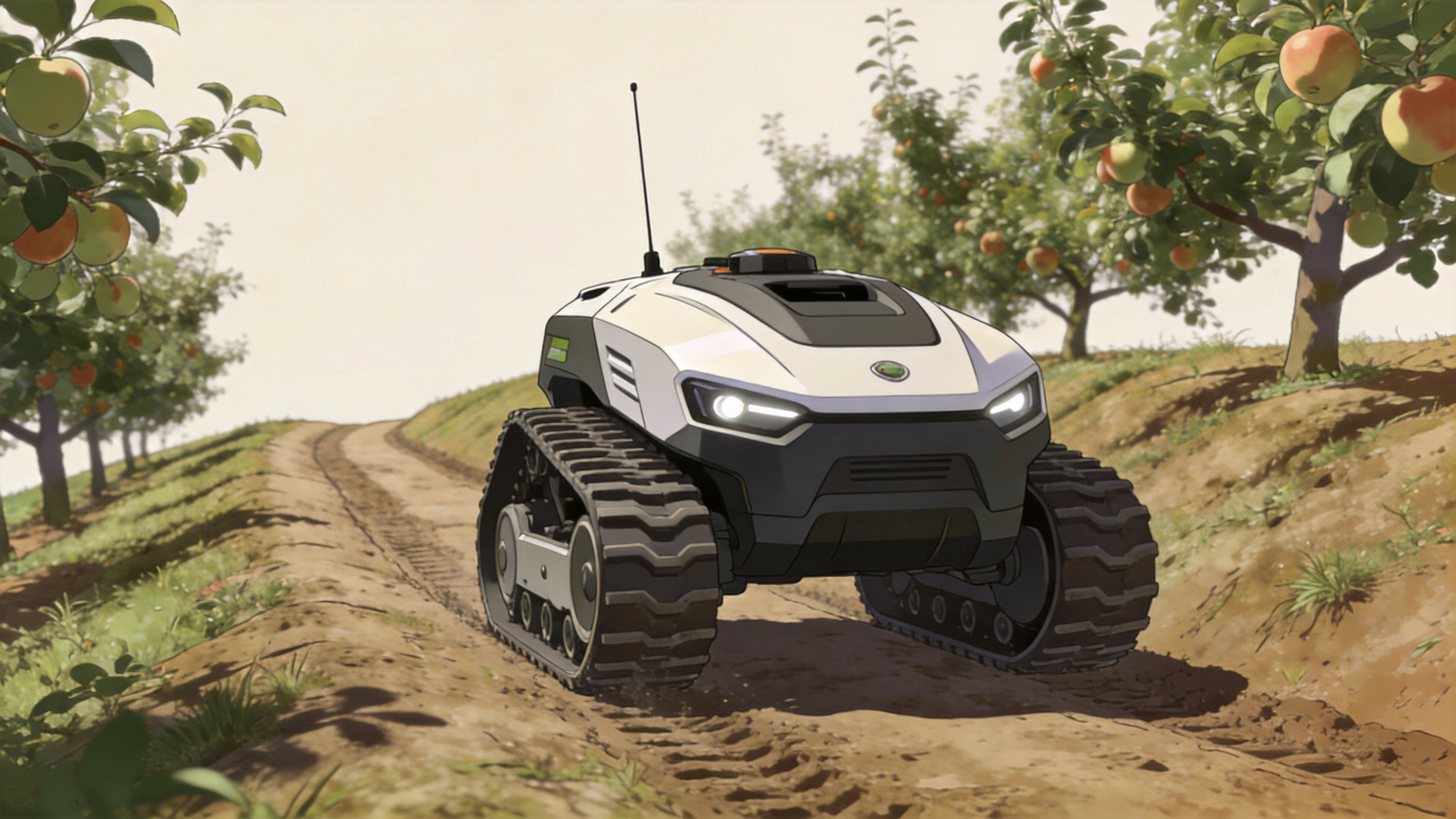
Orchard terrain is rarely a uniform hillside. Mowing routes can include crown-shaped lanes, compacted tractor passes, shallow drainage channels, exposed roots, fallen fruit, low branches, and changing vegetation. These features affect both traction and clearance. The most capable-looking robot lawnmower can be poorly matched if its intended route forces it to work next to an unprotected edge or repeatedly climb a sharp break in grade.
That is why site assessment should come before feature comparison. First list the non-negotiables: maximum verified slope, lane width, turning room, ditch and embankment locations, ground softness, obstruction frequency, and the distance needed to keep people clear. Then compare the optional convenience features. This order prevents a common buying mistake: treating track design as proof that every slope is suitable.
A practical pre-operation check for a robot lawnmower
- Measure the relevant grades. Check the steepest working section, not only the average orchard slope. Record cross-slope sections separately from climbing sections.
- Verify the machine documentation. Confirm the rated slope, permitted operating orientation, recommended ground conditions, maintenance requirements, and any restrictions for wet surfaces.
- Walk the route. Identify roots, holes, loose stones, irrigation hardware, wire, sudden drop-offs, and places where a track could climb an edge unexpectedly.
- Set conservative boundaries. Mark exclusion zones around ditches, retaining edges, public paths, and tree-row obstructions. Do not use a robot lawnmower where a loss of control would enter an unsafe area.
- Run a supervised trial. Start with a low-risk section. Watch for track slip, wandering, uneven support, debris build-up, or an approach angle that makes turning unstable.
- Recheck after conditions change. Rain, irrigation, mowing residue, and soil disturbance can alter grip. A previously accepted route deserves another inspection when conditions change.
What tracks do well—and what they cannot guarantee
| Potential benefit of a tracked robot mower | What still needs verification |
|---|---|
| Broader ground contact may improve traction on irregular turf. | Actual slope rating, soil condition, and the risk of lateral sliding. |
| Continuous contact can help the mower cross small ruts or surface changes. | Root height, ditch edges, break-over angles, and clearance. |
| Remote or autonomous operation can keep the operator away from the immediate cutting zone. | Line of sight, exclusion zones, emergency-stop procedures, and local safe-work requirements. |
| Route repeatability can make routine orchard maintenance more consistent. | Whether every turn, row end, and recovery area remains safe in changing weather. |
Safety guidance on mower rollovers reinforces the need for this caution. OSHA describes rollover hazards for riding mowers and notes an employer practice of reserving specialized slope equipment for steeper areas. That example is not a universal grade limit for a tracked robot mower, but it is a useful reminder to match the equipment category and operating plan to the terrain rather than relying on a familiar machine outside its intended range.
How to compare a tracked robot mower for orchard work
When speaking with a supplier, ask for evidence rather than broad promises. Request the model’s slope specification, a description of the track and chassis layout, weight and dimensions, emergency-stop method, recommended route conditions, service intervals, and the procedure for clearing debris safely. If your orchard includes wet clay, sandy soil, terraces, or narrow rows, provide photos and measured dimensions so the discussion is based on the actual task.
Also ask how the robot lawnmower behaves when it detects an obstacle or loses traction. A clear response should distinguish documented functions from details that need confirmation. Avoid assuming that a feature seen on one configuration applies to another. The right answer may be a different mower layout, a modified route, seasonal restrictions, or choosing a manual method for a small high-risk section.
Bottom line: stability is a system, not a track pattern
A tracked robot mower can keep more consistent contact with sloped orchard ground because tracks can spread load and support traction across uneven surfaces. That mechanical advantage is valuable, especially where lane conditions vary. Yet a stable result still depends on the robot lawnmower’s verified slope capability, centre of mass, route geometry, soil condition, speed, maintenance state, and operator controls.
Before purchasing or deploying a tracked robot mower, assess the site, obtain the relevant model documentation, establish exclusion zones, and conduct a supervised test on representative ground. That disciplined process is more useful than any universal slope claim—and it helps turn automation into a controlled orchard-maintenance routine rather than an avoidable risk.