EN
EN
What Ground Conditions Need a Track Lawnmower Instead of a Wheeled Mower?
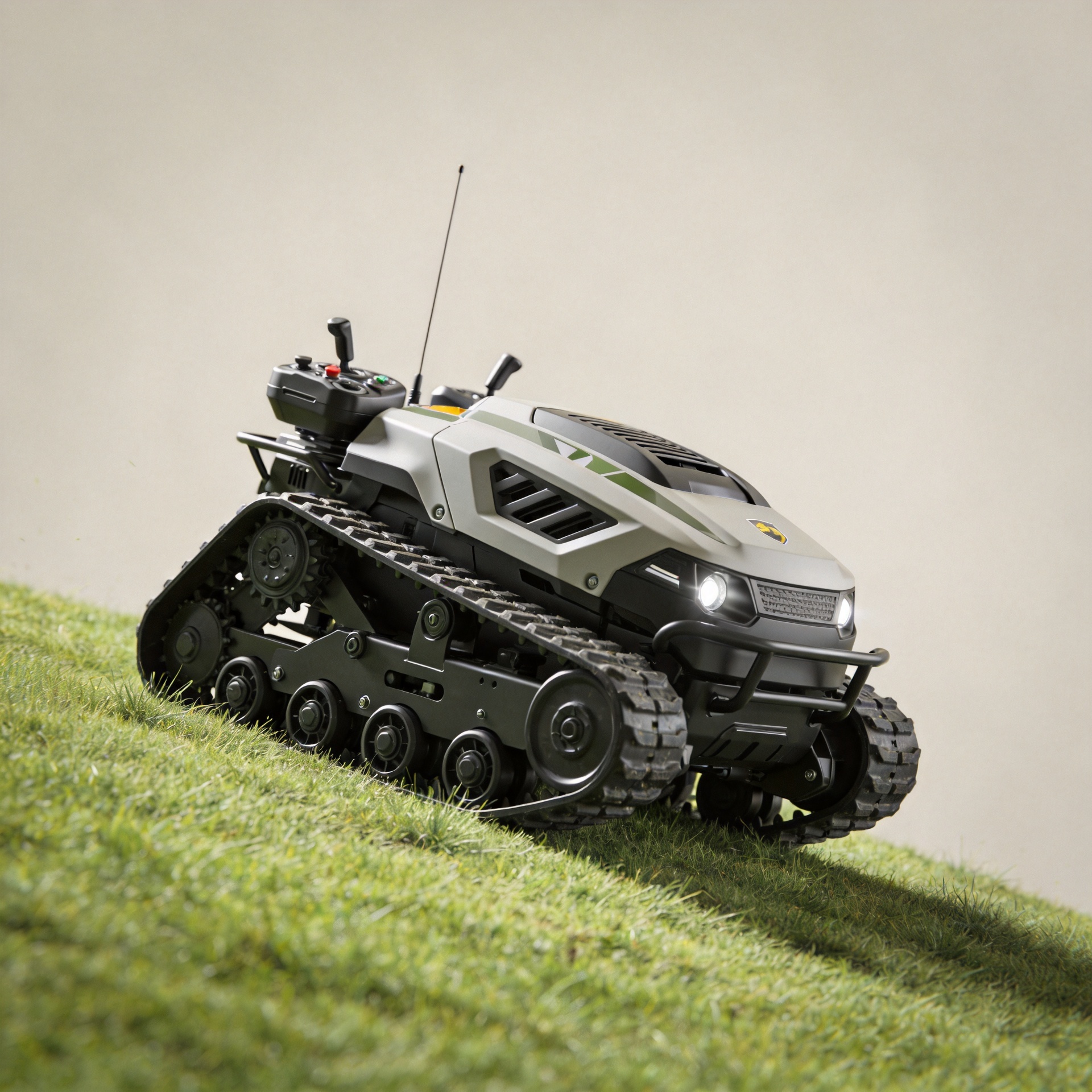
Choosing between a tracked lawn mower and a wheeled mower starts with the ground, not the brochure. On a dry, smooth lawn with gentle grades, a conventional wheeled mower is often the simpler choice. A tracked lawn mower becomes worth considering when the site repeatedly takes traction away, creates unstable footing, or makes it unsafe for an operator to stand close to the cutting path.
As a landscaping-equipment selection question, this is answered by walking the ground in sections. Look at slope changes, soil firmness, ruts, wet spots, vegetation, obstacles, and the distance an operator must work from a hazard. A track lawnmower is not automatically safer or better in every difficult-looking area. It is a tool for conditions where a larger contact patch and steadier drive path may help, provided the selected machine is approved for the work and the site assessment supports its use.
Start with the real question: what is making wheels lose control?
Wheels work efficiently when tires can maintain contact, steering response, and predictable braking. Problems arise when one or more wheels unload, spin, sink, or drop into irregular ground. Before moving to a tracked lawn mower, identify the failure pattern. Is the issue a side slope? A muddy access lane? Loose material over firm soil? Tall vegetation hiding holes? The answer affects both the machine type and the operating plan.
| Ground condition | Why wheeled mowing can become difficult | Why tracks may help | What still needs checking |
|---|---|---|---|
| Steep or changing slopes | Traction and stability can vary as weight shifts. | Tracks can provide a broader, more continuous contact area. | Manufacturer slope rating, surface condition, travel direction, and recovery plan. |
| Wet, soft, or recently saturated ground | Tires can spin, rut the surface, or lose steering response. | A tracked lawn mower may spread machine load over more ground area. | Whether the soil can support the machine at all; avoid protected or excessively soft ground. |
| Rutted, uneven, or rough fields | Individual wheels may drop into holes or lift across ridges. | Tracks can bridge small irregularities more progressively. | Hidden debris, rollover exposure, clearance, and the machine's approved terrain limits. |
| Loose soil, gravel, or dry sandy banks | Drive wheels can spin before the mower advances. | Tracks can improve the available grip when the surface is loose. | Edge stability, dust, stones, and blade-area hazards. |
| Dense grass or brush over uncertain ground | Vegetation can conceal washouts, rocks, and changes in grade. | Remote operation can help keep the operator farther from the cutting zone. | Pre-walk the site; do not use vegetation as evidence that the ground is safe. |
Slopes are the clearest reason to consider a tracked lawn mower
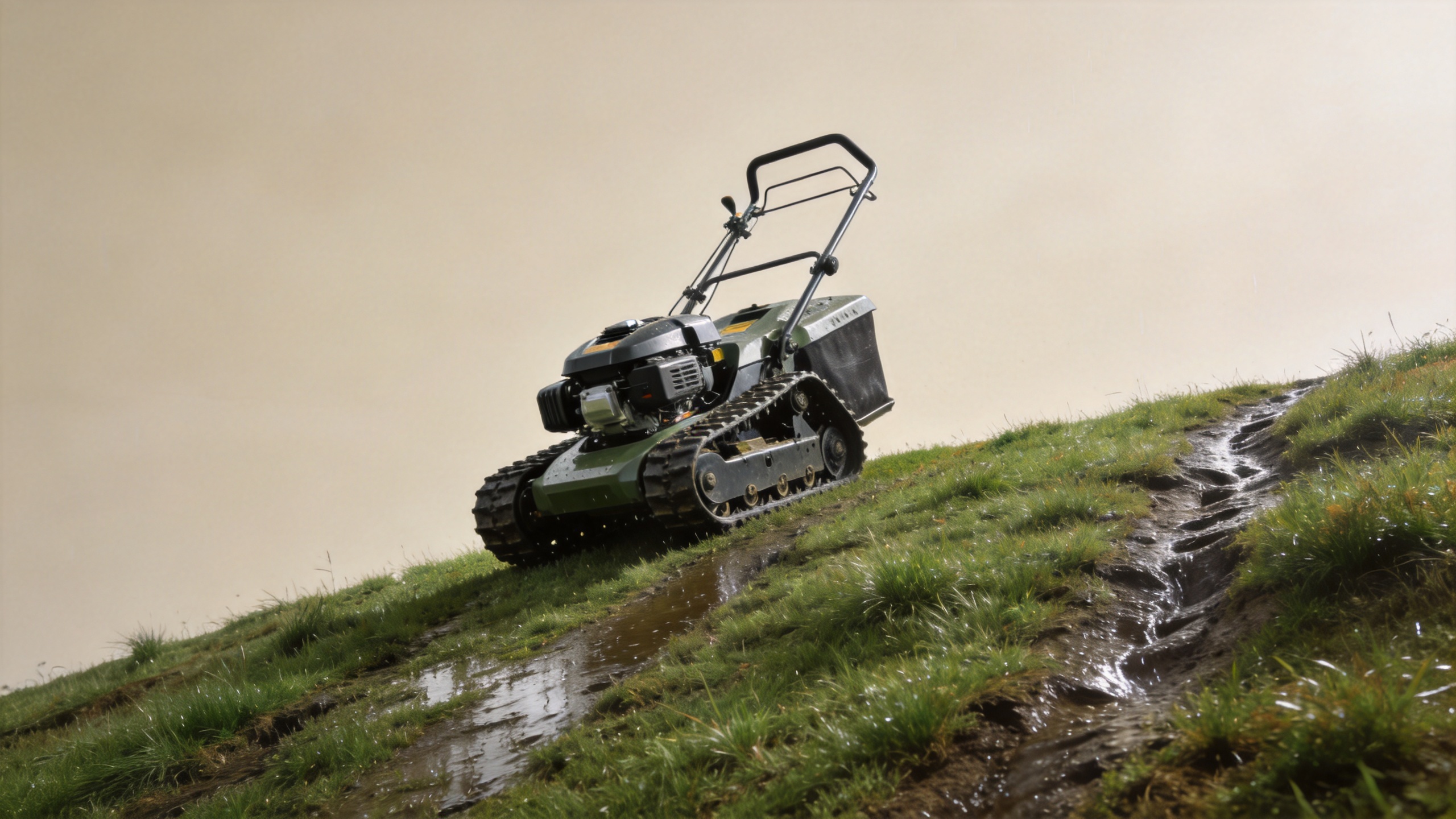
A side slope or bank is often where a track lawnmower has the strongest practical case. The ground can look manageable from above yet change quickly when it is damp, cut grass is lying on the surface, or the grade breaks near a ditch. Search results for this equipment category commonly focus on slope mowing, and safety guidance on mower rollover risk consistently points back to site assessment and using equipment only within its approved terrain range.
That does not create a universal “safe angle” for every tracked lawn mower. Track design, center of gravity, attachments, grass moisture, soil type, obstacles, and the direction of travel all matter. Treat the operator manual as the controlling limit. If the site exceeds the manufacturer guidance, has an unprotected drop-off, or cannot be inspected clearly, a tracked mower is not a license to proceed.
Signs that a slope deserves a closer equipment review
- The grade steepens unexpectedly near the bottom or beside a drainage feature.
- The mowing route includes cross-slope travel rather than a simple, approved approach.
- Grass, leaves, or loose soil make the surface different from the underlying ground.
- A wheeled mower has previously spun, slid, or required repeated corrective steering.
- The operator would otherwise work close to a bank, retaining edge, traffic area, or watercourse.
Soft and wet ground changes the decision in a different way
Soft ground is not only a traction problem. It is also a support problem. A tracked lawn mower may reduce localized loading compared with narrow tires, which can be useful where wheels leave ruts or sink. Yet low ground pressure is not the same as zero impact, and no mower should be forced through saturated soil simply because it has tracks.
Inspect the route after rain, irrigation, or thawing conditions. Look for standing water, pumping soil, wheel ruts from other equipment, and turf that separates from the surface when stepped on. If the mower would damage the site, slide toward a hazard, or become stuck beyond a safe recovery path, postpone work. In many cases, timing the job for firmer conditions is the better operational decision.
Rough ground and hidden obstacles favor a methodical inspection
Fields, orchard rows, utility corridors, and neglected margins often combine uneven soil with tall growth. A wheeled mower may bounce, lose a consistent cut height, or require the operator to correct direction repeatedly. A tracked lawn mower can be a better mobility platform in these conditions, but it does not remove the need to identify hazards first.
Walk the work zone when visibility allows. Mark rocks, stumps, wire, drainage covers, holes, and soft shoulders. Check transitions between firm and loose surfaces rather than judging the whole site by its most favorable section. This inspection also helps determine whether a track lawnmower has enough clearance and whether its cutting system is appropriate for the vegetation type.
When a wheeled mower is still the better answer
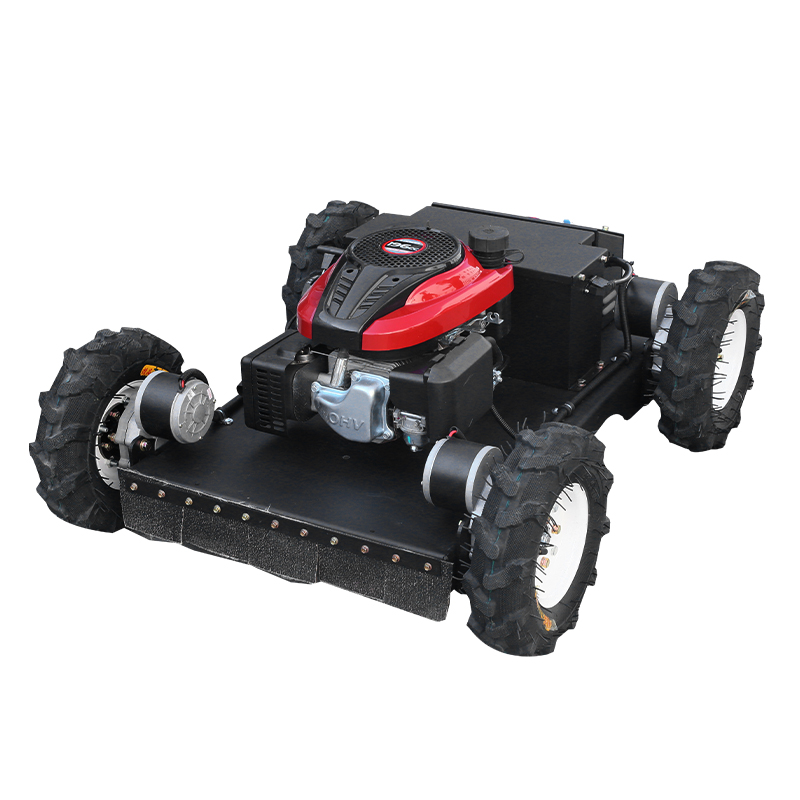
Tracks add complexity, turning resistance, and potentially more surface disturbance during tight maneuvers. On level, dry, open turf with reliable traction and no operator-exposure issue, a wheeled mower may cut efficiently and be easier to transport and service. Do not choose a tracked lawn mower just because the site has one small rough patch. Instead, compare how often the difficult condition occurs, how long the machine will work there, and whether it changes the safety controls required for the job.
A field checklist before specifying a track lawnmower
- Measure the terrain: map slopes, transitions, ditches, edges, and access routes rather than relying on a visual estimate.
- Check the surface: note wet soil, loose aggregate, ruts, turf damage, and places where vegetation hides the ground.
- Confirm the work: identify grass height, brush density, debris, desired cut result, and expected operating hours.
- Match the machine to the manual: verify the exact tracked lawn mower's slope, attachment, and operating restrictions.
- Plan people and recovery: establish exclusion zones, line of sight for remote work, PPE, communication, and a safe recovery method.
- Run a controlled trial: start on the least hazardous representative section and stop if traction, ground support, or visibility changes.
Make the choice condition by condition
A sound reason to choose a tracked lawn mower is not simply that the ground looks difficult. It is that repeated conditions—slopes, soft soil, loose surfaces, ruts, dense vegetation, or operator exposure—make predictable traction and a safer working position more important than the simplicity of wheels. A track lawnmower can be a useful part of that solution when the model, operating method, and site controls all match.
For a purchase discussion, provide suppliers with photos, measured grades, soil conditions, vegetation type, access limits, and the tasks that caused the wheeled mower to struggle. That gives the team a concrete basis for checking whether a tracked lawn mower configuration is appropriate instead of making assumptions from a single site photo.