EN
EN
What Is The Suitable Slope Angle For Remote mower on tracks
A suitable slope angle for a tracked lawn mower is not a single number that can be copied from a brochure. It is the angle that stays inside the specific machine's published operating limit after you account for ground condition, grass cover, travel direction, obstacles, visibility, and the operator's ability to stop safely. A remote mower on tracks can keep an operator away from a hazardous bank, but remote control does not make a risky slope safe.
From an operator's viewpoint, the practical question is not simply, “How steep can this tracked lawn mower climb?” It is, “Can this exact machine cut this exact area today with dependable traction, control, and an exit route?” That small change in thinking helps buyers avoid treating a maximum-angle claim as an all-purpose working recommendation.
Start With the Manufacturer's Rated Limit
The first rule is straightforward: use the slope limit in the manual, specification sheet, or safety label for the exact tracked lawn mower model and configuration. That limit should be treated as a boundary, not a target for routine work. Attachments, cutting height, fuel level, tire or track condition, and added accessories can change how a machine behaves. If a supplier cannot provide a model-specific limit and the conditions attached to it, the slope should be treated as unverified rather than assumed acceptable.
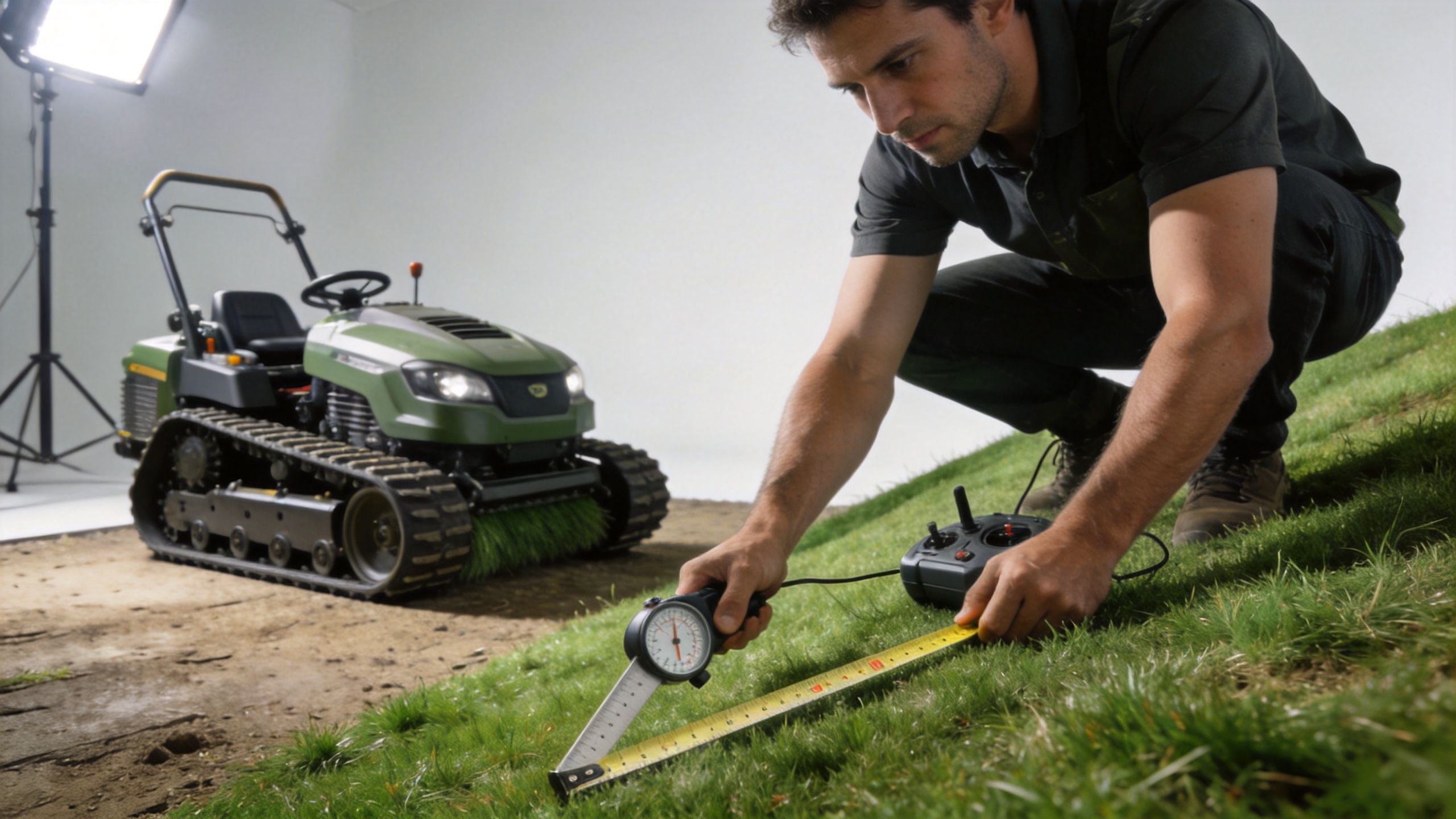
General occupational-safety guidance for mowing makes the same point: do not exceed the equipment manufacturer's slope limit, and measure the slope with an inclinometer or slope indicator before operation. Guidance for conventional riding mowers sometimes uses 15 degrees as a conservative fallback where no other information is available, but that is not a performance rating for a tracked lawn mower. Specialized equipment must still be evaluated against its own approved documentation.
Measure the Ground Instead of Estimating It
Eyes are poor measuring tools on an uneven site. A bank that looks manageable from the bottom may include short, steeper sections, ruts, drainage channels, loose soil, or a crest that limits visibility. Before deploying a tracked lawn mower, walk the full route and measure the steepest representative sections with a reliable inclinometer. Record the direction of the slope, not just the highest number.
- Measure the main mowing face, transitions at the top and bottom, and any access ramp.
- Mark wet patches, buried rocks, holes, roots, drop-offs, and areas where cut grass can collect.
- Check whether the operator can maintain line of sight and a clear remote-control position.
- Identify a safe recovery plan before a tracked lawn mower enters the slope.
This is where a field-first assessment matters more than a feature list. Tracks can improve contact area and may help on soft or irregular ground, but they do not erase the effects of slick vegetation, side loading, a sudden obstacle, or a change in center of gravity. The relevant angle is therefore the safe angle for the whole task, not the highest angle reached during a brief demonstration.
Why Direction Changes the Decision
A slope rating does not automatically mean every travel direction is equally suitable. Moving straight up or down can create a different load path from traversing across a slope. Cross-slope mowing can place more lateral demand on a tracked lawn mower, especially where the surface has bumps, loose material, or hidden depressions. Turning, stopping, and restarting are also separate moments of risk.
Plan the route before cutting. Keep the machine within the operating pattern described by its documentation, leave room for turns on stable ground, and avoid improvising around a stump or drainage edge midway through a pass. If the safe route cannot be made clear, the correct decision may be to use another method or specialized equipment rather than push a tracked lawn mower to its limit.
Reassess Traction Every Time Conditions Change
Dry compacted soil and wet grass are not the same job. Rain, dew, mud, leaf litter, long grass, loose gravel, and freshly cut clippings can change traction quickly. A tracked lawn mower that handled a slope in dry weather may need a lower working angle after a storm. Likewise, a route that is acceptable with a light cutting load may become less predictable in dense vegetation.
Use a staged approach: inspect the site, make a controlled test pass only within the documented limit, and stop if the machine slips, pitches unexpectedly, loses line of sight, or cannot be halted smoothly. Do not try to compensate for uncertainty by increasing speed or making sharp corrections. The operator should stay outside the machine's potential path and away from lower runout zones, ditches, and obstacles.
What to Confirm Before Buying a Tracked Mower
For a purchasing team, the suitable slope angle should become a verification checklist. Ask the supplier to identify the specific tracked lawn mower configuration used to establish the rating; whether the rating is for climbing, mowing, or both; what surface assumptions apply; and which attachments or operating modes affect it. Ask for the applicable manual, inspection requirements, emergency-stop procedure, maintenance instructions, and training expectations.
| Question to verify | Why it matters |
|---|---|
| What is the documented slope limit for this exact tracked lawn mower? | It prevents a generic claim from being treated as an approved operating limit. |
| Is the rating for dry grass, wet ground, straight travel, or mowing under load? | Conditions determine whether the rating fits the planned task. |
| How is the slope measured and where is the operator positioned? | Measurement and line of sight affect repeatable safe operation. |
| What must be inspected before each shift? | Tracks, guards, controls, brakes, and emergency-stop functions need documented checks. |
A Practical Answer to the Angle Question
The suitable angle for a remote mower on tracks is the lower of two limits: the manufacturer-approved limit for the exact tracked lawn mower, and the angle that remains safe after the real site conditions are assessed. The second limit may be much lower on wet, rough, obstructed, or poorly visible ground. That is not a weakness in the machine; it is sound operating judgment.
For site managers and buyers, a useful outcome is a documented decision: measured slope readings, current ground conditions, a confirmed machine rating, a planned travel pattern, and a stop-work rule. Shandong Maide En Intelligent Technology can support a condition-based discussion around remote mowing needs, but a final equipment choice should be confirmed against the relevant product documents and the actual worksite. With that evidence in place, a tracked lawn mower can be evaluated as a practical tool rather than a promise based on one headline angle.