EN
Where Can RC Lawn Mower Mini Crawler Operate in Narrow Spaces?
An rc lawn mower mini crawler can be useful where a walk-behind machine is awkward to guide and a larger mower cannot enter safely. The practical question is not simply whether the cutting deck fits. A site planner should assess the complete machine envelope, the room needed to steer or turn, the operator’s line of sight, and the safe exit route. In other words, a compact rc lawn mower mini crawler is more usefully evaluated as a small remote-operated work system rather than as a narrow cutting tool.
For facilities teams, orchard managers, landscape contractors, and property owners, an rc lawn mower may suit selected corridors, tree-row edges, utility clearances, embankment approaches, and irregular patches of vegetation. It should not be sent into every tight gap. Clearance, ground condition, hidden obstacles, and local operating procedures still determine whether a route is workable.
Start With the Whole Machine Envelope
The first rule for using an rc lawn mower in a narrow area is to compare the route with the dimensions of the actual machine configuration. Request the supplier’s current specification sheet and check overall transport width, track width, deck overhang, handle or antenna clearance, and any guards that project beyond the chassis. Cutting width alone is not a safe measure of access.
Measure the narrowest point of the intended route: gates, bollards, tree guards, irrigation boxes, parked equipment, fence returns, and building corners can all reduce usable space. Leave a meaningful operating margin rather than planning for a machine to brush past obstacles. That margin allows for uneven ground, vegetation that hides edges, track movement during steering, and a controlled stop if the operator needs to pause.
- Record the smallest clear opening and its surface condition.
- Check the widest part of the rc lawn mower, including fitted guards and attachments.
- Confirm whether the machine must enter straight, make a turn, or reverse through the restriction.
- Plan an exit route before beginning the cut.
Places a Compact Tracked RC Lawn Mower Can Be Considered
Orchard and tree-row margins
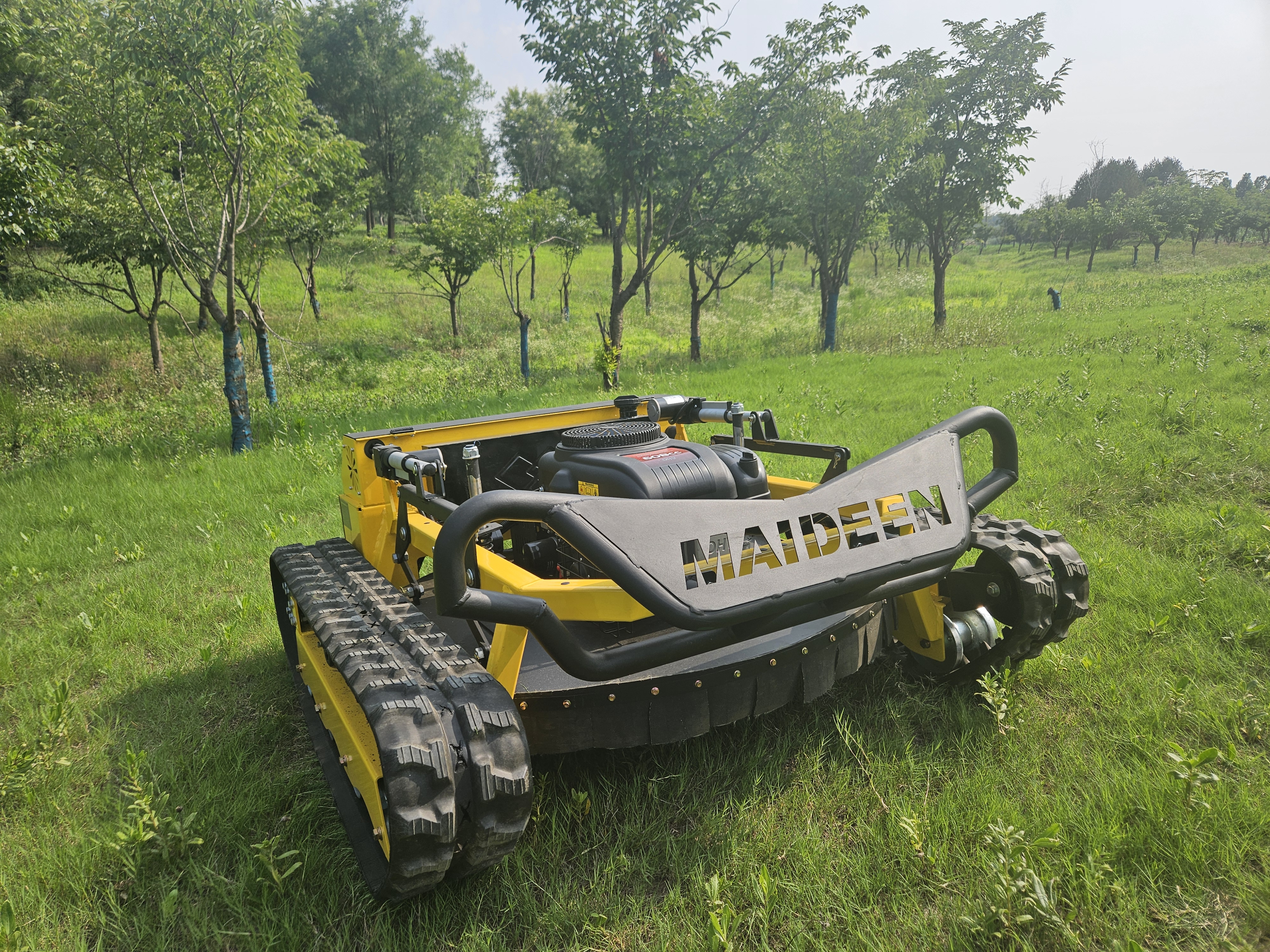
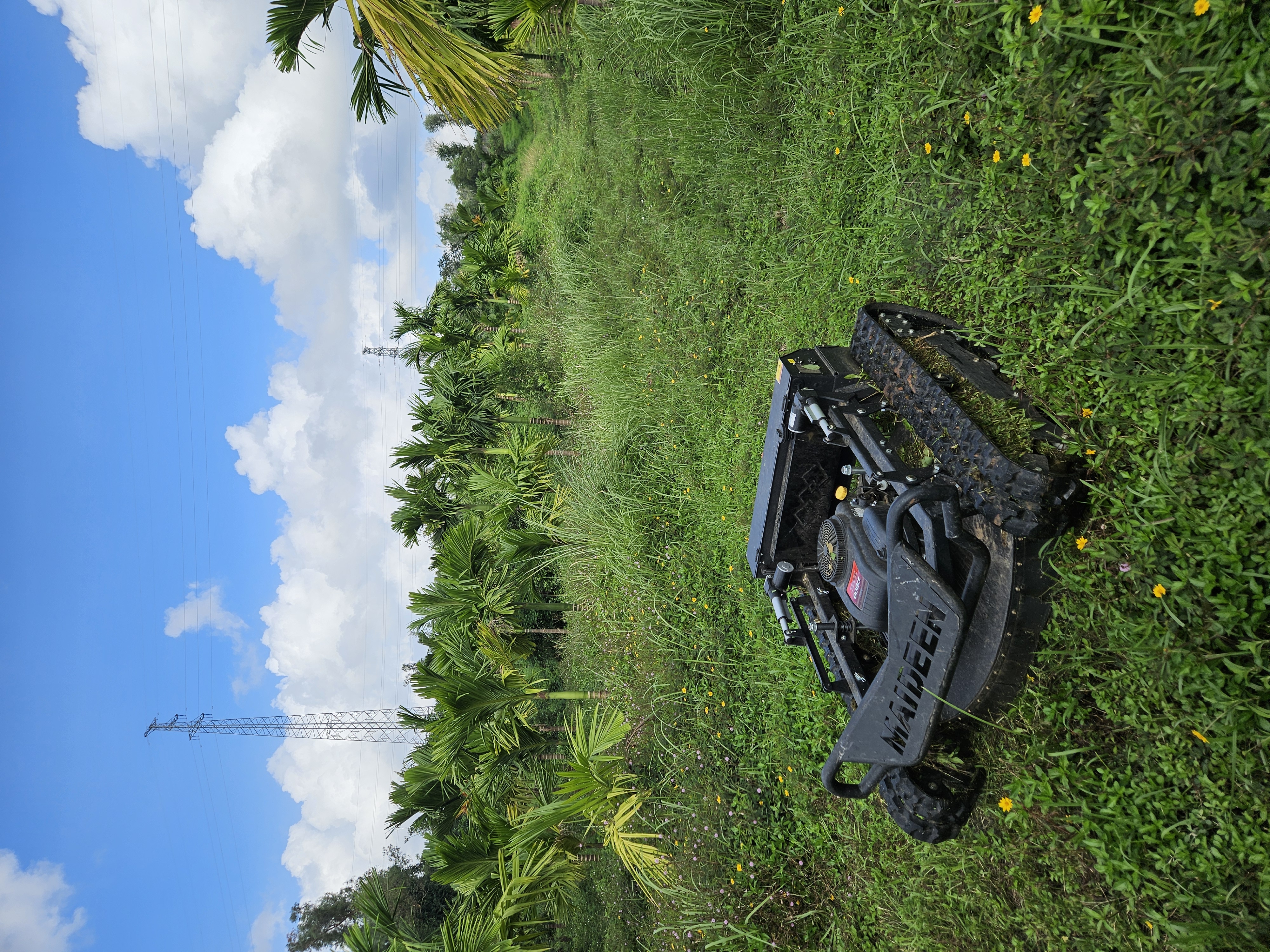
Where row spacing and turning room are verified, an rc lawn mower can help maintain grass along orchard lanes or around outer rows. The operator should map trunks, low branches, irrigation equipment, drainage inlets, and guy wires before work starts. A compact crawler format may be useful where the travel surface is uneven, but it does not make tree roots or concealed holes harmless. Use a slow first pass, keep the machine within a clear viewing angle, and stop whenever vegetation prevents the operator from seeing the route.
Landscape access strips and fenced boundaries
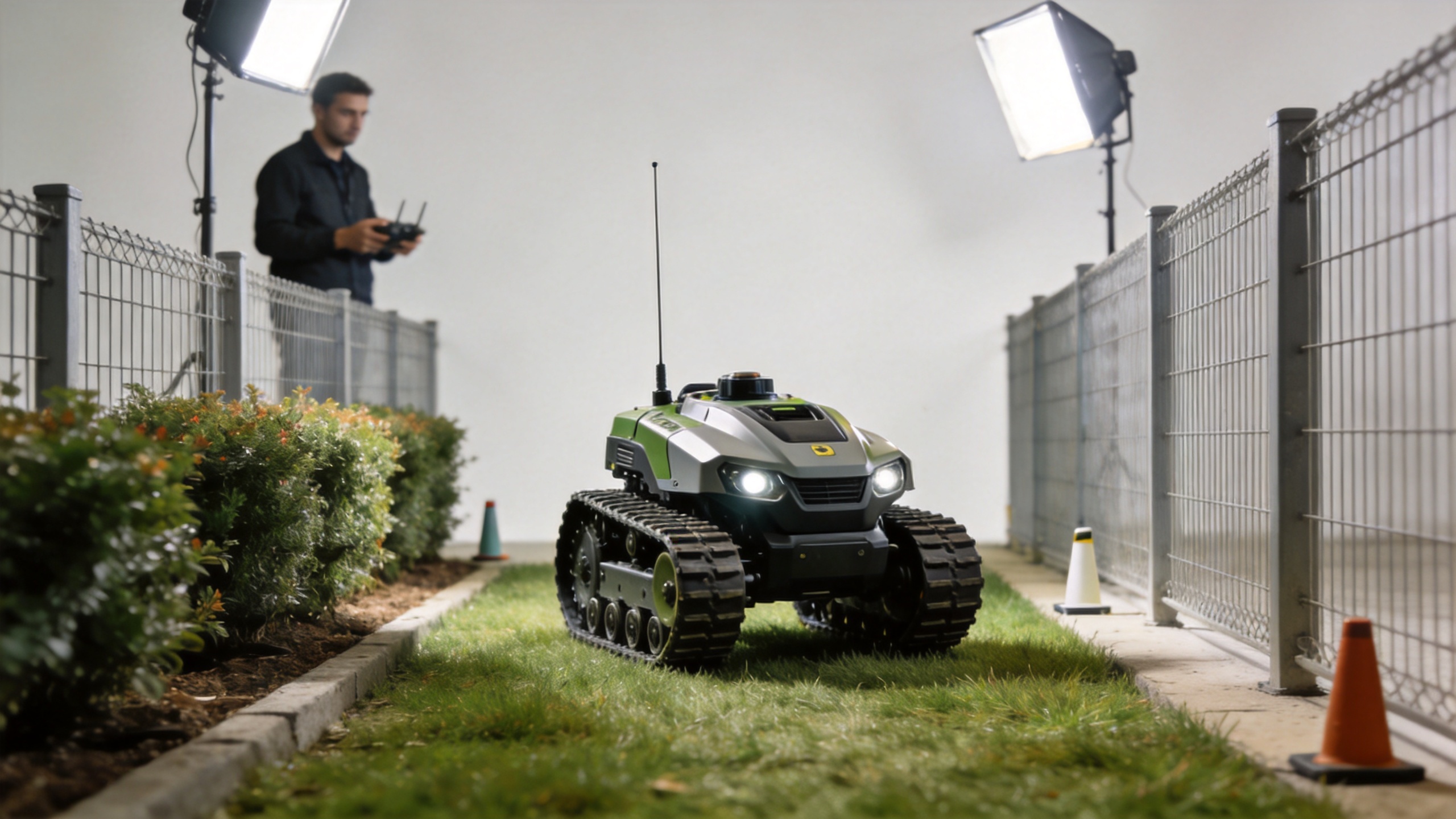
A narrow strip between a fence and a planting bed may be suitable for an rc lawn mower mini crawler if the site has enough side clearance and no exposed irrigation, loose wire, or hard debris. These areas are often better handled in short, deliberate sections than with long blind passes. The operator needs space to correct direction without driving a track into a fence, border, or wall.
Solar, utility, and equipment-adjacent areas
Controlled vegetation work around fixed infrastructure is another possible use for an rc lawn mower, provided the property owner has defined exclusions and the machine’s height and width have been checked. Do not assume that a low profile guarantees clearance below equipment. Review supports, cable protection, drainage components, and restricted zones first. A documented route protects both the equipment and the people supervising the work.
Approach lanes near slopes or rough ground
An rc lawn mower can be considered for a narrow approach to a larger work area when the lane is firm, visible, and free of abrupt edge hazards. Tracks may change how the machine moves on loose or uneven surfaces, but they do not eliminate the risk from wet grass, side slopes, soft shoulders, ditches, or sudden grade changes. Confirm the model-specific operating limits with the manufacturer and establish a no-go boundary well before any drop-off or unstable edge.
Turning Space Is Often the Limiting Factor
A route can be wide enough for an rc lawn mower to enter but still be unsuitable for productive mowing. The machine may need room to reverse, realign, or turn at the end of a pass. Tight corners also increase the chance of repeated track scuffing, contact with a fixed obstacle, or loss of sight behind shrubs. Before scheduling the work, walk the intended path in both directions and identify every point where a turn, reversal, or emergency stop would be required.
A useful site sketch includes entry points, pinch points, turning pockets, obstacles, slopes, and a safe operator position. Divide complicated spaces into manageable zones. If a zone has no controlled way to enter and leave, it should be maintained with a different method rather than forcing the rc lawn mower through it.
Plan Visibility and Remote-Control Position
Remote operation does not remove the need for direct supervision. An rc lawn mower should be operated from a position where the user can see the machine, the cutting path, and likely hazards. Hedges, parked vehicles, walls, and elevation changes can quickly block visibility. If the route includes a blind corner, redesign the work sequence so the machine is stopped and repositioned under direct observation rather than driven on assumption.
Before operating, identify where bystanders, pets, workers, and vehicles might enter the zone. Use site controls appropriate to the property, maintain a clear exclusion area, and follow the equipment manual for startup, stopping, battery or fuel handling, and emergency procedures. A compact rc lawn mower is not a substitute for a risk assessment or trained supervision.
A Practical Narrow-Space Assessment Checklist
- Obtain current model dimensions and confirm the configuration to be used.
- Measure gates, corridors, fixed objects, and end-of-pass turning areas.
- Inspect for roots, rocks, wire, drop-offs, drainage covers, wet patches, and hidden debris.
- Confirm a visible operator location, controlled access, and an exit route.
- Test one short section at low speed before committing to the full route.
- Stop if conditions change or the rc lawn mower cannot be kept under direct control.
When Narrow Spaces Are Not a Good Fit
An rc lawn mower mini crawler should be excluded when the route leaves no operating margin, the turning area is inadequate, obstacles cannot be inspected, the ground is unstable, or the operator cannot maintain visibility. The same applies when a path leads close to an unprotected ditch, roadway, water feature, pedestrian zone, or fragile infrastructure. In those cases, a hand-held tool, a different machine class, or a revised landscape-maintenance plan may be safer and more effective.
Make the Decision From Site Facts
Suitable places for an rc lawn mower mini crawler are not defined by a generic “narrow-space” label. They are defined by verified clearance, a workable turning plan, stable ground, visible control, and safe entry and exit. For a planned purchase or a new maintenance route, share site measurements, vegetation type, terrain photos, and access constraints with the equipment supplier. That creates a more useful technical discussion than relying on a product category alone and helps determine whether the rc lawn mower is genuinely appropriate for the task.