EN
What Power Source Choices For Wireless lawn mower
Choosing a remote control lawn mower starts with the job, not with a favorite fuel type. A wireless lawn mower can make distance operation practical, but its power source changes the workday: how long the machine can run, where it can be prepared, what operators must check, and how maintenance is planned. For grounds teams, orchard managers, contractors, and buyers, the useful question is not “which power source fits?” It is “which source fits this site, task, and support plan?”
As a technical explanation for remote mowing, this article compares battery-electric, gasoline, hybrid, and corded or charging-supported approaches. Model-specific runtime, slope capability, and safety requirements should be confirmed from the manufacturer’s documentation and local rules.
Start with the work pattern of the remote control lawn mower
Before comparing a battery or an engine, define the work. Is the remote control lawn mower used for brief routine cuts around a facility, longer passes in an orchard, seasonal tall-grass work, or irregular areas with boundaries and obstacles? A machine that appears suitable on paper can become a poor match if the team cannot recharge, refuel, inspect, or store it safely within the actual schedule.
- Map the acreage or task zones, including travel back to the charging or refueling point.
- Record grass height, density, moisture, slope, surface changes, and obstacles.
- Estimate uninterrupted operating windows rather than only total daily area.
- Identify who will inspect the remote control lawn mower, manage fuel or batteries, and respond to a stop condition.
That short exercise often clarifies the choice. A compact wireless lawn mower used in several short shifts has different energy needs from a remote mower that must stay productive far from a building.
Battery-electric: practical where charging fits the schedule
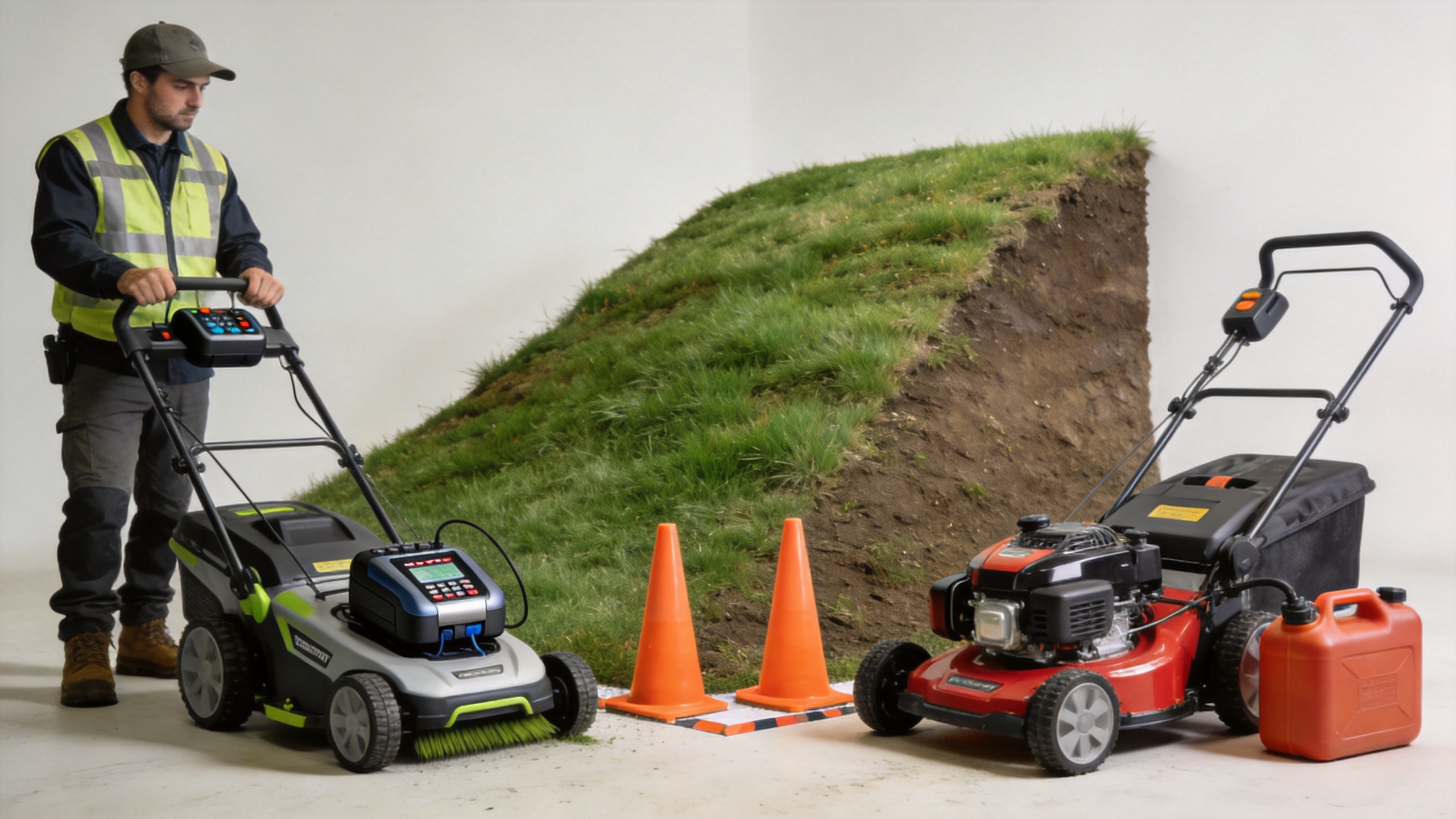
A battery-electric remote control lawn mower is often considered when a site has dependable charging access, a predictable work window, and a preference for avoiding on-site gasoline handling. Battery systems can simplify daily preparation, but “battery powered” is not a complete answer. Usable runtime is affected by grass load, terrain, travel, cutting conditions, battery condition, and operating behavior.
Consumer Reports describes average battery walk-behind mower runtime of roughly 45 to 50 minutes per charge in its consumer testing context. That is not a specification for a remote control lawn mower; it is a reminder to ask for the exact machine’s working-time conditions. For a wireless lawn mower, request the battery type, rated capacity, charging method, expected runtime under stated conditions, spare-battery options, and battery storage guidance.
Battery power tends to suit planned routes near a charging base, facilities with overnight charging, and operations that can divide work into defined cycles. It may require more coordination when a remote control lawn mower must cover long, remote routes without an approved charge point. Charging areas should be dry, protected, and managed according to the battery and charger instructions.
Gasoline engines: consider range, handling, and service together
A gasoline-powered remote control lawn mower may be considered when longer operating periods, remote locations, or refueling logistics make battery cycles difficult to schedule. Refueling can reduce downtime in some workflows, but it adds fuel storage, transport, engine inspection, and maintenance responsibilities. It also requires a clear approach to spills, hot surfaces, ventilation, and shutdown procedures.
Gasoline lawn and garden equipment is also associated with emissions considerations. The U.S. Environmental Protection Agency has published work on emissions from gasoline-powered lawn and garden equipment. The practical buying implication is not to assume one power source is universally better; it is to review local operating constraints, fuel-management capability, and the engine documentation for the intended remote control lawn mower.
Ask a supplier what regular engine service is required, which consumables are needed, how fuel quality and storage affect operation, and what support is available in the intended market. A wireless lawn mower with remote controls still needs an inspection routine even if its propulsion comes from a combustion engine.
Hybrid and charging-supported arrangements
Some buyers explore hybrid concepts or equipment plans that pair a remote control lawn mower with a charging vehicle, spare batteries, or a service vehicle. These arrangements are not automatically simpler. Their value depends on whether the added logistics reduce interruptions without creating new safety or transport issues.
For a multi-zone site, it can be useful to compare total process time: preparation, travel, mowing, energy replenishment, inspection, and return. This prevents a narrow focus on either tank size or battery capacity. A wireless lawn mower may fit well when the team can rotate it through planned charging cycles; a gasoline configuration may fit better where a verified fuel routine supports longer continuous work.
A comparison table for the buying discussion
| Power-source approach | Potential fit | Questions to verify |
|---|---|---|
| Battery-electric | Predictable work windows with reliable charging access | Runtime under task conditions, charging time, spare packs, battery care |
| Gasoline engine | Remote or extended work where refueling is workable | Fuel handling, engine service, emissions requirements, parts support |
| Hybrid or support-vehicle plan | Multi-zone work needing planned energy logistics | Transport safety, handoff process, real downtime, operator responsibilities |
| Corded/charging-supported setup | Very controlled locations with a documented energy plan | Cable or charging safety, site access, weather limitations, route control |
Do not let power choice replace safety planning
Remote operation can change the operator’s position, but it does not remove the need for a site assessment. Before using a remote control lawn mower, establish exclusion zones, visibility expectations, emergency-stop procedures, route boundaries, and inspection steps. Efficiency matters, but conditions such as wet ground, unseen obstacles, pedestrians, animals, and unstable edges may change what is appropriate.
Power choice should support the safety plan. For example, battery handling requires confirmation of charger and storage instructions; gasoline operation requires approved refueling and maintenance practices. In either case, follow the product manual and local requirements rather than treating generic guidance as a substitute.
Questions to send before requesting a quotation
- What grass, terrain, and operating window will the remote control lawn mower face?
- Where will a wireless lawn mower be charged, refueled, inspected, and stored?
- Which runtime or refueling figures are documented for comparable conditions?
- What safety instructions, training material, service intervals, and spare-parts support are available?
- Which power-source configuration is compatible with the confirmed machine and local compliance requirements?
Choose the power source after the site is clear
The right remote control lawn mower power source is a trade-off, not a label. Battery-electric options can suit organized charging cycles. Gasoline power can suit longer or more remote work when fuel management and service are established. Hybrid or support-vehicle arrangements can help only when their logistics have been tested against the real route. By documenting the task first, buyers can have a more useful conversation about a wireless lawn mower and avoid selecting a configuration based on a single headline specification.
For remote mowing projects, Shandong Maide En Intelligent Technology Co., Ltd. can use a site-and-task checklist to structure early configuration discussions. Final suitability should be confirmed against product documentation, the operating environment, and applicable safety requirements.