EN
EN
How Does Automatic Lawnmower Robot Detect Obstacles On Lawn?
A robot lawnmower is not simply driving until it touches something. In practical lawn work, it must decide whether an object is part of the route, a lawn boundary, a temporary obstruction, or a reason to stop. As a technical explainer for remote mowing equipment, I would start with one important distinction: a mower can detect an object without fully identifying it. Safe operation depends on how its sensors, navigation rules, speed limits, and site setup work together.
This matters especially on changing lawns. Toys, branches, pets, uneven ground, tall grass, garden edging, and people can appear after the route was mapped. An automatic lawnmower robot therefore needs more than one response: slow down, steer around an obstruction, stop, or request operator attention. The correct response varies by machine and by the conditions it encounters.
The Main Ways a Robot Lawnmower Detects Obstacles
Most robot lawnmowers use a combination of sensing methods rather than one sensor alone. The exact hardware differs by model, but the following systems explain the basic logic.
Contact sensors and bumper detection
The simplest layer is a physical bumper or contact sensor. When the mower touches a solid object, the bumper movement signals the controller to stop or reverse before choosing a new direction. This method is useful as a last line of detection, but it is not the same as detecting an obstacle before contact. A robot lawnmower that relies heavily on contact detection may still be suitable for clear, predictable areas, yet it needs sensible operating boundaries and regular checks.
Ultrasonic sensing
Ultrasonic sensors send sound waves and measure the returning signal to estimate whether an object is ahead. They can provide awareness before contact, particularly for hard objects within the sensor’s working zone. Surface angle, distance, wind, grass movement, and the material of an object can affect a reading, so ultrasonic sensing should be treated as one layer in a safety system, not a promise that every object will always be recognized.
Cameras and vision systems
Camera-based systems look for shapes, contrast, edges, and movement. Some use computer vision to help distinguish open grass from objects that should be avoided. This can be valuable for wire-free navigation and changing routes. However, vision depends on usable image conditions. Bright glare, deep shade, rain on a lens, low light, mud, or dense vegetation can reduce confidence. In other words, a camera-equipped robot lawnmower still benefits from a tidy route and conservative settings where visibility is uncertain.
LiDAR, radar, and depth sensing
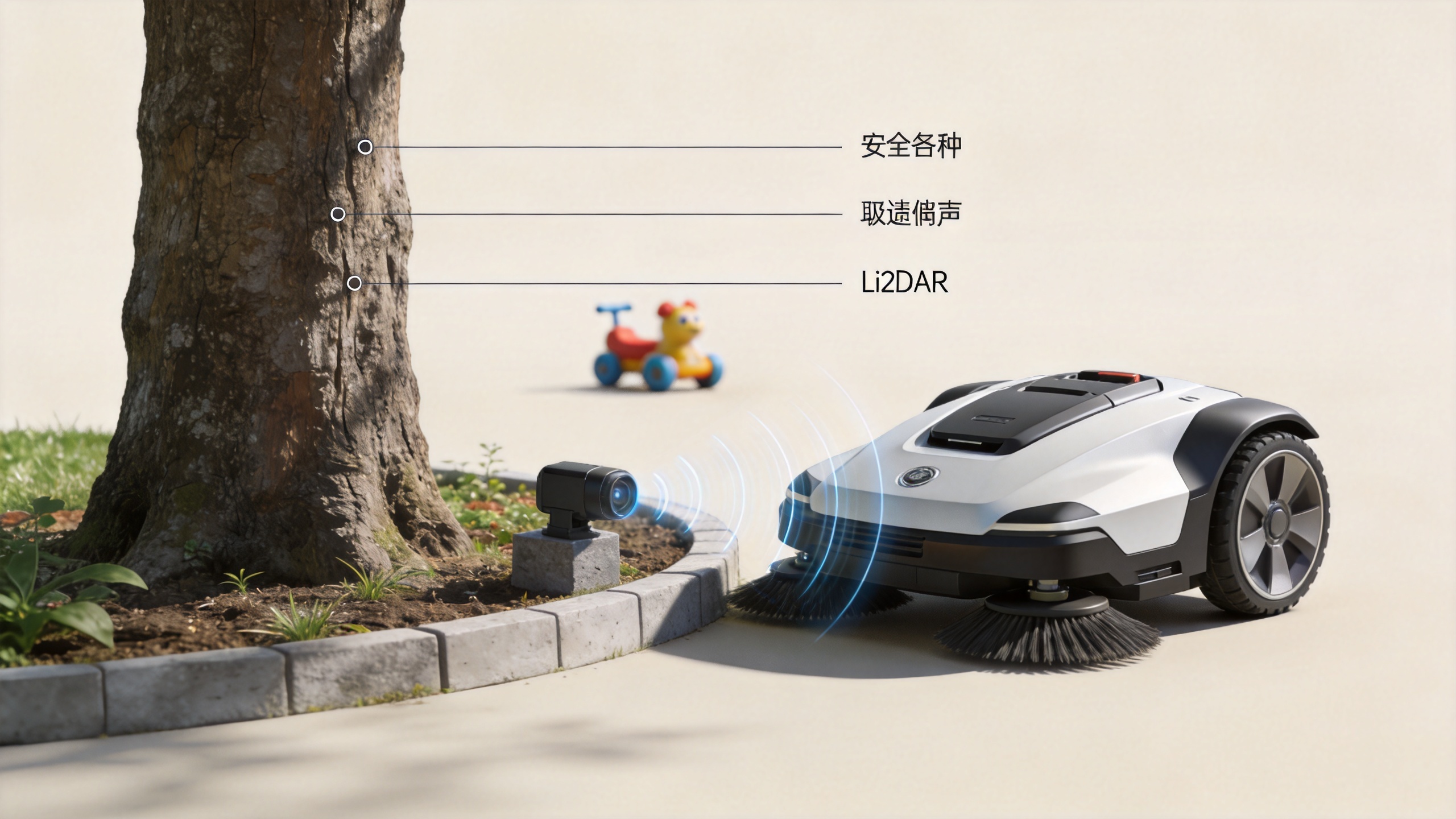
LiDAR scans nearby surfaces with light to build a three-dimensional representation of the surroundings. Other depth-sensing approaches may serve a similar purpose. These systems can help a mower recognize that something occupies space ahead of it before physical contact. They are useful for navigation as well as avoidance, but their performance is not identical across products. Small, low, soft, highly reflective, or partially hidden items can remain difficult. Ask for model-specific documentation and a site demonstration rather than assuming a technology label describes every real-world condition.
Boundary and navigation inputs
Boundary wire, GNSS/RTK positioning, mapped zones, wheel sensors, and tilt sensors do not all “see” obstacles. Instead, they help the robot lawnmower understand where it is allowed to travel and whether its movement is normal. That location awareness reduces the chance of entering off-limits areas, but it does not replace forward obstacle sensing. A boundary keeps the route defined; it does not make an unexpected object disappear.
Why Sensor Fusion Is More Useful Than a Single Feature
Sensor fusion means the mower compares information from multiple sources. For example, a camera may notice an object, a distance sensor may estimate how close it is, and wheel feedback may confirm that the mower is not moving as expected. The controller can then choose a safer action. This layered approach is more realistic than expecting one component to work perfectly everywhere.
For buyers, the useful question is not “Does it have a camera?” but “What happens when the camera, distance sensor, or navigation signal is uncertain?” A well-planned evaluation should cover whether the machine slows, stops, reroutes, sends an alert, or requires manual recovery. Safety-related product documentation may reference standards such as IEC 60335-2-107; review current manufacturer documentation for the specific model and market rather than treating a standard reference as proof of safe operation in every lawn.
What Can Make Detection Less Reliable?
Obstacle detection is highly site-dependent. A robot lawnmower may behave differently on a dry, open lawn than on a damp lawn with long grass and low sun. Before relying on automatic operation, consider these conditions:
- Object size and height: low hoses, thin wires, or small toys may be harder to sense than a wall or tree trunk.
- Object material: soft, dark, transparent, reflective, or irregular objects can challenge certain sensing methods.
- Light and weather: glare, darkness, fog, rain, and dirty lenses can affect vision-based performance.
- Terrain and vegetation: holes, slopes, loose soil, thick weeds, and overgrown edges can change the mower’s orientation and line of sight.
- Route changes: a mapped lawn is not a permanently clear lawn; seasonal growth and temporary items need fresh checks.
It is tempting to focus on the mower’s advertised coverage area. In practice, a safe route review is often more important than lawn size alone. Boundary zones, narrow passages, ditches, water edges, and places where people or animals may enter deserve separate attention.
A Practical Pre-Run Check for an Automatic Lawnmower Robot
Use a short routine before each unattended or semi-attended mowing session. It turns obstacle detection from a feature claim into a workable operating process.
- Walk the mowing area and remove toys, hoses, tools, fallen branches, and loose debris.
- Check that boundary markers, virtual zones, or wire routes still match the intended lawn area.
- Inspect cameras, sensor windows, bumpers, and wheels for mud, grass buildup, or damage.
- Confirm that children, pets, and bystanders are away from the work area before starting.
- Test a controlled run near representative edges and fixed obstacles after changing settings, terrain conditions, or the route.
- Stop work and investigate repeated alerts, unexpected turning, or reduced sensor confidence instead of allowing the issue to repeat.
How to Evaluate a Robot Lawnmower Before You Buy
When comparing a robot lawnmower, ask the supplier to explain the sensing stack, not just list features. Request a demonstration on conditions that resemble your own site: open grass, a boundary edge, a tree or post, shaded ground, and a safe representative obstacle. Confirm the machine’s documented response when a sensor is blocked, when a navigation signal weakens, or when an object is detected late.
For commercial or mixed-use grounds, record the terrain, grass height, obstacle types, operating hours, and access controls before discussing configuration. This condition-first approach helps a supplier match the equipment to the task and prevents an automatic feature from being mistaken for a substitute for supervision, maintenance, or site management.
Key Takeaway
An automatic lawnmower robot detects obstacles through a layered mix of bumpers, distance sensing, cameras, depth sensing, and navigation inputs. The strongest practical result comes from matching that system to real lawn conditions, keeping the route clear, and verifying how the mower responds when information is uncertain. Treat obstacle avoidance as part of an operating plan, not as a reason to ignore preparation or safety checks.