EN
EN
Why Lawn Mower Tank Tracks Improve Passability on Rough Land
When rough ground turns a routine cut into a traction problem, a tracked lawn mower can change the conversation. The point is not that tracks make every slope or wet patch safe. Instead, they can give a machine a broader, more continuous contact patch than conventional tires. For property managers, contractors, and landowners working around ruts, loose soil, tall grass, or uneven field edges, that difference can improve passability when the machine, operator, and site are properly matched.
From a remote-mower technical perspective, it helps to separate three questions: Can the mower keep moving? Can it remain stable? And can the operator complete the task safely? A tracked lawn mower may help with the first two, but the third still depends on an approved operating limit, visibility, vegetation, weather, and a careful pre-start inspection.
What “passability” really means on rough land
Passability is more than forward motion. A mower needs enough grip to climb or traverse without uncontrolled slip, enough flotation not to sink excessively, enough clearance to avoid hanging up, and enough stability to keep its cutting path predictable. Rough land often changes from firm turf to loose soil, shallow ruts, stones, damp grass, or tangled vegetation within a few meters. That is why a tracked lawn mower should be evaluated against the whole route rather than a single attractive patch of ground.
A common assumption is that engine power decides whether a mower can cross difficult terrain. Power matters, but it is only one part of the system. If the contact surface cannot transmit that power without spinning or digging in, extra power does not solve the underlying problem. Track design, track condition, terrain firmness, machine balance, and operator decisions all affect the outcome.
How lawn mower tank tracks improve traction
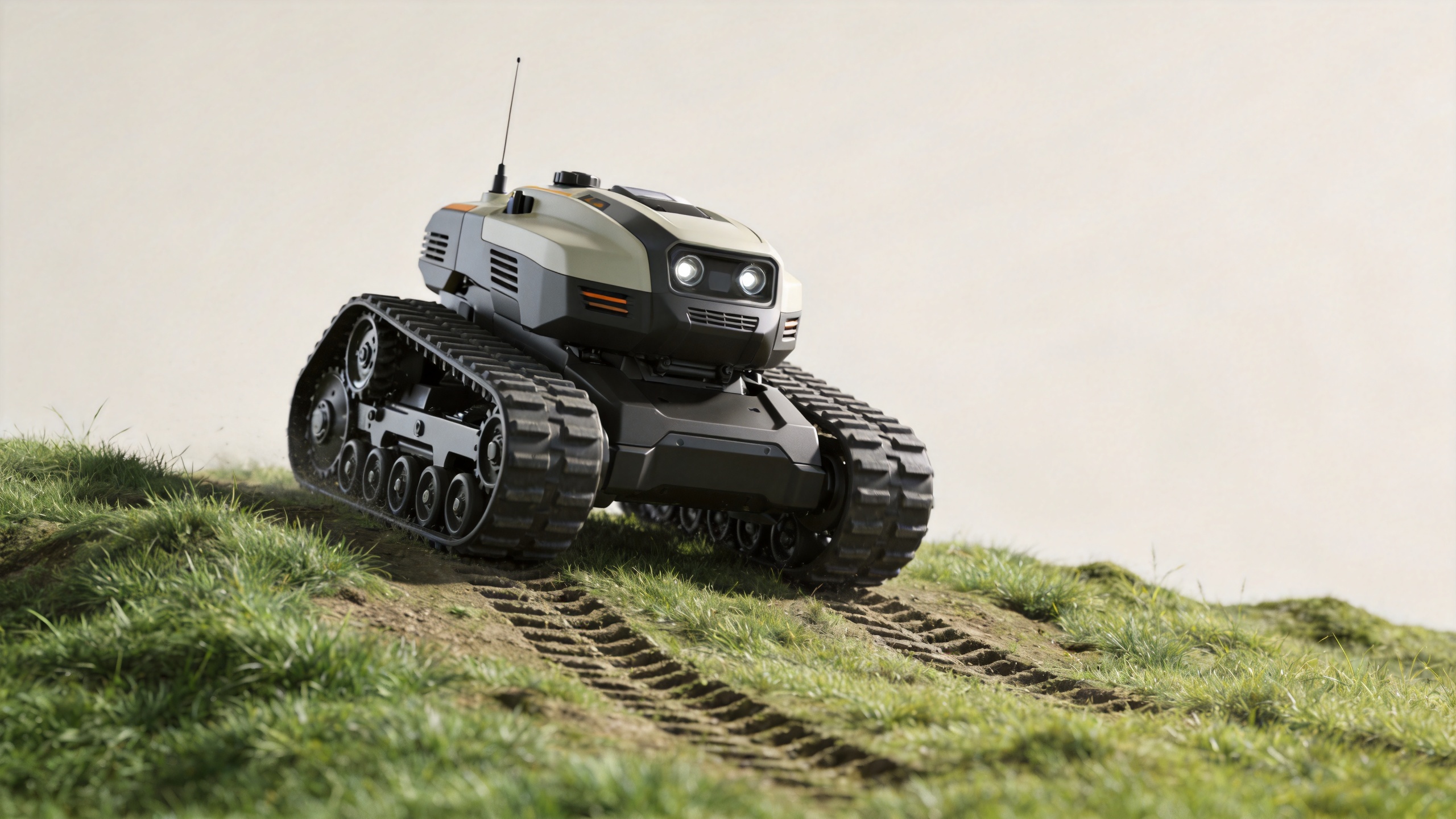
Lawn mower tank tracks spread the driving force along a longer contact area. Their tread lugs can engage uneven turf, soil, and short obstacles at multiple points instead of relying on a small tire contact patch. On rough but reasonably firm ground, this can reduce sudden wheelspin and help a tracked lawn mower maintain a steadier crawl.
The improvement is especially useful where one side of the machine crosses a shallow depression or loose section. A continuous track may keep more of the drive surface engaged while the terrain changes underneath it. Still, traction is conditional. Wet clay, deep mud, icy grass, hidden roots, and loose stones can defeat any undercarriage. A tracked lawn mower should not be treated as a license to enter terrain that has not been assessed.
Why a larger contact area can help flotation
On soft ground, the machine’s weight must be supported by the soil. Because lawn mower tank tracks generally distribute load across more area than narrow tires, they can reduce localized pressure on the surface. In practical terms, a tracked lawn mower may be less likely to cut deep ruts into suitable turf or settle suddenly into a soft section.
That does not mean tracks prevent ground damage. Saturated ground may still deform, and repeated passes can compact or scar sensitive turf. If the surface is already yielding under a boot or vehicle, postponing the work may be better than relying on a tracked lawn mower to force a route. Match the mowing schedule to ground conditions, not just to the calendar.
Stability comes from more than tracks
Tracks can support a stable stance by providing consistent ground contact, but they do not erase rollover risk. Center of gravity, track width, attachment position, turning direction, ground contour, and the load on each side of the machine all matter. A tracked lawn mower can still become unstable if one track climbs a bank, enters a hole, or loses support near a ditch or drop-off.
This distinction matters on slopes. Search results on slope mowing consistently emphasize traction, stability, rollover risk, operator exposure, ground pressure, and vegetation density as separate factors. Do not borrow a slope limit from another machine type or a marketplace listing. Use the exact operating guidance supplied for the specific tracked lawn mower, and reduce risk further when grass is wet, sightlines are poor, or the surface changes unexpectedly.
Tracks make uneven routes easier to manage
Rough land is rarely a uniform slope. It may contain washouts, molehills, compacted wheel tracks, stubble, low branches, and transitions between grass and bare soil. A tracked lawn mower can often move more smoothly through modest irregularities because its undercarriage bridges small changes in elevation. The result can be more predictable steering and fewer abrupt corrections.
Predictable movement is particularly valuable with remote operation. The operator can choose a safer observation point while monitoring the machine’s path, rather than standing directly in a hazard area. However, remote control does not remove the need for a clear exclusion zone. Before operating a tracked lawn mower, check for people, animals, hidden obstacles, overhead or underground hazards, and an unobstructed recovery route.
What to inspect before sending a tracked lawn mower onto rough land
Good passability starts before the engine starts. Rather than asking only whether the machine has enough power, break the task into preparation, operation, and review.
- Walk the route: Identify holes, ditches, loose rock, concealed debris, soft shoulders, and areas where a turn would place one track higher than the other.
- Check the surface: Note moisture, loose soil, tall or tangled vegetation, and any section likely to rut under the mower.
- Inspect the undercarriage: Follow the manufacturer’s instructions for track tension, visible damage, packed mud, debris, and drive-component condition.
- Confirm machine-specific limits: Verify the approved slope, side-slope, turning, transport, and remote-control guidance for the exact tracked lawn mower.
- Plan a conservative pattern: Start on the least demanding section, use smooth control inputs, avoid sudden turns, and stop if stability or visibility changes.
When tracks are the right choice—and when they are not
A tracked lawn mower is worth considering when the job repeatedly involves uneven fields, rough access lanes, moderate surface irregularities, or ground where tire slip interrupts productive work. The benefit is strongest when the route has been inspected and the mower’s track system, balance, and controls suit the task.
Tracks may be less helpful on smooth, dry lawn areas where maneuverability, speed, and minimal turf marking are the main priorities. They are also not a remedy for unstable banks, deep mud, terrain with hidden voids, or work outside the manufacturer’s stated conditions. In those cases, change the plan, improve site access, or use a different method.
Choose by site conditions, not by one feature
A strong case for a tracked lawn mower is not simply that it has tracks. It is that its traction, flotation, stability, remote-control arrangement, and maintenance requirements align with the land you need to mow. Before selecting equipment, document slope changes, soil condition, grass height, obstacle types, route length, and the frequency of work. Then confirm the relevant configuration and operating documentation with the supplier.
In short, lawn mower tank tracks can improve passability by creating more usable contact with rough ground, helping the machine manage uneven surfaces with steadier traction and load distribution. Treat that advantage as part of a complete safe-work plan—not as a substitute for terrain assessment, machine-specific limits, and disciplined operation.