EN
EN
What Safety Testing Does Remote control lawn mower for steep slopes Pass
A remote control lawn mower can remove an operator from the immediate cutting zone, but remote operation does not make a steep site automatically safe. Before comparing models, a buyer should separate two questions: what has been tested on the machine, and what must still be assessed on the actual slope. That distinction matters because a remote control lawn mower for steep slopes is used around changing traction, hidden obstacles, edges, wet vegetation, and people who may enter the work area.
From a technical-explanation perspective, the most useful evidence is not a vague claim that a remote-operated mower is “safe on hills.” It is a clear test record, a configuration-specific operating limit, and an operating procedure that states the conditions behind that limit. This article explains the safety tests and documents worth requesting before a remote control lawn mower is assigned to steep terrain.
Start with the right definition of safety testing
Safety testing is not one test or one certificate. For this type of remotely operated mower, it is normally a group of design checks, functional checks, and verification activities. The applicable framework depends on the mower’s power source, machine category, destination market, and final configuration. ISO 5395 is one example of a lawnmower safety standards family: ISO 5395-1 describes common terminology and test methods, while other parts address particular mower categories. That does not prove that every remote control lawn mower or every optional attachment is covered. A supplier should identify the standard, edition, machine category, and exact model covered by its evidence.
In other words, do not begin with a general promise. Ask what the machine was tested as delivered: tracked or wheeled, engine or electric, deck type, guards fitted, remote-control system version, and any slope-related setup. The answer should be documented rather than inferred from photographs or a marketing video.
Core machine safety checks to ask about
A machine intended for remote steep-slope mowing should be reviewed as a complete machine. The following areas commonly deserve attention during design verification, pre-delivery inspection, and buyer acceptance:
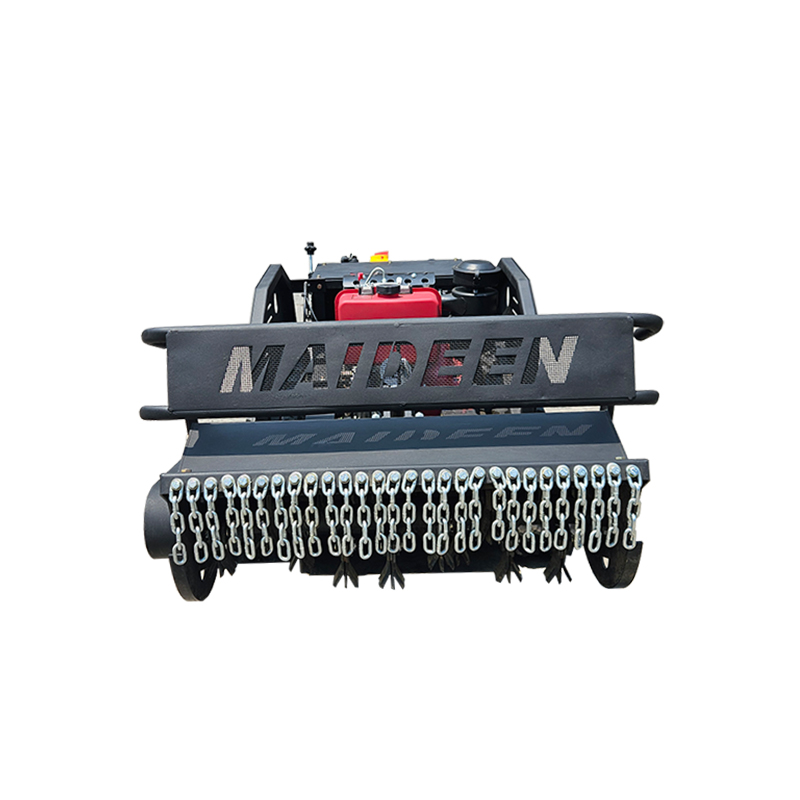
- Blade and discharge guarding: Check that guards, shields, deck covers, and fasteners are present and correctly installed. Testing should address protection from contact with cutting components and the controlled direction of thrown material where applicable.
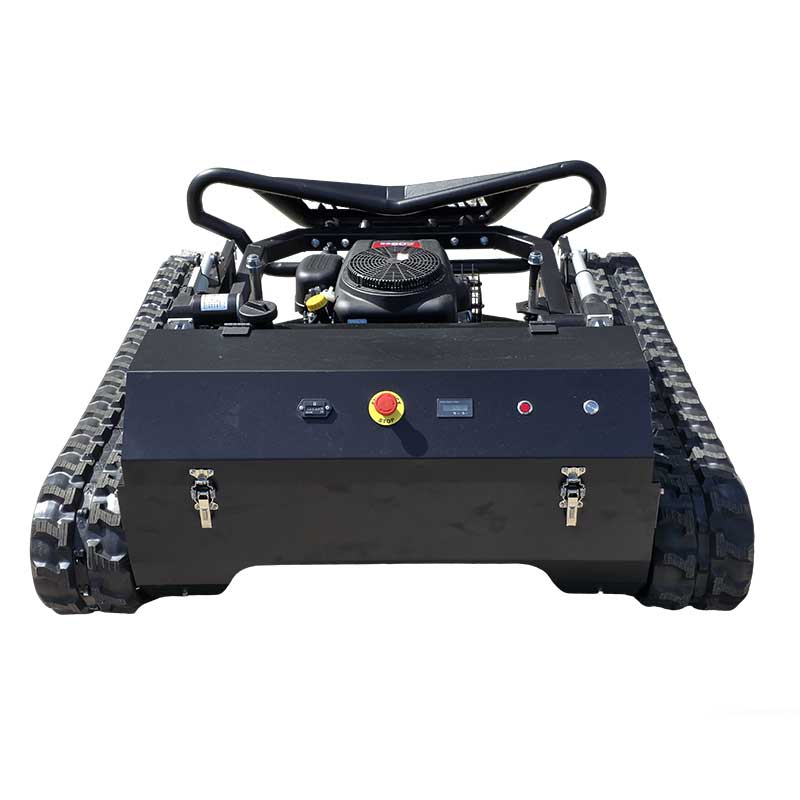
- Emergency stopping: Confirm how the mower stops from the transmitter and at the machine. Test the stop function before each work period, with a clear exclusion area and no bystanders.
- Remote-control loss response: Ask what happens if signal quality drops, power is interrupted, or the transmitter is switched off. The expected fail-safe behavior, reset process, and inspection requirement should be stated in the operating documentation.
- Drive and brake behavior: On a slope, a remote control lawn mower must be evaluated for predictable stopping, holding, and direction changes. Test records should make clear whether the assessment addresses propulsion, braking, and any parking function separately.
- Hot surfaces, fuel, battery, and wiring: Depending on the powertrain, inspection can include fuel-system integrity, battery restraint, cable routing, covers, charging instructions, and protection against accidental contact with hot components.
- Controls and warnings: Labels, control identification, start-up sequence, and audible or visual alerts should be legible and consistent with the supplied manual.
These points are not a substitute for the machine manual or local rules. They are a practical way to turn a remote control lawn mower safety claim into questions that a technical team can answer.
Why steep-slope testing requires a separate review
It is tempting to treat track width or a low center of gravity as a pass/fail answer. In practice, a remote-operated mower works on a changing surface, not on an abstract angle alone. Soil type, damp grass, loose stones, ruts, drainage channels, turning direction, load distribution, and the route to the slope can all change the risk. A declared maximum slope angle is meaningful only when the manufacturer explains its conditions and the operator confirms that the actual site fits them.
For a remote control lawn mower for steep slopes, ask whether the manufacturer has a defined test method for traction, braking, stability, and restart behavior on an incline. Ask whether the stated limit assumes dry ground, a particular cutting direction, a specified deck height, or no attachments. If a supplier cannot connect a slope claim to a test condition or operating instruction, treat the claim as unverified rather than as a working limit.
A practical site acceptance test before regular use
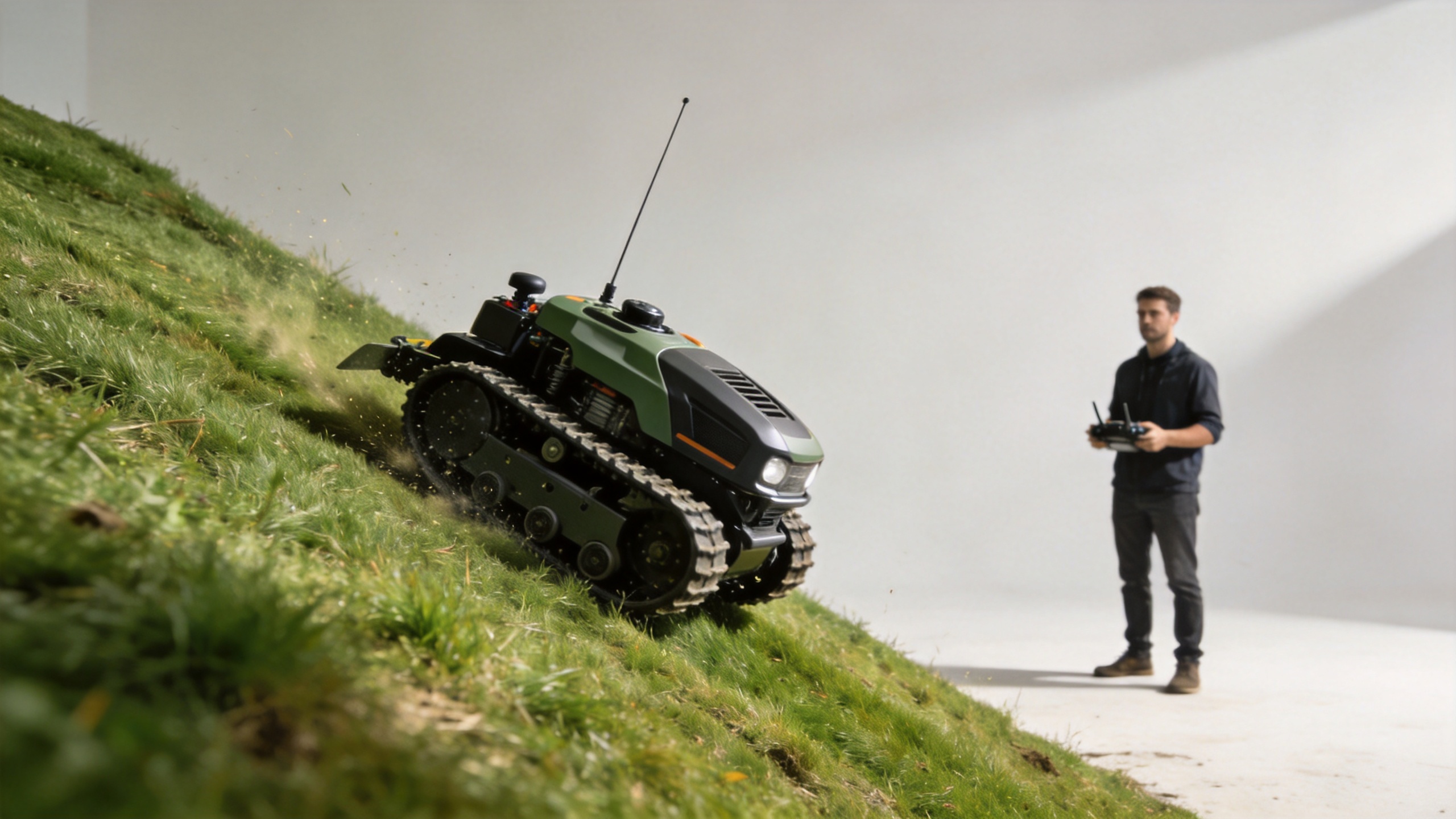
The right workflow is to test the machine and the site together. Before regular mowing, establish a controlled trial area with no people, animals, traffic, exposed stones, drop-offs, or hidden services. The trained operator should keep a safe position with a clear view and should avoid standing below a moving mower on the slope.
- Walk the route and mark holes, drainage lines, soft ground, tree roots, and boundaries.
- Measure or verify the slope and compare it with the exact model’s declared operating information.
- Inspect guards, controls, tyres or tracks, blade condition, fluid or battery condition, and emergency-stop operation.
- Conduct a low-speed, no-cutting movement test in the intended direction. Observe steering response, stopping distance, traction changes, and signal quality.
- Only after the trial is satisfactory should the remote control lawn mower begin cutting; pause immediately if terrain or weather changes the assumptions.
This approach corrects a common mistake: the machine may have passed a factory test, yet the steep site may still require a different route, a lower-risk method, or a decision not to mow that day.
Documents a buyer should request
For procurement or fleet review, request the operating manual, risk warnings, declaration or test documentation relevant to the destination market, model and serial-number traceability, remote-control specifications, emergency-stop instructions, maintenance schedule, and the declared conditions behind any slope rating. If the remote control lawn mower includes an attachment or a modified deck, ask whether that exact combination is covered. Where a testing standard is cited, request the standard reference and what it verifies; do not assume a standard name alone proves every performance claim.
Shandong Maide En Intelligent Technology can support a structured discussion around terrain, vegetation, route access, and the configuration information needed for a remote control lawn mower evaluation. The final suitability decision should remain tied to confirmed product documentation, local requirements, trained personnel, and the real worksite.
Conclusion: a pass is evidence, not permission to ignore conditions
A remote control lawn mower for steep slopes should be evaluated through machine safeguards, control-loss behavior, stopping and traction checks, documentation, and a supervised site trial. The safest purchase question is not simply “Does this remote control lawn mower pass testing?” It is “Which tests apply to this exact configuration, under what conditions, and what must our team verify before operating it here?” That question produces a safer, more defensible mowing plan.