EN
EN
Why Robot lawn mower with remote control Combine Manual And Auto Mode
A robot lawnmower with both remote control and automatic operation is not simply trying to offer more buttons. The two modes solve different parts of a real mowing job. Automatic operation can take care of repeatable, well-understood sections of a site. Direct remote control gives an operator a way to inspect, position, recover, and make a judgment when conditions change. For a robot lawn mower with remote control, that combination can make the work process more practical—provided the machine, terrain, and safety procedures have been checked first.
From an operator’s viewpoint, the useful question is not whether a robot lawnmower is fully autonomous. It is whether the chosen mode matches the task in front of it. A regular lawn with clear boundaries may suit an automated route. A gate opening, a ditch edge, unexpected debris, or a wet patch may call for the operator to take control. Treating both modes as parts of one work plan makes the technology easier to assess.
Automatic mowing handles repeatable work
Automatic mode is valuable when the mowing area, route, and operating conditions are sufficiently clear. In this setting, a robot lawnmower can follow its configured operating logic while the operator focuses on supervision rather than continuous steering. Search results for robotic mowing commonly emphasize area detection, navigation, access to power, and obstacle awareness. Those factors explain why automatic operation is most useful after a site has been assessed, not before.
For example, an operator may divide a property into sections. A clear central grass area can be assigned to automatic mowing, while narrow approaches, boundaries, and irregular corners remain separate tasks. This is more useful than assuming that every square metre should be managed in the same way. A robot lawnmower still needs an appropriate route, sufficient visibility for supervision, and a working area that fits its confirmed instructions.
Automation can also support consistency. When grass condition and terrain remain similar, an automatic routine can help maintain a repeatable cutting pattern. But consistency is conditional. Tall grass, changing moisture, loose branches, or newly placed objects can change the work requirement. The operator should therefore be able to pause, inspect, and reassess rather than treating automatic mode as an unattended promise.
Remote control gives the operator a decision tool
Manual remote operation matters because mowing sites rarely stay perfectly predictable. A robot lawn mower with remote control lets the operator guide the machine through a specific approach, reposition it after an interruption, or move it away from an area that needs closer inspection. That does not mean the remote mode makes every difficult site suitable. It means the person responsible for the work has a controlled way to respond within the equipment’s confirmed operating limits.
Direct control is especially relevant during preparation and transitions. Before starting a planned route, an operator can use manual control to place the robot lawnmower in a safe starting position and confirm that the path is clear. When moving between mowing zones, the same mode can help manage gates, tight turns, or uneven access areas. After the automatic pass, manual control can support a careful return or a short, targeted finish where the route requires judgment.
In other words, remote control is not just a backup for autonomy. It can be the mode for tasks that are too variable to describe as a repeatable route. The operator should still follow the product documentation and site rules. Remote operation does not remove the need for safe separation from people, animals, traffic, water hazards, or unstable ground.
Why switching modes improves the work sequence
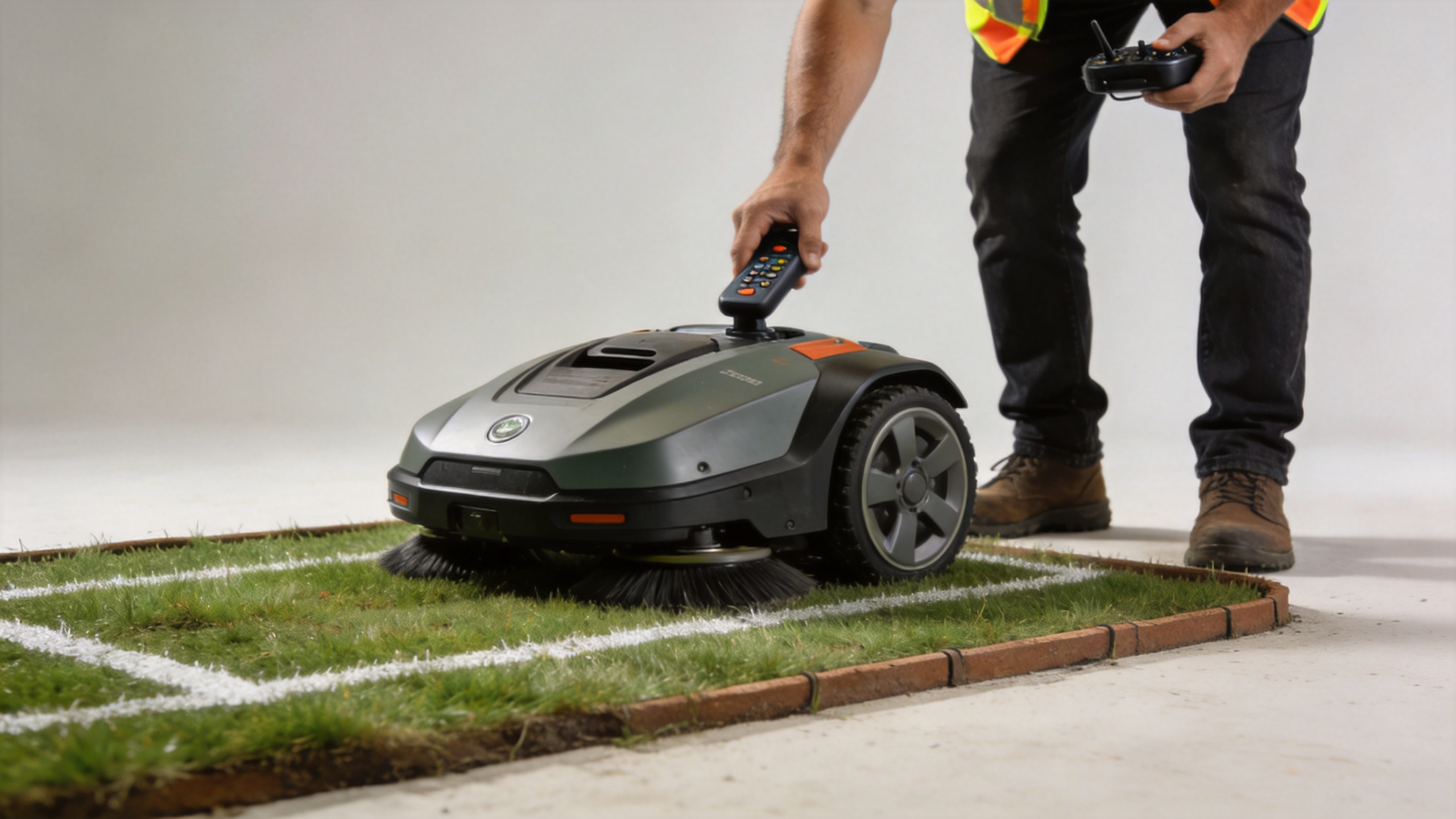
The practical strength of a dual-mode robot lawnmower is the ability to split a job into preparation, execution, and review. During preparation, the operator checks the mowing area, intended route, obstacles, and boundary conditions. During execution, automatic mode may be appropriate for the stable, repeatable section. During review, remote control can be used to reposition the machine or address a small area only after its condition has been evaluated.
This task-based approach avoids two common mistakes. The first is trying to manually steer every part of a straightforward area even when a confirmed automated routine may suit it. The second is assuming that automatic mode should cover areas that have not been inspected. A robot lawnmower is more useful when its operating method is chosen after the site is divided into manageable conditions.
There is also a training benefit. A new operator can learn the site, controls, and stopping procedures in a controlled manual workflow before relying on a longer automatic routine. Training requirements and the manufacturer’s operating instructions remain decisive, but a staged approach gives the team a clear sequence: inspect, position, operate, verify.
Safety checks come before either mode
Automation and remote control are not substitutes for safety management. Before operating a robot lawnmower, confirm the applicable manual, local rules, training requirements, safe work zone, and condition of the machine. Do not assume that a feature such as obstacle sensing, stopping logic, or a remote signal is present or suitable unless it is confirmed for the actual configuration.
Start with the site. Look for people and animals, hidden objects, slopes, loose material, drainage edges, soft ground, low branches, and restricted visibility. Then consider the work sequence. If the operator cannot maintain the required awareness or the terrain falls outside the confirmed operating conditions, pause the task. A robot lawn mower with remote control may offer a useful choice of modes, but it does not make a questionable area safe by default.
Signal and communication conditions also deserve attention when a remote function is involved. Keep the operating area within the manufacturer-approved range and avoid relying on a control link through blind areas. If the machine behaves unexpectedly, use the documented stop procedure and inspect the cause before restarting. Safety instructions supplied with the actual robot lawnmower take priority over general guidance.
How to decide which mode to use
| Work situation | Likely operating approach | What to verify |
|---|---|---|
| Open, familiar mowing zone | Automatic mode may be considered | Boundaries, route logic, conditions, supervision requirements |
| Starting position or zone transition | Manual remote control may be useful | Access path, turning space, visibility, people and obstacles |
| Changing ground or uncertain obstacle | Pause and inspect; use manual control only if conditions allow | Ground stability, hazard clearance, documented limitations |
| Edge, ditch, tree line, or confined area | Use a task-specific plan rather than assuming automation | Safe distance, route, line of sight, local site rules |
Notice that the table does not promise a universal answer. The right decision depends on the model’s confirmed specifications and the actual site. For a robot lawnmower, a manual mode can be useful precisely because it allows a person to keep judgment in the loop where conditions are less repeatable.
Questions to confirm before choosing a dual-mode machine
- Which mowing areas are regular enough for an automatic routine, and which require direct operator judgment?
- What are the manufacturer-confirmed limits for terrain, visibility, signal range, boundaries, and stopping procedures?
- How will operators inspect the site before each job and respond if conditions change?
- What training, maintenance checks, and replacement-part support should be confirmed for the intended use?
- Does the proposed robot lawn mower with remote control match the property’s access paths, grass condition, and work frequency?
Conclusion
A robot lawnmower combines manual and automatic modes because mowing work includes both repeatable and variable moments. Automatic operation can be useful in a prepared, suitable zone. Remote control can help the operator position the machine, manage transitions, and respond to conditions that need closer judgment. The strongest approach is not to choose automation over manual work. It is to assign each mode to the part of the job where it is appropriate, verify the real operating limits, and keep safety checks at the centre of every decision.