EN
EN
How Does Remote Control Robot Lawn Mower Avoid Hitting Hard Objects
A robot lawnmower is often discussed as though it can simply drive around every object by itself. In real mowing conditions, that is too simple. A remote control robot lawn mower can reduce exposure to the cutting area, but safe operation still depends on the machine’s sensing and stop functions, the operator’s route planning, and a careful site inspection. Hard objects such as rocks, posts, irrigation covers, discarded wire, curbs, and tools can affect both the cutting system and the machine’s path.
From a technical-explainer perspective, it helps to separate obstacle avoidance into three questions: what the machine can detect, what it does after detection, and what the operator must prevent before work begins. The answer will vary by model, configuration, terrain, speed, and visibility. Use the applicable operator manual and confirmed product documentation as the final authority.
Obstacle Avoidance Is a Layered Safety Process
A remote control robot lawn mower may use one or more sensing methods to recognize an object in its expected travel path. Depending on the design, these can include contact bumpers, ultrasonic or radar-style sensing, cameras, LiDAR-style scanning, current monitoring, tilt detection, or a combination of controls. A sensor does not make a universal promise that every object will be seen in every light, grass height, or approach angle. Instead, it provides one layer in a broader safety process.
The useful distinction is between detection and avoidance. Detection means the robot lawnmower receives a signal that something may be in the path. Avoidance means it can slow, stop, reverse, turn, or wait according to its programmed logic and current operating mode. The response may be different when the machine is remote-controlled rather than following a planned route. Operators should confirm the behavior for the intended configuration before relying on it near a hard object.
Before comparing features, inspect the work area. A sensor can support a safer process, but it cannot turn loose metal, hidden wire, or a partly buried rock into a safe mowing condition. This is especially important where tall grass, uneven ground, shadows, or wet vegetation can obscure hazards.
How a Robot Lawnmower Typically Responds to a Hard Object
1. It recognizes a possible obstruction
When an obstacle enters a sensor zone or makes contact with a bumper, the control system may flag it as a potential obstruction. The quality of that decision depends on factors such as object size, material, contrast, distance, mower speed, sensor cleanliness, and the angle of approach. A small low-profile object may not present the same signal as a wall or tree trunk.
2. It changes motion or stops
Once an obstruction is recognized, the remote control robot lawn mower may command a controlled stop, a reverse movement, a turn, or an alert. The correct response is not necessarily a detour. Near a ditch, retaining edge, fence, or other constrained boundary, stopping and reassessing can be safer than automatically choosing a new direction. Verify how the selected robot lawnmower behaves in its manual, including any emergency-stop function and blade-related interlocks.
3. It requires a human decision
Remote control does not remove the need for active supervision. The operator needs a clear view of the machine and its route, a safe operating position, and a way to stop the unit promptly. If an alert occurs, do not assume the object has been cleared. Stop the robot lawnmower, secure it following the manufacturer’s procedure, then inspect the obstruction and the cutting area before restarting.
Hard Objects That Deserve Separate Planning
Not all obstacles should be treated alike. A visible tree trunk, a fixed post, and a loose object in the grass create different operating decisions. Use a route plan that distinguishes between fixed features and removable hazards.
- Fixed vertical objects: trees, posts, walls, and sign supports need a defined clearance zone. Do not depend solely on a last-second sensor reaction.
- Low or partially hidden objects: rocks, irrigation heads, edging, roots, and ground anchors should be marked, avoided, or removed where possible.
- Loose debris: wire, rope, plastic, branches, and tools should be cleared before operation because they may entangle or damage cutting components.
- Edges and drop-offs: curbs, drainage channels, retaining walls, and ditches require boundary planning. Obstacle sensing and boundary behavior can be separate functions.
- Moving people and animals: stop work when the operating area is no longer controlled. Do not rely on any one sensing feature as a substitute for exclusion-zone management.
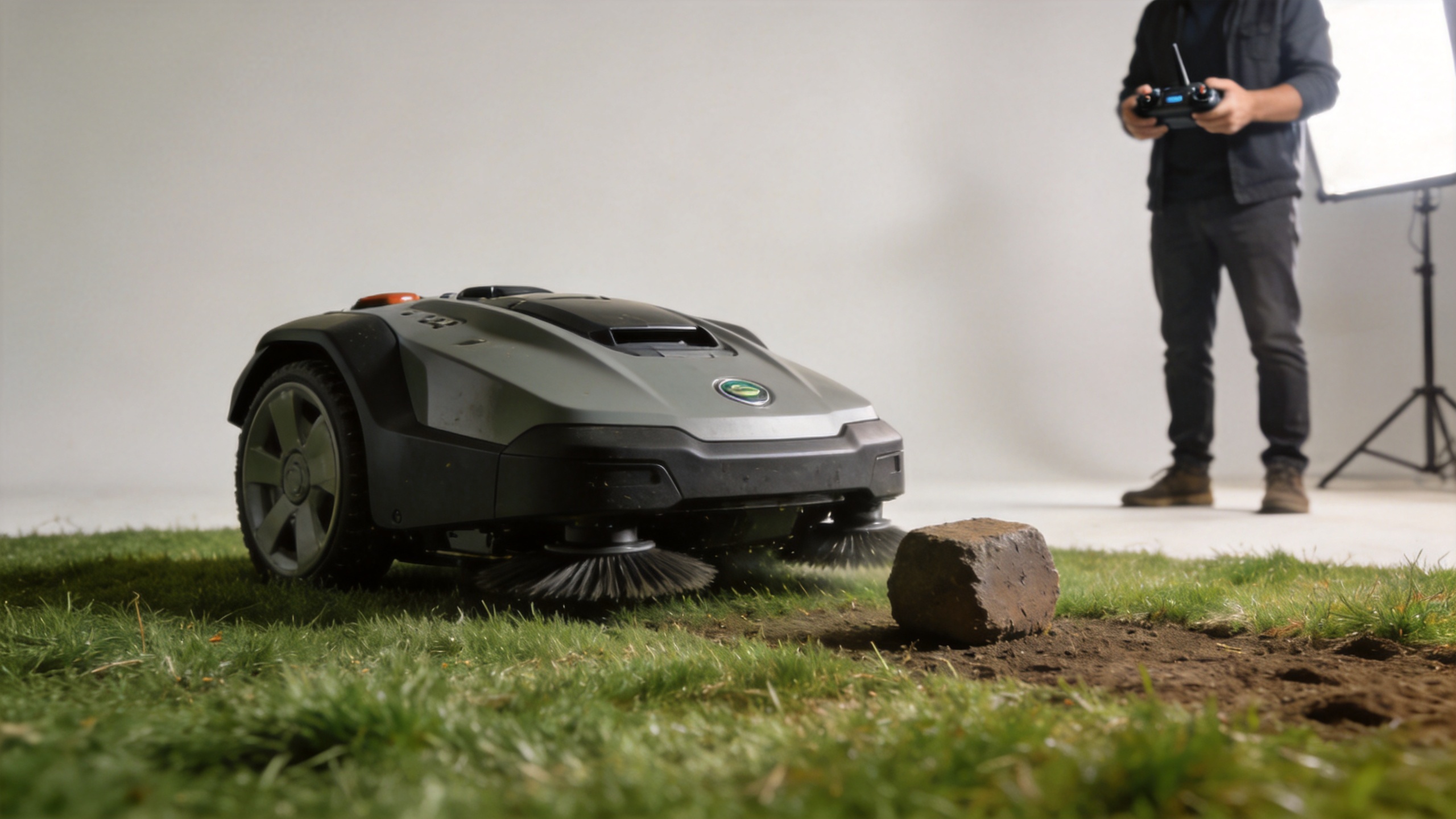
Prepare the Site Before Starting a Remote Control Robot Lawn Mower
The most reliable way to avoid striking hard objects is to reduce uncertainty before the blades or drive system are engaged. A short pre-operation walk is often more valuable than adding another unverified feature to a specification list.
- Walk the route: look for low objects, debris, sudden surface changes, hidden holes, and branches extending into the travel lane.
- Set the operating boundary: decide where the robot lawnmower should not travel, especially near roads, water, embankments, people, or fragile landscaping.
- Mark or remove hazards: remove loose objects; clearly mark fixed hazards that may be obscured by vegetation.
- Check sightlines: identify turns, blind spots, and areas where tall grass or terrain makes it difficult to judge clearance from the remote-control position.
- Confirm stop controls: test the required emergency or normal stop procedure in a safe open area before beginning the real task.
- Start conservatively: use a controlled route and pace until the operator understands how the remote control robot lawn mower responds to that site.
It may be tempting to judge a site only by its total area. In practice, obstacle density, visibility, slope, ground firmness, and the number of turns often matter more to safe operation than acreage alone.
Why Sensor Claims Must Be Verified in Context
Marketing descriptions may mention vision, radar, ultrasonic sensing, or automatic object avoidance. Those terms are useful starting points, but they do not confirm the exact behavior of a particular robot lawnmower on every job. Ask for the product documentation that explains sensor coverage, minimum detectable object conditions, response behavior, operating limits, cleaning requirements, and any settings that can alter the system’s behavior.
Also check whether an obstacle-related feature behaves differently near a work-area boundary. Some systems prioritize boundary coverage or navigation logic in ways that may limit how avoidance works in those locations. That does not make the equipment unsuitable; it means the operating plan must account for boundaries separately rather than treating sensing as a complete replacement for site control.
Operating Habits That Lower Collision Risk
During work, keep the robot lawnmower within the approved operating conditions and maintain attention rather than treating remote control as permission to multitask. Use a route that keeps the machine away from questionable areas until they have been inspected. Slow down before turns, crossings, dense vegetation, and transitions between surface types. If visibility is poor, stop and reposition instead of steering by assumption.
After any contact, unexpected stop, unusual noise, or change in cutting quality, pause the job. Follow the manufacturer’s shutdown instructions before checking the mower. Inspect the cutting area, guards, blades or cutting system, drive components, and sensor surfaces as applicable. If the event suggests damage or a sensor fault, keep the unit out of service until it has been evaluated according to the supplier’s or manufacturer’s instructions.
Questions to Ask Before Selecting or Deploying a Robot Lawnmower
For a remote control robot lawn mower, the right discussion is not simply “Does it avoid objects?” Ask how its documented safety and navigation functions match the actual site. Useful questions include:
- Which obstacle-detection and stop functions are confirmed for this configuration?
- What objects, terrain conditions, lighting conditions, and operating speeds affect the system’s limitations?
- How are fixed boundaries, low-profile hazards, and drop-offs managed?
- What is the specified procedure after the mower contacts an object or triggers an alert?
- What inspections, cleaning, training, and maintenance are required to keep the relevant functions working as intended?
Shandong Maide En Intelligent Technology Co., Ltd. can frame remote mower discussions around the site, vegetation, route, and operating conditions. For a purchase or deployment decision, provide the terrain layout, photos of recurring hazards, grass conditions, expected work frequency, and the safety rules that apply at the site. Final configuration and performance claims should be confirmed against the relevant product documentation.
Conclusion
A robot lawnmower avoids hard objects most reliably when machine functions and operator discipline work together. Sensors, controlled stops, route planning, clear sightlines, and a cleaned work area each address a different part of the risk. Treat a remote control robot lawn mower as a tool that supports a structured mowing process, not as a substitute for inspection, supervision, or the safety instructions supplied with the machine.